Affective disorder and Photosensitivity reaction
Summary:
Photosensitivity reaction is found among people with Affective disorder, especially for people who are female, 30-39 old.
The study analyzes which people have Photosensitivity reaction with Affective disorder. It is created by eHealthMe based on reports of 35 people who have Affective disorder from the Food and Drug Administration (FDA), and is updated regularly. You can use the study as a second opinion to make health care decisions.
What is Affective disorder?
Affective disorder (mental disorder) is found to be associated with 708 drugs and 786 conditions by eHealthMe. Check the latest studies of Affective disorder.
What is Photosensitivity reaction?
Photosensitivity reaction is found to be associated with 1,046 drugs and 1,262 conditions by eHealthMe. Check the latest studies of Photosensitivity reaction.
eHealthMe: drug outcomes in the real world
eHealthMe runs one of the largest post-marketing drug safety studies in the world. We study millions of patients and 5,000 more each day. Our data-driven phase IV clinical trials have been referenced on 800+ peer-reviewed medical publications including The Lancet, Mayo Clinic Proceedings, and Nature. Tools to study our phase IV findings are available to the public, anonymous and free >>>.
35 people who have Affective Disorder and Photosensitivity Reaction are studied.
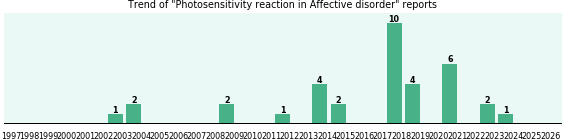
Gender of people who have Affective Disorder and experienced Photosensitivity Reaction *:
- female: 87.5 %
- male: 12.5 %
Age of people who have Affective Disorder and experienced Photosensitivity Reaction *:
- 0-1: 0.0 %
- 2-9: 3.33 %
- 10-19: 23.33 %
- 20-29: 6.67 %
- 30-39: 46.67 %
- 40-49: 16.67 %
- 50-59: 0.0 %
- 60+: 3.33 %
Common co-existing conditions for these people *:
- Migraine (headache): 11 people, 31.43%
- Stress And Anxiety: 8 people, 22.86%
- Depression: 7 people, 20.00%
- Depressed Mood: 4 people, 11.43%
- Sleep Disorder: 3 people, 8.57%
- Insomnia (sleeplessness): 3 people, 8.57%
- Generalized Anxiety Disorder (excessive, uncontrollable, unexplained and often irrational worry): 3 people, 8.57%
- Delusion (a false belief or opinion): 2 people, 5.71%
- Fever: 2 people, 5.71%
- Major Depression (a mood state that goes well beyond temporarily feeling sad or blue. it is a serious medical illness that affects one's thoughts, feelings): 2 people, 5.71%
Common drugs taken by these people *:
- Lamictal: 5 people, 14.29%
- Tegretol: 3 people, 8.57%
- Prozac: 3 people, 8.57%
- Fluoxetine: 3 people, 8.57%
- Quetiapine Fumarate: 2 people, 5.71%
- Levetiracetam: 2 people, 5.71%
- Cymbalta: 2 people, 5.71%
- Sertraline: 2 people, 5.71%
- Zoloft: 2 people, 5.71%
- Olanzapine: 2 people, 5.71%
Common symptoms for these people *:
- Fatigue (feeling of tiredness): 16 people, 45.71%
- Malaise (a feeling of general discomfort or uneasiness): 15 people, 42.86%
- Seizures (abnormal excessive or synchronous neuronal activity in the brain): 15 people, 42.86%
- Hyperacusis (disorder in loudness perception): 13 people, 37.14%
- Heart Rate Increased: 12 people, 34.29%
- Speech Disorder: 12 people, 34.29%
- Tremor (trembling or shaking movements in one or more parts of your body): 12 people, 34.29%
- Drowsiness: 12 people, 34.29%
- Hallucinations (sensations that appear real but are created by your mind): 11 people, 31.43%
- Catatonia (unresponsive to external stimuli): 11 people, 31.43%
* Approximation only. Some reports may have incomplete information.
Do you take medications and have Photosensitivity reaction?
- Check whether Photosensitivity reaction is associated with a drug or a conditionRelated publications that referenced our studies
- Stricklin SM, Stoecker WV, Rader RK, Hood AF, Litt JZ, Schuman TP, "Persistent edematous-plaque photosensitivity observed with sitagliptin phosphate (Januvia?)", Dermatology online journal, 2012 Feb .
- Kocamaz, M., & Karadag, O., "Topiramate-Induced Acute Myopia, Diplopia, and Photosensitivity: A Case Report", Beyoglu Eye Journal, 2019 Jan .
- Stricklin SM, Stoecker WV, Rader RK, Hood AF, Litt JZ, Schuman TP, "Persistent edematous-plaque photosensitivity observed with sitagliptin phosphate (Januvia?)", Dermatology online journal, 2012 Feb .
- Kocamaz, M., & Karadag, O., "Topiramate-Induced Acute Myopia, Diplopia, and Photosensitivity: A Case Report", Beyoglu Eye Journal, 2019 Jan .
Related studies:
Treatments, associated drugs and conditions:
- Affective disorder (25,677 reports)
- Photosensitivity reaction (19,066 reports)
All the drugs that are associated with Photosensitivity reaction:
- Photosensitivity reaction (1,046 drugs)
All the conditions that are associated with Photosensitivity reaction:
- Photosensitivity reaction (1,262 conditions)
How the study uses the data?
How to use the study?
DO NOT STOP MEDICATIONS without first consulting your doctor. If there are any serious or long term adverse effects discovered in the study, discuss the study with your doctor to ensure that proper medication management will be in place if applicable.
The study is based on Photosensitivity reaction and Affective disorder, and their synonyms.
Who is eHealthMe?
With medical big data and proven AI/ML algorithms, eHealthMe provides a platform for everyone to run phase IV clinical trials. We study millions of patients and 5,000 more each day. Results of our real-world drug study have been referenced on 800+ peer-reviewed medical publications, including The Lancet, Mayo Clinic Proceedings, and Nature. Our analysis results are available to researchers, health care professionals, patients (testimonials), and software developers (open API).
WARNING, DISCLAIMER, USE FOR PUBLICATION
WARNING: Please DO NOT STOP MEDICATIONS without first consulting a physician since doing so could be hazardous to your health.
DISCLAIMER: All material available on eHealthMe.com is for informational purposes only, and is not a substitute for medical advice, diagnosis, or treatment provided by a qualified healthcare provider. All information is observation-only. Our phase IV clinical studies alone cannot establish cause-effect relationship. Different individuals may respond to medication in different ways. Every effort has been made to ensure that all information is accurate, up-to-date, and complete, but no guarantee is made to that effect. The use of the eHealthMe site and its content is at your own risk.
If you use this eHealthMe study on publication, please acknowledge it with a citation: study title, URL, accessed date.
Recent studies on eHealthMe:
- Could Actos cause Numbness And Tingling? - a second ago
- Could Votrient cause Hyperkalemia? - a second ago
- Could Lotronex cause Back Pain? - 6 seconds ago
- Penicillin and Naproxen drug interactions for men aged 60+ - 8 seconds ago
- Could Benicar Hct cause Acute Respiratory Failure? - 11 seconds ago
- Could Voltaren cause Intestinal Obstruction? - 16 seconds ago
- Could Voltaren cause Diaphragmatic Disorder? - 22 seconds ago
- Could Propofol cause Blood Calcium Decreased? - 25 seconds ago
- Could Flonase cause Microcytic Anaemia? - 28 seconds ago
- Coq and Clonazepam drug interactions for women aged 50-59 - 31 seconds ago