Fatigue and Muscle function loss
Summary:
Muscle function loss is found among people with Fatigue, especially for people who are female, 40-49 old.
The study analyzes which people have Muscle function loss with Fatigue. It is created by eHealthMe based on reports of 30 people who have Fatigue from the Food and Drug Administration (FDA), and is updated regularly. You can use the study as a second opinion to make health care decisions.
What is Fatigue?
Fatigue (feeling of tiredness) is found to be associated with 4,026 drugs and 6,380 conditions by eHealthMe. Check the latest studies of Fatigue.
What is Muscle function loss?
Muscle function loss is found to be associated with 1,001 drugs and 1,521 conditions by eHealthMe. Check the latest studies of Muscle function loss.
30 people who have Fatigue and Muscle Function Loss are studied.
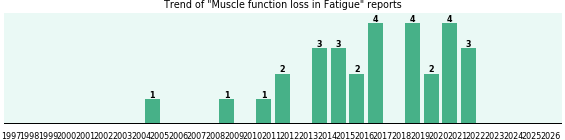
Gender of people who have Fatigue and experienced Muscle Function Loss *:
- female: 83.33 %
- male: 16.67 %
Age of people who have Fatigue and experienced Muscle Function Loss *:
- 0-1: 0.0 %
- 2-9: 0.0 %
- 10-19: 0.0 %
- 20-29: 0.0 %
- 30-39: 33.33 %
- 40-49: 33.33 %
- 50-59: 16.67 %
- 60+: 16.67 %
Common co-existing conditions for these people *:
- Pain: 13 people, 43.33%
- Multiple Sclerosis (a nervous system disease that affects your brain and spinal cord. it damages the myelin sheath): 11 people, 36.67%
- Sleep Disorder: 10 people, 33.33%
- Relapsing-Remitting Multiple Sclerosis (reoccurrence of an inflammatory disease in which the insulating covers of nerve cells in the brain and spinal cord are damaged): 8 people, 26.67%
- Bipolar Disorder (mood disorder): 7 people, 23.33%
- Stress And Anxiety: 6 people, 20.00%
- Insomnia (sleeplessness): 6 people, 20.00%
- Muscle Spasticity (tight or stiff muscles and an inability to control those muscles): 3 people, 10.00%
- Depression: 3 people, 10.00%
- Multiple Sclerosis Relapse (reoccurrence of a nervous system disease that affects your brain and spinal cord. it damages the myelin sheath): 2 people, 6.67%
Common drugs taken by these people *:
- Cymbalta: 8 people, 26.67%
- Benadryl: 7 people, 23.33%
- Vyvanse: 7 people, 23.33%
- Zopiclone: 6 people, 20.00%
- Wellbutrin: 6 people, 20.00%
- Gravol: 6 people, 20.00%
- Vitamin D: 6 people, 20.00%
- Provigil: 5 people, 16.67%
- Seroquel: 5 people, 16.67%
- Tysabri: 5 people, 16.67%
Common symptoms for these people *:
- Weakness: 13 people, 43.33%
- Multiple Sclerosis Relapse (reoccurrence of a nervous system disease that affects your brain and spinal cord. it damages the myelin sheath): 11 people, 36.67%
- Diarrhea: 10 people, 33.33%
- Urinary Tract Infection: 9 people, 30.00%
- Headache (pain in head): 8 people, 26.67%
- Cognitive Disorder (mental health disorders affects learning, memory, perception, and problem solving): 8 people, 26.67%
- Nausea (feeling of having an urge to vomit): 8 people, 26.67%
- Memory Loss: 7 people, 23.33%
- Dizziness: 7 people, 23.33%
- Blood Urine Present: 7 people, 23.33%
* Approximation only. Some reports may have incomplete information.
Do you take medications and have Muscle function loss?
- Check whether Muscle function loss is associated with a drug or a conditionRelated publications that referenced our studies
- Peel MM, Cooke M, Lewis-Peel HJ, Lea RA, Moyle W, "A randomized controlled trial of coenzyme Q 10 for fatigue in the late-onset sequelae of poliomyelitis", Complementary therapies in medicine, 2015 Dec .
- Peel MM, Cooke M, Lewis-Peel HJ, Lea RA, Moyle W, "A randomized controlled trial of coenzyme Q 10 for fatigue in the late-onset sequelae of poliomyelitis", Complementary therapies in medicine, 2015 Dec .
Related studies:
Treatments, associated drugs and conditions:
- Fatigue (967,537 reports)
- Muscle function loss (17,723 reports)
All the drugs that are associated with Muscle function loss:
- Muscle function loss (1,001 drugs)
All the conditions that are associated with Muscle function loss:
- Muscle function loss (1,521 conditions)
How the study uses the data?
How to use the study?
DO NOT STOP MEDICATIONS without first consulting your doctor. If there are any serious or long term adverse effects discovered in the study, discuss the study with your doctor to ensure that proper medication management will be in place if applicable.
The study is based on Muscle function loss and Fatigue, and their synonyms.
Who is eHealthMe?
With medical big data and proven AI/ML algorithms, eHealthMe provides a platform for everyone to run phase IV clinical trials. We study millions of patients and 5,000 more each day. Results of our real-world drug study have been referenced on 800+ peer-reviewed medical publications, including The Lancet, Mayo Clinic Proceedings, and Nature. Our analysis results are available to researchers, health care professionals, patients (testimonials), and software developers (open API).
WARNING, DISCLAIMER, USE FOR PUBLICATION
WARNING: Please DO NOT STOP MEDICATIONS without first consulting a physician since doing so could be hazardous to your health.
DISCLAIMER: All material available on eHealthMe.com is for informational purposes only, and is not a substitute for medical advice, diagnosis, or treatment provided by a qualified healthcare provider. All information is observation-only. Our phase IV clinical studies alone cannot establish cause-effect relationship. Different individuals may respond to medication in different ways. Every effort has been made to ensure that all information is accurate, up-to-date, and complete, but no guarantee is made to that effect. The use of the eHealthMe site and its content is at your own risk.
If you use this eHealthMe study on publication, please acknowledge it with a citation: study title, URL, accessed date.
Recent studies on eHealthMe:
- Could Memantine cause Drooling? - 4 seconds ago
- Could Vitamin B12 cause Sinus Congestion? - 4 seconds ago
- Brintellix vs. Marplan, side effect and effectiveness comparison - 6 seconds ago
- Could Candesartan Cilexetil cause Personality Disorder? - 7 seconds ago
- Drug interactions of Aggrenox and Excedrin - 13 seconds ago
- Drug interactions of Ropinirole Hydrochloride and Hydrochlorothiazide - 21 seconds ago
- Could Atazanavir Sulfate cause Abdominal Pain Upper? - 35 seconds ago
- Gastroesophageal Reflux Disease and Tumor - 44 seconds ago
- Could Magnesium Oxide cause Diabetes Mellitus Non-Insulin-Dependent? - a minute ago
- Could Magnesium Oxide cause Type 2 Diabetes? - a minute ago