Hypercalcaemia and Second primary malignancy
Summary:
Second primary malignancy is found among people with Hypercalcaemia, especially for people who are male, 50-59 old.
The study analyzes which people have Second primary malignancy with Hypercalcaemia. It is created by eHealthMe based on reports of 15 people who have Hypercalcaemia from the Food and Drug Administration (FDA), and is updated regularly. You can use the study as a second opinion to make health care decisions.
What is Hypercalcaemia?
Hypercalcaemia (elevated calcium (ca+) level in the blood) is found to be associated with 1,062 drugs and 1,017 conditions by eHealthMe. Check the latest studies of Hypercalcaemia.
What is Second primary malignancy?
Second primary malignancy (after getting cure a cancer, a new cancer development) is found to be associated with 536 drugs and 467 conditions by eHealthMe. Check the latest studies of Second primary malignancy.
15 people who have Hypercalcaemia and Second Primary Malignancy are studied.
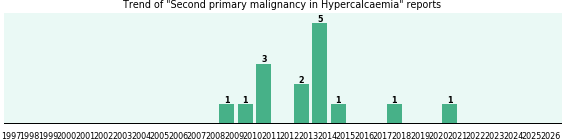
Gender of people who have Hypercalcaemia and experienced Second Primary Malignancy *:
- female: 46.67 %
- male: 53.33 %
Age of people who have Hypercalcaemia and experienced Second Primary Malignancy *:
- 0-1: 0.0 %
- 2-9: 0.0 %
- 10-19: 0.0 %
- 20-29: 0.0 %
- 30-39: 20 %
- 40-49: 20 %
- 50-59: 40 %
- 60+: 20 %
Common co-existing conditions for these people *:
- Multiple Myeloma (cancer of the plasma cells): 9 people, 60.00%
- Metastases To Bone (cancer spreads to bone): 5 people, 33.33%
- Transient Ischaemic Attack (a transient episode of neurologic dysfunction caused by ischemia (loss of blood flow)): 2 people, 13.33%
- Pain: 2 people, 13.33%
- Ulcerative Colitis (inflammatory bowel disease (ibd). it causes swelling, ulcerations, and loss of function of the large intestine): 1 person, 6.67%
- Seasonal Allergy (allergic condition due to certain season): 1 person, 6.67%
- Resorption Bone Increased: 1 person, 6.67%
- Psoriasis (immune-mediated disease that affects the skin): 1 person, 6.67%
- Pancreatic Neuroendocrine Tumor Metastatic: 1 person, 6.67%
- Neuroendocrine Tumor: 1 person, 6.67%
Common drugs taken by these people *:
- Zometa: 14 people, 93.33%
- Aredia: 12 people, 80.00%
- Melphalan: 6 people, 40.00%
- Oxycontin: 5 people, 33.33%
- Revlimid: 5 people, 33.33%
- Lasix: 4 people, 26.67%
- Prilosec: 4 people, 26.67%
- Velcade: 4 people, 26.67%
- Aspirin: 4 people, 26.67%
- Oxycodone: 4 people, 26.67%
Common symptoms for these people *:
- Anaemia (lack of blood): 15 people, 100.00%
- Pain: 14 people, 93.33%
- Injury: 13 people, 86.67%
- Intervertebral Disc Protrusion (spinal disc protrusion): 13 people, 86.67%
- Fall: 12 people, 80.00%
- Arthritis (form of joint disorder that involves inflammation of one or more joints): 12 people, 80.00%
- Atelectasis (partial or complete collapse of the lung): 12 people, 80.00%
- Pneumonia: 11 people, 73.33%
- Fatigue (feeling of tiredness): 11 people, 73.33%
- Stress And Anxiety: 11 people, 73.33%
* Approximation only. Some reports may have incomplete information.
Do you take medications and have Second primary malignancy?
- Check whether Second primary malignancy is associated with a drug or a conditionRelated studies:
Treatments, associated drugs and conditions:
- Hypercalcaemia (18,731 reports)
- Second primary malignancy (9,955 reports)
All the drugs that are associated with Second primary malignancy:
- Second primary malignancy (536 drugs)
All the conditions that are associated with Second primary malignancy:
- Second primary malignancy (467 conditions)
How the study uses the data?
How to use the study?
DO NOT STOP MEDICATIONS without first consulting your doctor. If there are any serious or long term adverse effects discovered in the study, discuss the study with your doctor to ensure that proper medication management will be in place if applicable.
The study is based on Second primary malignancy and Hypercalcaemia, and their synonyms.
Who is eHealthMe?
With medical big data and proven AI/ML algorithms, eHealthMe provides a platform for everyone to run phase IV clinical trials. We study millions of patients and 5,000 more each day. Results of our real-world drug study have been referenced on 800+ peer-reviewed medical publications, including The Lancet, Mayo Clinic Proceedings, and Nature. Our analysis results are available to researchers, health care professionals, patients (testimonials), and software developers (open API).
WARNING, DISCLAIMER, USE FOR PUBLICATION
WARNING: Please DO NOT STOP MEDICATIONS without first consulting a physician since doing so could be hazardous to your health.
DISCLAIMER: All material available on eHealthMe.com is for informational purposes only, and is not a substitute for medical advice, diagnosis, or treatment provided by a qualified healthcare provider. All information is observation-only. Our phase IV clinical studies alone cannot establish cause-effect relationship. Different individuals may respond to medication in different ways. Every effort has been made to ensure that all information is accurate, up-to-date, and complete, but no guarantee is made to that effect. The use of the eHealthMe site and its content is at your own risk.
If you use this eHealthMe study on publication, please acknowledge it with a citation: study title, URL, accessed date.
Recent studies on eHealthMe:
- How effective is Exelon for Alzheimer'S Disease? - 11 seconds ago
- Could Albuterol Sulfate cause Systolic Dysfunction? - 17 seconds ago
- Gastroesophageal Reflux Disease and Pneumonia Pneumococcal - 49 seconds ago
- Could Thalidomide cause Dizziness? - 54 seconds ago
- Drug interactions of Methylphenidate Hydrochloride and B12 - a minute ago
- Drug interactions of Cefdinir and Tymlos - a minute ago
- Drug interactions of Focalin and Vitamin B12 - a minute ago
- Could Pantoprazole cause Conjunctival Pallor? - a minute ago
- Insulin Resistance and Sleep Disorder - a minute ago
- Could Bumetanide cause Hypernatraemia? - 2 minutes ago