Squamous cell carcinoma and Skin toxicity
Summary:
Skin toxicity is found among people with Squamous cell carcinoma, especially for people who are female, 60+ old.
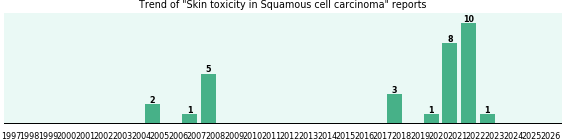
The study analyzes which people have Skin toxicity with Squamous cell carcinoma. It is created by eHealthMe based on reports of 31 people who have Squamous cell carcinoma from the Food and Drug Administration (FDA), and is updated regularly. You can use the study as a second opinion to make health care decisions.
What is Squamous cell carcinoma?
Squamous cell carcinoma (a cancer of a kind of epithelial cell) is found to be associated with 814 drugs and 895 conditions by eHealthMe. Check the latest studies of Squamous cell carcinoma.
What is Skin toxicity?
Skin toxicity (skin damage due to toxin/poison) is found to be associated with 270 drugs and 375 conditions by eHealthMe. Check the latest studies of Skin toxicity.
31 people who have Squamous Cell Carcinoma and Skin Toxicity are studied.
Gender of people who have Squamous Cell Carcinoma and experienced Skin Toxicity *:
- female: 60 %
- male: 40 %
Age of people who have Squamous Cell Carcinoma and experienced Skin Toxicity *:
- 0-1: 0.0 %
- 2-9: 0.0 %
- 10-19: 0.0 %
- 20-29: 0.0 %
- 30-39: 0.0 %
- 40-49: 0.0 %
- 50-59: 16.67 %
- 60+: 83.33 %
Common co-existing conditions for these people *:
- Skin Infection: 1 person, 3.23%
- Rash Maculo-Papular (red area on the skin that is covered with small confluent bumps): 1 person, 3.23%
- Joint Pain: 1 person, 3.23%
- Ear Pain: 1 person, 3.23%
Common drugs taken by these people *:
- Prednisone: 11 people, 35.48%
- Celecoxib: 11 people, 35.48%
- Carboplatin: 4 people, 12.90%
- Fluorouracil: 3 people, 9.68%
- Erbitux: 3 people, 9.68%
- Iressa: 3 people, 9.68%
- Metoprolol Tartrate: 2 people, 6.45%
- Flomax: 2 people, 6.45%
- Synthroid: 2 people, 6.45%
- Zantac: 1 person, 3.23%
Common symptoms for these people *:
- Pemphigoid (tense blisters on the skin): 15 people, 48.39%
- Febrile Neutropenia (fever with reduced white blood cells): 2 people, 6.45%
- Cellulitis (infection under the skin): 2 people, 6.45%
- Hyperkeratosis (thickening of the outer layer of the skin): 2 people, 6.45%
- Dehydration (dryness resulting from the removal of water): 2 people, 6.45%
- Dermatitis Acneiform (dermatoses including acne vulgaris, rosacea, folliculitis, and perioral dermatitis): 2 people, 6.45%
- Dry Skin: 2 people, 6.45%
- Soft Tissue Infection: 1 person, 3.23%
- Aortic Arteriosclerosis (hardening of the aortic arteries): 1 person, 3.23%
- Arteriosclerosis Coronary Artery (thickening and hardening of arteries- coronary artery): 1 person, 3.23%
* Approximation only. Some reports may have incomplete information.
Do you take medications and have Skin toxicity?
- Check whether Skin toxicity is associated with a drug or a conditionRelated publications that referenced our studies
- Kim DJ, Lee SC, Park GS, Kim GJ, Hwang WT, Lee CS, Lee MH, Hahn DH, Koh HC, "Amiodarone Induced Multiorgan Toxicity in a Patient of Hypertrophic Cardiomyopathy With Atrial Fibrillation", Journal of the Korean Geriatrics Society, 2013 Dec .
- Kim DJ, Lee SC, Park GS, Kim GJ, Hwang WT, Lee CS, Lee MH, Hahn DH, Koh HC, "Amiodarone Induced Multiorgan Toxicity in a Patient of Hypertrophic Cardiomyopathy With Atrial Fibrillation", Journal of the Korean Geriatrics Society, 2013 Dec .
Related studies:
Treatments, associated drugs and conditions:
- Squamous cell carcinoma (16,402 reports)
- Skin toxicity (5,295 reports)
All the drugs that are associated with Skin toxicity:
- Skin toxicity (270 drugs)
All the conditions that are associated with Skin toxicity:
- Skin toxicity (375 conditions)
How the study uses the data?
How to use the study?
DO NOT STOP MEDICATIONS without first consulting your doctor. If there are any serious or long term adverse effects discovered in the study, discuss the study with your doctor to ensure that proper medication management will be in place if applicable.
The study is based on Skin toxicity and Squamous cell carcinoma, and their synonyms.
Who is eHealthMe?
With medical big data and proven AI/ML algorithms, eHealthMe provides a platform for everyone to run phase IV clinical trials. We study millions of patients and 5,000 more each day. Results of our real-world drug study have been referenced on 800+ peer-reviewed medical publications, including The Lancet, Mayo Clinic Proceedings, and Nature. Our analysis results are available to researchers, health care professionals, patients (testimonials), and software developers (open API).
WARNING, DISCLAIMER, USE FOR PUBLICATION
WARNING: Please DO NOT STOP MEDICATIONS without first consulting a physician since doing so could be hazardous to your health.
DISCLAIMER: All material available on eHealthMe.com is for informational purposes only, and is not a substitute for medical advice, diagnosis, or treatment provided by a qualified healthcare provider. All information is observation-only. Our phase IV clinical studies alone cannot establish cause-effect relationship. Different individuals may respond to medication in different ways. Every effort has been made to ensure that all information is accurate, up-to-date, and complete, but no guarantee is made to that effect. The use of the eHealthMe site and its content is at your own risk.
If you use this eHealthMe study on publication, please acknowledge it with a citation: study title, URL, accessed date.
Recent studies on eHealthMe:
- Folic Acid and Zits for Women aged 20-29 - now
- Folic Acid and Pimples for Women aged 20-29 - a second ago
- Folic Acid and Cystic Acne for Women aged 20-29 - a second ago
- Folic Acid and Acne Vulgaris for Women aged 20-29 - a second ago
- Folic Acid and Acne for Women aged 20-29 - 2 seconds ago
- Zoloft and Fever for Women aged 60+ - 15 seconds ago
- Zoloft and Heat Stroke for Women aged 60+ - 15 seconds ago
- Zoloft and Pyrexia for Women aged 60+ - 15 seconds ago
- Zoloft and Hyperthermia for Women aged 60+ - 15 seconds ago
- Zoloft and Elevated Temperature for Women aged 60+ - 16 seconds ago