Atarax and Iopamidol drug interactions - a phase IV clinical study of FDA data
Summary:
Drug interactions are reported among people who take Atarax (hydroxyzine hydrochloride) and Iopamidol (iopamidol). Common drug interactions include necrosis among females and toxic skin eruption among males.
The phase IV clinical study analyzes what interactions people have when they take Atarax and Iopamidol. It is created by eHealthMe based on reports of 57 people who take the same drugs from the FDA, and is updated regularly.
What is Atarax?
Atarax has active ingredients of hydroxyzine hydrochloride. It is often used in stress and anxiety. eHealthMe is studying from 23,553 Atarax users. Check the latest studies of Atarax.
What is Iopamidol?
Iopamidol has active ingredients of iopamidol. eHealthMe is studying from 2,029 Iopamidol users. Check the latest studies of Iopamidol.
57 people who take Atarax and Iopamidol together, and have interactions are studied.
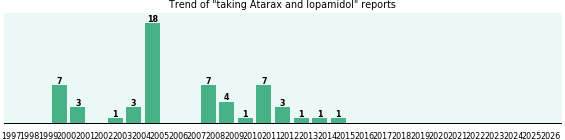
What are the common drug interactions of Atarax and Iopamidol, by gender? *:
female:
- Necrosis (the death of body tissue)
- Obstructive airways disorder (a progressive disease that makes it hard to breathe)
- Anal fissure
- Atrial fibrillation (fibrillation of the muscles of the atria of the heart)
- Blood pressure decreased
- Cell mediated allergic reaction (hypersensitivity)
- Cholelithiasis (the presence or formation of gallstones in the gallbladder or bile ducts)
- Cough
- Dehydration (dryness resulting from the removal of water)
- Depressed level of consciousness
male:
- Toxic skin eruption (skin breakdown due to toxic substance)
- Eosinophil count increased
- Mouth ulceration (mouth ulcers)
- Rash
- Angina pectoris (chest pain due to ischemia of the heart muscle)
- Arteriospasm coronary (spasm of the large- or medium-sized coronary arteries)
- Blood magnesium decreased
- Contusion (a type of hematoma of tissue in which capillaries)
- Coronary angioplasty
- Coronary arterial stent insertion
What are the common drug interactions of Atarax and Iopamidol, by age (0-1 to 60+)? *:
0-1:
n/a
2-9:
n/a
10-19:
n/a
20-29:
n/a
30-39:
- Rash
- Acute circulatory failure (shock)
- Cell mediated allergic reaction (hypersensitivity)
- Hyperpyrexia (extremely high fever)
- Pyrexia (fever)
40-49:
- Toxic skin eruption (skin breakdown due to toxic substance)
- Eosinophil count increased
- Angina pectoris (chest pain due to ischemia of the heart muscle)
- Arteriospasm coronary (spasm of the large- or medium-sized coronary arteries)
- Blood magnesium decreased
- Cardiovascular disorder (heart diseases)
- Contusion (a type of hematoma of tissue in which capillaries)
- Coronary angioplasty
- Coronary arterial stent insertion
- Coronary artery stenosis (narrowing of coronary artery)
50-59:
- Drug eruption (adverse drug reaction of the skin)
- Dysphonia (speech disorder attributable to a disorder of phonation)
- Erythrodermic psoriasis (generalized redness of the skin)
- Hypersensitivity
- Large intestine carcinoma (cancer of large intestine)
- Laryngeal oedema (swelling of larynx)
- Necrosis (the death of body tissue)
- Obstructive airways disorder (a progressive disease that makes it hard to breathe)
- Pyrexia (fever)
- Respiratory arrest (cessation of normal respiration due to failure of the lungs to function effectively)
60+:
- Atrial fibrillation (fibrillation of the muscles of the atria of the heart)
- Pleural effusion (water on the lungs)
- Lung infection
- Troponin t increased
- Cardiac failure
- Pulmonary oedema (fluid accumulation in the lungs)
- Septic shock (shock due to blood infection)
- Cholecystitis (infection of gallbladder)
- Dermatitis bullous (inflammation of the skin characterized by the presence of bullae which are filled with fluid)
- Epidermal necrosis (skin condition that is usually caused by a reaction to drugs)
What are the existing conditions these people have? *
- Musculoskeletal Pain (pain affects the bones, muscles, ligaments, tendons, and nerves): 10 people, 17.54%
- Ill-Defined Disorder: 8 people, 14.04%
- Respiratory Disorder (respiratory disease): 6 people, 10.53%
- Pain: 4 people, 7.02%
- Chronic Myeloid Leukaemia (long lasting type of cancer that starts in the blood-forming cells of the bone marrow and invades the blood): 4 people, 7.02%
- Pneumonia: 3 people, 5.26%
- Fever: 3 people, 5.26%
- Constipation: 3 people, 5.26%
* Approximation only. Some reports may have incomplete information.
Do you take Atarax and Iopamidol?
- Personalize this study to your gender, age, symptoms and drugs
- Predict drug outcomes for up to one year with AI
- Get an AI agent to monitor your drugs continuously
Related studies:
Effectiveness of, side effects of, and alternative drugs to the 2 drugs:
Browse all drug interactions of Atarax and Iopamidol:
a b c d e f g h i j k l m n o p q r s t u v w x y zSub-studies by gender and age:
Female: 0-1 2-9 10-19 20-29 30-39 40-49 50-59 60+
Male: 0-1 2-9 10-19 20-29 30-39 40-49 50-59 60+
Browse all side effects of Atarax:
a b c d e f g h i j k l m n o p q r s t u v w x y zBrowse all side effects of Iopamidol:
a b c d e f g h i j k l m n o p q r s t u v w x y zBrowse all interactions between Atarax and drugs from A to Z:
a b c d e f g h i j k l m n o p q r s t u v w x y zBrowse all interactions between Iopamidol and drugs from A to Z:
a b c d e f g h i j k l m n o p q r s t u v w x y zRelated publications that referenced our studies
- Ate? ?, Arikan MF, Kaplan M, Altay M, "Hydroxyzine induced pancytopenia and petechial rashes: a rare complication", Journal Of Contemporary Medicine, 2017 Jan .
- Ate? ?, Arikan MF, Kaplan M, Altay M, "Hydroxyzine induced pancytopenia and petechial rashes: a rare complication", Journal Of Contemporary Medicine, 2017 Jan .
How the study uses the data?
The study uses data from the FDA. It is based on hydroxyzine hydrochloride and iopamidol (the active ingredients of Atarax and Iopamidol, respectively), and Atarax and Iopamidol (the brand names). Other drugs that have the same active ingredients (e.g. generic drugs) are not considered. Dosage of drugs is not considered in the study.
How to use the study?
DO NOT STOP MEDICATIONS without first consulting your doctor. If there are any serious or long term adverse effects discovered in the study, discuss the study with your doctor to ensure that proper medication management will be in place if applicable.
Who is eHealthMe?
With medical big data and proven AI/ML algorithms, eHealthMe provides a platform for everyone to run phase IV clinical trials. We study millions of patients and 5,000 more each day. Results of our real-world drug study have been referenced on 800+ peer-reviewed medical publications, including The Lancet, Mayo Clinic Proceedings, and Nature. Our analysis results are available to researchers, health care professionals, patients (testimonials), and software developers (open API).
WARNING, DISCLAIMER, USE FOR PUBLICATION
WARNING: Please DO NOT STOP MEDICATIONS without first consulting a physician since doing so could be hazardous to your health.
DISCLAIMER: All material available on eHealthMe.com is for informational purposes only, and is not a substitute for medical advice, diagnosis, or treatment provided by a qualified healthcare provider. All information is observation-only. Our phase IV clinical studies alone cannot establish cause-effect relationship. Different individuals may respond to medication in different ways. Every effort has been made to ensure that all information is accurate, up-to-date, and complete, but no guarantee is made to that effect. The use of the eHealthMe site and its content is at your own risk.
If you use this eHealthMe study on publication, please acknowledge it with a citation: study title, URL, accessed date.
Recent studies on eHealthMe:
- Could Singulair cause Nephrosclerosis? - 2 seconds ago
- Could Singulair cause Fungal Oesophagitis? - 4 seconds ago
- Could Apixaban cause Stress And Anxiety? - 5 seconds ago
- Could Apixaban cause Drug Resistance? - 15 seconds ago
- Could Apidra cause Drug Effect Decreased? - 17 seconds ago
- Could Apidra Solostar cause Headache? - 19 seconds ago
- Could Pantothenic Acid cause Hypotension? - 23 seconds ago
- Could Metoprolol Succinate cause Abnormal Loss Of Weight? - 30 seconds ago
- Ibuprofen vs. Amlodipine Besylate, side effect and effectiveness comparison - 30 seconds ago
- Drug interactions of Minocycline Hydrochloride and Linezolid - 35 seconds ago