Calcium pantothenate and Sulfamethoxazole and trimethoprim drug interactions - a phase IV clinical study of FDA data
Summary:
Drug interactions are reported among people who take Calcium pantothenate (pantothenic acid (vitamin b5)) and Sulfamethoxazole and trimethoprim (sulfamethoxazole; trimethoprim). Common drug interactions include deep vein thrombosis among females and decreased appetite among males.
The phase IV clinical study analyzes what interactions people have when they take Calcium pantothenate and Sulfamethoxazole and trimethoprim. It is created by eHealthMe based on reports of 18 people who take the same drugs from the FDA, and is updated regularly.
What is Calcium pantothenate?
Calcium pantothenate has active ingredients of pantothenic acid (vitamin b5). eHealthMe is studying from 1,495 Calcium pantothenate users. Check the latest studies of Calcium pantothenate.
What is Sulfamethoxazole and trimethoprim?
Sulfamethoxazole and trimethoprim has active ingredients of sulfamethoxazole; trimethoprim. It is often used in urinary tract infection. eHealthMe is studying from 17,645 Sulfamethoxazole and trimethoprim users. Check the latest studies of Sulfamethoxazole and trimethoprim.
18 people who take Calcium pantothenate and Sulfamethoxazole and trimethoprim together, and have interactions are studied.
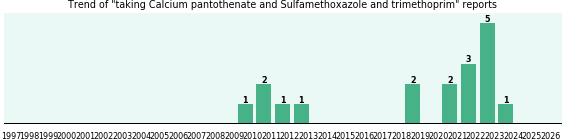
What are the common drug interactions of Calcium Pantothenate and Sulfamethoxazole And Trimethoprim, by gender? *:
female:
- Deep vein thrombosis (blood clot in a major vein that usually develops in the legs and/or pelvis)
- Gastritis haemorrhagic (inflammation of stomach with bleeding)
- Oesophageal candidiasis (fungal infection of oesophagus)
- Disseminated intravascular coagulation (systemic activation of blood coagulation)
- Enterococcus test positive
- Generalised oedema (swelling all over the body)
- Hepatorenal syndrome (renal failure in patients with advanced chronic liver disease)
- Hypoalbuminaemia (levels of albumin in blood serum are abnormally low)
- Hyponatraemia (abnormally low level of sodium in the blood; associated with dehydration)
- Interstitial lung disease
male:
- Decreased appetite
- Dizziness postural
- Fall
- Pneumonia aspiration (bronchopneumonia that develops due to the entrance of foreign materials into the bronchial tree)
- Spinal compression fracture (fracture due to spinal compression on bone)
What are the common drug interactions of Calcium Pantothenate and Sulfamethoxazole And Trimethoprim, by age (0-1 to 60+)? *:
0-1:
n/a
2-9:
n/a
10-19:
n/a
20-29:
n/a
30-39:
n/a
40-49:
n/a
50-59:
n/a
60+:
- Pneumonia aspiration (bronchopneumonia that develops due to the entrance of foreign materials into the bronchial tree)
- Coma (state of unconsciousness lasting more than six hours)
- Generalised oedema (swelling all over the body)
- Hepatorenal syndrome (renal failure in patients with advanced chronic liver disease)
- Hypoalbuminaemia (levels of albumin in blood serum are abnormally low)
- Hyponatraemia (abnormally low level of sodium in the blood; associated with dehydration)
- Interstitial lung disease
- Metabolic acidosis (body produces too much acid, or when the kidneys are not removing enough acid from the body)
- Pneumocystis jiroveci pneumonia (fungal infection of the lungs)
- Decreased appetite
What are the existing conditions these people have? *
- Pain: 8 people, 44.44%
- Rheumatoid Arthritis (a chronic progressive disease causing inflammation in the joints): 4 people, 22.22%
- Enterocolitis (inflammation of the digestive tract, involving enteritis of the small intestine and colitis of the colon): 3 people, 16.67%
- Pseudomonas Infection (pseudomonas infection is caused by a bacterium, pseudomonas aeruginosa): 1 person, 5.56%
- Multiple Sclerosis (a nervous system disease that affects your brain and spinal cord. it damages the myelin sheath): 1 person, 5.56%
- Gastroesophageal Reflux Disease (a condition in which stomach contents leak backward from the stomach into the oesophagus): 1 person, 5.56%
- Cystic Fibrosis (disease of the secretary glands): 1 person, 5.56%
- Asthma: 1 person, 5.56%
* Approximation only. Some reports may have incomplete information.
Do you take Calcium pantothenate and Sulfamethoxazole and trimethoprim?
- Personalize this study to your gender, age, symptoms and drugs
- Predict drug outcomes for up to one year with AI
- Get an AI agent to monitor your drugs continuously
Related studies:
Effectiveness of, side effects of, and alternative drugs to the 2 drugs:
- Calcium pantothenate (1,495 reports)
- Sulfamethoxazole and trimethoprim (17,645 reports)
Browse all drug interactions of Calcium pantothenate and Sulfamethoxazole and trimethoprim:
a b c d e f g h i j k l m n o p q r s t u v w x y zSub-studies by gender and age:
Female: 0-1 2-9 10-19 20-29 30-39 40-49 50-59 60+
Male: 0-1 2-9 10-19 20-29 30-39 40-49 50-59 60+
Browse all side effects of Calcium pantothenate:
a b c d e f g h i j k l m n o p q r s t u v w x y zBrowse all side effects of Sulfamethoxazole and trimethoprim:
a b c d e f g h i j k l m n o p q r s t u v w x y zBrowse all interactions between Calcium pantothenate and drugs from A to Z:
a b c d e f g h i j k l m n o p q r s t u v w x y zBrowse all interactions between Sulfamethoxazole and trimethoprim and drugs from A to Z:
a b c d e f g h i j k l m n o p q r s t u v w x y zHow the study uses the data?
The study uses data from the FDA. It is based on pantothenic acid (vitamin b5) and sulfamethoxazole; trimethoprim (the active ingredients of Calcium pantothenate and Sulfamethoxazole and trimethoprim, respectively), and Calcium pantothenate and Sulfamethoxazole and trimethoprim (the brand names). Other drugs that have the same active ingredients (e.g. generic drugs) are not considered. Dosage of drugs is not considered in the study.
How to use the study?
DO NOT STOP MEDICATIONS without first consulting your doctor. If there are any serious or long term adverse effects discovered in the study, discuss the study with your doctor to ensure that proper medication management will be in place if applicable.
Who is eHealthMe?
With medical big data and proven AI/ML algorithms, eHealthMe provides a platform for everyone to run phase IV clinical trials. We study millions of patients and 5,000 more each day. Results of our real-world drug study have been referenced on 800+ peer-reviewed medical publications, including The Lancet, Mayo Clinic Proceedings, and Nature. Our analysis results are available to researchers, health care professionals, patients (testimonials), and software developers (open API).
WARNING, DISCLAIMER, USE FOR PUBLICATION
WARNING: Please DO NOT STOP MEDICATIONS without first consulting a physician since doing so could be hazardous to your health.
DISCLAIMER: All material available on eHealthMe.com is for informational purposes only, and is not a substitute for medical advice, diagnosis, or treatment provided by a qualified healthcare provider. All information is observation-only. Our phase IV clinical studies alone cannot establish cause-effect relationship. Different individuals may respond to medication in different ways. Every effort has been made to ensure that all information is accurate, up-to-date, and complete, but no guarantee is made to that effect. The use of the eHealthMe site and its content is at your own risk.
If you use this eHealthMe study on publication, please acknowledge it with a citation: study title, URL, accessed date.
Recent studies on eHealthMe:
- Drug interactions of Pantoprazole Sodium and Levophed - 5 seconds ago
- Could Aciphex cause Poor Quality Sleep? - 6 seconds ago
- Could Ultracet cause Paroxysmal Supraventricular Tachycardia? - 8 seconds ago
- On And Off Phenomenon and Dementia - 10 seconds ago
- Could Rabeprazole Sodium cause Protein Total Decreased? - 12 seconds ago
- Drug interactions of Methimazole and Gleevec - 13 seconds ago
- Drug interactions of Cytarabine and Sodium Bicarbonate - 13 seconds ago
- Could Xgeva cause Tongue Ulceration? - 15 seconds ago
- Could Ddavp cause Cough? - 17 seconds ago
- Could Benicar cause Varicose Vein? - 18 seconds ago