Fluticasone propionate and Glycopyrrolate drug interactions - a phase IV clinical study of FDA data
Summary:
Drug interactions are reported among people who take Fluticasone propionate (fluticasone propionate) and Glycopyrrolate (glycopyrrolate). Common drug interactions include chest pain among females and dyspnoea among males.
The phase IV clinical study analyzes what interactions people have when they take Fluticasone propionate and Glycopyrrolate. It is created by eHealthMe based on reports of 96 people who take the same drugs from the FDA, and is updated regularly.
What is Fluticasone propionate?
Fluticasone propionate has active ingredients of fluticasone propionate. It is often used in allergies. eHealthMe is studying from 35,174 Fluticasone propionate users. Check the latest studies of Fluticasone propionate.
What is Glycopyrrolate?
Glycopyrrolate has active ingredients of glycopyrrolate. It is often used in hyperhidrosis. eHealthMe is studying from 5,599 Glycopyrrolate users. Check the latest studies of Glycopyrrolate.
96 people who take Fluticasone propionate and Glycopyrrolate together, and have interactions are studied.
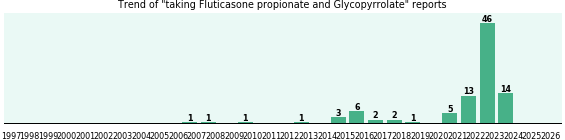
What are the common drug interactions of Fluticasone Propionate and Glycopyrrolate, by gender? *:
female:
- Chest pain
- Depressed mood
- Depressive symptom
- Dyspnoea exertional (breathlessness or shortness of breath)
- Flank pain (a distressing sensation experienced around the lower back and the upper abdomen)
- Malaise (a feeling of general discomfort or uneasiness)
- Nasopharyngitis (inflammation of the nasopharynx)
- Prolonged expiration (person's difficulty in breathing)
- Pyrexia (fever)
- Rales (an abnormal respiratory sound characterized by fine crackles)
male:
- Dyspnoea (difficult or laboured respiration)
- Cough
- Neuropathy peripheral (surface nerve damage)
- Paraesthesia (sensation of tingling, tickling, prickling, pricking, or burning of a person's skin with no apparent long-term physical effect)
- Upper respiratory tract infection
- Vasculitis (inflammation of a blood vessel or blood vessels)
- Drug intolerance (drug sensitivity)
- Breath sounds
- Bronchial hyperreactivity
- Bronchitis (inflammation of the mucous membrane in the bronchial tubes)
What are the common drug interactions of Fluticasone Propionate and Glycopyrrolate, by age (0-1 to 60+)? *:
0-1:
n/a
2-9:
- Hypoglycaemia (deficiency of glucose in the bloodstream)
- Blood glucose decreased
10-19:
- Cardio-respiratory arrest (sudden dysfunction of heart and lungs)
- Constipation
- Incontinence (lack of moderation or self-control)
- Lethargy (tiredness)
- Leukocytosis (increased white blood cells)
- Lung infiltration (a substance that normally includes fluid, inflammatory exudates or cells that fill a region of lung)
- Pneumonia
- Respiratory failure (inadequate gas exchange by the respiratory system)
- Sepsis (a severe blood infection that can lead to organ failure and death)
- Stenotrophomonas infection
20-29:
- Myelomalacia (softening and damage of the spinal cord due to some injury like compression by disc extrusion)
- Pneumonia
30-39:
n/a
40-49:
- Aphasia (damage to the parts of the brain that control language)
- Cognitive disorder (mental health disorders affects learning, memory, perception, and problem solving)
- Death
- Decreased appetite
- Lethargy (tiredness)
- Memory impairment
- Blood pressure decreased
- Choking (mechanical obstruction of the flow of air from the environment into the lungs)
- Chronic kidney disease
- Dizziness
50-59:
- Bronchitis (inflammation of the mucous membrane in the bronchial tubes)
- Dermatitis contact (skin reaction (dermatitis) resulting from exposure to allergens)
- Dizziness
- Dry eye (lack of adequate tears)
- Dry mouth
- Fall
- Fatigue (feeling of tiredness)
- Granuloma (a small area of inflammation due to tissue injury)
- Headache (pain in head)
- Herpes zoster
60+:
- Dyspnoea (difficult or laboured respiration)
- Cough
- Haemoptysis (blood-stained sputum from the bronchi, larynx, trachea, or lungs)
- Neuropathy peripheral (surface nerve damage)
- Paraesthesia (sensation of tingling, tickling, prickling, pricking, or burning of a person's skin with no apparent long-term physical effect)
- Vasculitis (inflammation of a blood vessel or blood vessels)
- Wheezing (a high-pitched whistling sound made while you breath)
- Chest discomfort
- Depressed mood
- Sleep disorder due to a general medical condition
What are the existing conditions these people have? *
- Asthma: 52 people, 54.17%
- Vasculitis (inflammation of a blood vessel or blood vessels): 26 people, 27.08%
- Eosinophilia (eosinophil count in the peripheral blood exceeds): 26 people, 27.08%
- Productive Cough: 17 people, 17.71%
- Eczema (patches of skin become rough and inflamed, with itching and bleeding blisters): 15 people, 15.62%
- Narcolepsy (brain's inability to regulate sleep-wake cycles normally): 12 people, 12.50%
- Drowsiness: 8 people, 8.33%
- Cataplexy (loss of muscle tone accompanied by full conscious awareness): 8 people, 8.33%
- Pain: 6 people, 6.25%
- Muscle Spasms (muscle contraction): 5 people, 5.21%
* Approximation only. Some reports may have incomplete information.
Do you take Fluticasone propionate and Glycopyrrolate?
- Personalize this study to your gender, age, symptoms and drugs
- Predict drug outcomes for up to one year with AI
- Get an AI agent to monitor your drugs continuously
Related studies:
Effectiveness of, side effects of, and alternative drugs to the 2 drugs:
- Fluticasone propionate (35,174 reports)
- Glycopyrrolate (5,599 reports)
Browse all drug interactions of Fluticasone propionate and Glycopyrrolate:
a b c d e f g h i j k l m n o p q r s t u v w x y zSub-studies by gender and age:
Female: 0-1 2-9 10-19 20-29 30-39 40-49 50-59 60+
Male: 0-1 2-9 10-19 20-29 30-39 40-49 50-59 60+
Browse all side effects of Fluticasone propionate:
a b c d e f g h i j k l m n o p q r s t u v w x y zBrowse all side effects of Glycopyrrolate:
a b c d e f g h i j k l m n o p q r s t u v w x y zBrowse all interactions between Fluticasone propionate and drugs from A to Z:
a b c d e f g h i j k l m n o p q r s t u v w x y zBrowse all interactions between Glycopyrrolate and drugs from A to Z:
a b c d e f g h i j k l m n o p q r s t u v w x y zRelated publications that referenced our studies
- Lehrer, S., & Rheinstein, P. H. , "Alzheimer’s Disease and Intranasal Fluticasone Propionate in the FDA MedWatch Adverse Events Database", Journal of Alzheimer's disease reports, (Preprint), 1-5., 2018 Jan .
- D'souza S, Gowler V, "Glycopyrrolate‐induced respiratory arrest: an unusual side effect", Acta Anaesthesiologica Scandinavica, 2015 Mar .
- Lehrer, S., & Rheinstein, P. H. , "Alzheimer’s Disease and Intranasal Fluticasone Propionate in the FDA MedWatch Adverse Events Database", Journal of Alzheimer's disease reports, (Preprint), 1-5., 2018 Jan .
- D'souza S, Gowler V, "Glycopyrrolate‐induced respiratory arrest: an unusual side effect", Acta Anaesthesiologica Scandinavica, 2015 Mar .
How the study uses the data?
The study uses data from the FDA. It is based on fluticasone propionate and glycopyrrolate (the active ingredients of Fluticasone propionate and Glycopyrrolate, respectively), and Fluticasone propionate and Glycopyrrolate (the brand names). Other drugs that have the same active ingredients (e.g. generic drugs) are not considered. Dosage of drugs is not considered in the study.
How to use the study?
DO NOT STOP MEDICATIONS without first consulting your doctor. If there are any serious or long term adverse effects discovered in the study, discuss the study with your doctor to ensure that proper medication management will be in place if applicable.
Who is eHealthMe?
With medical big data and proven AI/ML algorithms, eHealthMe provides a platform for everyone to run phase IV clinical trials. We study millions of patients and 5,000 more each day. Results of our real-world drug study have been referenced on 800+ peer-reviewed medical publications, including The Lancet, Mayo Clinic Proceedings, and Nature. Our analysis results are available to researchers, health care professionals, patients (testimonials), and software developers (open API).
WARNING, DISCLAIMER, USE FOR PUBLICATION
WARNING: Please DO NOT STOP MEDICATIONS without first consulting a physician since doing so could be hazardous to your health.
DISCLAIMER: All material available on eHealthMe.com is for informational purposes only, and is not a substitute for medical advice, diagnosis, or treatment provided by a qualified healthcare provider. All information is observation-only. Our phase IV clinical studies alone cannot establish cause-effect relationship. Different individuals may respond to medication in different ways. Every effort has been made to ensure that all information is accurate, up-to-date, and complete, but no guarantee is made to that effect. The use of the eHealthMe site and its content is at your own risk.
If you use this eHealthMe study on publication, please acknowledge it with a citation: study title, URL, accessed date.
Recent studies on eHealthMe:
- Cardiac Failure Chronic and Epilepsy - 3 seconds ago
- Could Aricept cause Ill-Defined Disorder? - 12 seconds ago
- Could Rebif cause Facial Spasm? - 23 seconds ago
- Could Buspirone Hcl cause Withdrawal Syndrome? - 29 seconds ago
- Could Sodium Chloride cause Systemic Lupus Erythematosus? - 40 seconds ago
- Could Darzalex cause Mucosal Inflammation? - 42 seconds ago
- Drug interactions of Abraxane and Naprosyn - 43 seconds ago
- Could Lunesta cause Dyspnea? - 43 seconds ago
- Quercetin-3-Rutinoside vs. Mucinex, side effect and effectiveness comparison - 47 seconds ago
- Drug interactions of Metoprolol Succinate and Lunesta - 49 seconds ago