Fragmin and Maxipime drug interactions - a phase IV clinical study of FDA data
Summary:
Drug interactions are reported among people who take Fragmin (dalteparin sodium) and Maxipime (cefepime hydrochloride). Common drug interactions include gingival ulceration among females and sepsis among males.
The phase IV clinical study analyzes what interactions people have when they take Fragmin and Maxipime. It is created by eHealthMe based on reports of 67 people who take the same drugs from the FDA, and is updated regularly.
What is Fragmin?
Fragmin has active ingredients of dalteparin sodium. It is often used in deep venous thrombosis. eHealthMe is studying from 11,999 Fragmin users. Check the latest studies of Fragmin.
What is Maxipime?
Maxipime has active ingredients of cefepime hydrochloride. eHealthMe is studying from 4,279 Maxipime users. Check the latest studies of Maxipime.
67 people who take Fragmin and Maxipime together, and have interactions are studied.
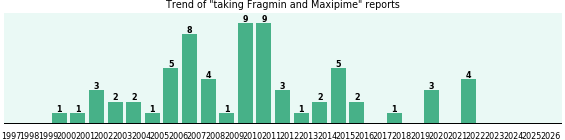
What are the common drug interactions of Fragmin and Maxipime, by gender? *:
female:
- Gingival ulceration (ulcer on gums)
- Hypoxia (low oxygen in tissues)
- Pulmonary alveolar haemorrhage (acute bleeding)
- Respiratory distress (difficulty in breathing)
- Sepsis (a severe blood infection that can lead to organ failure and death)
- Vomiting
- Cardiac failure
- Circulatory collapse
- Depressed level of consciousness
- Febrile neutropenia (fever with reduced white blood cells)
male:
- Sepsis (a severe blood infection that can lead to organ failure and death)
- Disseminated intravascular coagulation (systemic activation of blood coagulation)
- Renal disorder (kidney disease)
- Respiratory disorder (respiratory disease)
- Alanine aminotransferase increased
- Aspartate aminotransferase increased
- Blood bilirubin increased
- Blood lactate dehydrogenase increased
- Blood urea increased
- Blood urine present
What are the common drug interactions of Fragmin and Maxipime, by age (0-1 to 60+)? *:
0-1:
n/a
2-9:
- Disseminated intravascular coagulation (systemic activation of blood coagulation)
- Hypertension (high blood pressure)
- Sepsis (a severe blood infection that can lead to organ failure and death)
- Blood potassium increased
- Convulsion (muscles contract and relax rapidly and repeatedly, resulting in an uncontrolled shaking of the body)
- Cytokine storm (over-protective immune response that can actually be fatal)
- Depressed level of consciousness
- Encephalopathy (functioning of the brain is affected by some agent or condition)
- Eye movement disorder
- Haemolytic anaemia (anaemia due to haemolysis)
10-19:
- Sepsis (a severe blood infection that can lead to organ failure and death)
- Diarrhoea
- Graft versus host disease (the donated bone marrow or stem cells view the recipient's body as foreign, and the donated cells/bone marrow attack the body)
- Myelosuppression (a decrease in the production of blood cells)
- Pyrexia (fever)
- Eosinophil count increased
- Interstitial lung disease
- Nervous system disorder (a general class of medical conditions affecting the nervous system)
- Platelet count decreased
- Respiratory disorder (respiratory disease)
20-29:
- Dysphagia (a condition in which swallowing is difficult or painful)
- Fatigue (feeling of tiredness)
- Meningitis herpes (herpes virus caused inflammation of the protective membranes covering the brain and spinal cord, known collectively as the meninges)
- Pancytopenia (medical condition in which there is a reduction in the number of red and white blood cells, as well as platelets)
30-39:
- Circulatory collapse
- Hepatitis b
- Multi-organ failure (multisystem organ failure)
- Acute lymphocytic leukaemia recurrent (cancer in which the bone marrow makes too many lymphocytes-recurrent)
- Febrile neutropenia (fever with reduced white blood cells)
- Gastric cancer (stomach cancer)
- Hypocalcaemia (levels of calcium in blood serum are abnormally low)
- Pneumonia
- Reye's syndrome (sudden (acute) brain damage and liver function problems of unknown cause)
- Cerebral haemorrhage (bleeding within the brain)
40-49:
- Disseminated intravascular coagulation (systemic activation of blood coagulation)
- Interstitial lung disease
- White blood cell count decreased
- Anaemia (lack of blood)
- Malignant neoplasm progression (cancer tumour came back)
- Adult respiratory distress syndrome (type of lung (pulmonary) failure)
- Blood creatinine increased
- Encephalitis herpes (inflammation of the brain due to herpes infection)
- Engraftment syndrome (inflammatory condition during neutrophil recovery after hematopoietic stem cell transplantation)
- Graft versus host disease (the donated bone marrow or stem cells view the recipient's body as foreign, and the donated cells/bone marrow attack the body)
50-59:
- Mouth haemorrhage (bleeding from mouth)
- Occult blood (blood in the faeces that is not visibly apparent)
- Oropharyngeal discomfort (pain or irritation of oropharynx)
- Peripheral coldness
- Pneumonia cytomegaloviral (cmv pneumonia is caused by a member of a group of herpes-type viruses)
- Respiratory disorder (respiratory disease)
- Retinoic acid syndrome (complication of blood cancer treatment with tretinoin)
- Speech disorder
- Systemic candida (whole body fungal infection)
- Thrombocytopenia (decrease of platelets in blood)
60+:
- Scrotal ulcer
- Acute myeloid leukaemia (acute cancer in which the bone marrow makes abnormal myeloblasts)
- Atrial fibrillation (fibrillation of the muscles of the atria of the heart)
- Back pain
- Blood urea increased
- Body temperature decreased
- C-reactive protein increased
- Coma (state of unconsciousness lasting more than six hours)
- Confusional state
- Constipation
What are the existing conditions these people have? *
- Immunodeficiency Disorders: 7 people, 10.45%
- Acute Promyelocytic Leukaemia (cancer of the blood and bone marrow): 7 people, 10.45%
- Febrile Neutropenia (fever with reduced white blood cells): 6 people, 8.96%
- Systemic Candida (whole body fungal infection): 4 people, 5.97%
- Oedema (fluid collection in tissue): 4 people, 5.97%
- Medulloblastoma (a fast-growing, high-grade tumour that always begins in the cerebellum): 4 people, 5.97%
- Infection: 4 people, 5.97%
- Fever: 4 people, 5.97%
- Diarrhea: 4 people, 5.97%
- Bone Marrow Conditioning Regimen: 4 people, 5.97%
* Approximation only. Some reports may have incomplete information.
Do you take Fragmin and Maxipime?
- Personalize this study to your gender, age, symptoms and drugs
- Predict drug outcomes for up to one year with AI
- Get an AI agent to monitor your drugs continuously
Related studies:
Effectiveness of, side effects of, and alternative drugs to the 2 drugs:
Browse all drug interactions of Fragmin and Maxipime:
a b c d e f g h i j k l m n o p q r s t u v w x y zSub-studies by gender and age:
Female: 0-1 2-9 10-19 20-29 30-39 40-49 50-59 60+
Male: 0-1 2-9 10-19 20-29 30-39 40-49 50-59 60+
Browse all side effects of Fragmin:
a b c d e f g h i j k l m n o p q r s t u v w x y zBrowse all side effects of Maxipime:
a b c d e f g h i j k l m n o p q r s t u v w x y zBrowse all interactions between Fragmin and drugs from A to Z:
a b c d e f g h i j k l m n o p q r s t u v w x y zBrowse all interactions between Maxipime and drugs from A to Z:
a b c d e f g h i j k l m n o p q r s t u v w x y zHow the study uses the data?
The study uses data from the FDA. It is based on dalteparin sodium and cefepime hydrochloride (the active ingredients of Fragmin and Maxipime, respectively), and Fragmin and Maxipime (the brand names). Other drugs that have the same active ingredients (e.g. generic drugs) are not considered. Dosage of drugs is not considered in the study.
How to use the study?
DO NOT STOP MEDICATIONS without first consulting your doctor. If there are any serious or long term adverse effects discovered in the study, discuss the study with your doctor to ensure that proper medication management will be in place if applicable.
Who is eHealthMe?
With medical big data and proven AI/ML algorithms, eHealthMe provides a platform for everyone to run phase IV clinical trials. We study millions of patients and 5,000 more each day. Results of our real-world drug study have been referenced on 800+ peer-reviewed medical publications, including The Lancet, Mayo Clinic Proceedings, and Nature. Our analysis results are available to researchers, health care professionals, patients (testimonials), and software developers (open API).
WARNING, DISCLAIMER, USE FOR PUBLICATION
WARNING: Please DO NOT STOP MEDICATIONS without first consulting a physician since doing so could be hazardous to your health.
DISCLAIMER: All material available on eHealthMe.com is for informational purposes only, and is not a substitute for medical advice, diagnosis, or treatment provided by a qualified healthcare provider. All information is observation-only. Our phase IV clinical studies alone cannot establish cause-effect relationship. Different individuals may respond to medication in different ways. Every effort has been made to ensure that all information is accurate, up-to-date, and complete, but no guarantee is made to that effect. The use of the eHealthMe site and its content is at your own risk.
If you use this eHealthMe study on publication, please acknowledge it with a citation: study title, URL, accessed date.
Recent studies on eHealthMe:
- Drug interactions of Alphagan and Diovan - 3 seconds ago
- Could Albuterol Sulfate cause Menopausal Symptoms? - 4 seconds ago
- Drug interactions of Tegretol and Sutent - 4 seconds ago
- Drug interactions of Colace and Cobalamin - 8 seconds ago
- Drug interactions of Hydromorphone Hydrochloride and Almotriptan Malate - 12 seconds ago
- Could Akynzeo cause Indigestion? - 23 seconds ago
- Could Gentamicin cause Ventricular Hypertrophy? - 23 seconds ago
- Could Oracort cause Erythema Multiforme? - 25 seconds ago
- Could Combivent cause Mobility Decreased? - 37 seconds ago
- Could Zetia cause Joint Pain? - 37 seconds ago