Keppra and Tadalafil drug interactions - a phase IV clinical study of FDA data
Summary:
Drug interactions are reported among people who take Keppra (levetiracetam) and Tadalafil (tadalafil). Common drug interactions include ascites among females and pain among males.
The phase IV clinical study analyzes what interactions people have when they take Keppra and Tadalafil. It is created by eHealthMe based on reports of 36 people who take the same drugs from the FDA, and is updated regularly.
What is Keppra?
Keppra has active ingredients of levetiracetam. It is often used in epilepsy. eHealthMe is studying from 73,504 Keppra users. Check the latest studies of Keppra.
What is Tadalafil?
Tadalafil has active ingredients of tadalafil. It is often used in erection problems. eHealthMe is studying from 25,548 Tadalafil users. Check the latest studies of Tadalafil.
36 people who take Keppra and Tadalafil together, and have interactions are studied.
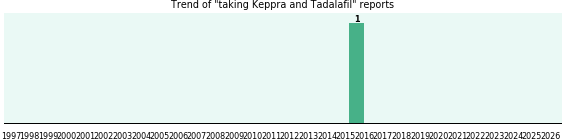
What are the common drug interactions of Keppra and Tadalafil, by gender? *:
female:
- Ascites (accumulation of fluid in the abdominal cavity)
- Bacterial sepsis
- Cerebral thrombosis (blood clot in brain)
- Chest pain
- Cough
- Dizziness postural
- Dyspnoea (difficult or laboured respiration)
- Dyspnoea exertional (breathlessness or shortness of breath)
- Exercise tolerance decreased
- Fluid overload (too much fluid in the blood)
male:
- Pain
- Alanine aminotransferase increased
- Nausea (feeling of having an urge to vomit)
- Patient-device incompatibility
- Abdominal pain
- Blood bilirubin increased
- Bowel movement irregularity
- Facial bones fracture (bone fracture of face)
- Fall
- Mental status changes (general changes in brain function, such as confusion, amnesia (memory loss), loss of alertness, loss of orientation)
What are the common drug interactions of Keppra and Tadalafil, by age (0-1 to 60+)? *:
0-1:
n/a
2-9:
- Infusion site pain
- Infusion site reaction
- Pain
- Patient-device incompatibility
- Asthenia (weakness)
- Nausea (feeling of having an urge to vomit)
- Upper respiratory tract infection
- Respiratory failure (inadequate gas exchange by the respiratory system)
- Tracheostomy infection (infection of trachea surgical opening)
- Infusion site inflammation
10-19:
- Food intolerance (inability to have food)
- Retching (strong involuntary effort to vomit)
- Sinusitis (inflammation of sinus)
20-29:
n/a
30-39:
- Pain
- Abdominal distension
- Amnesia (deficit in memory caused by brain damage, disease, or psychological trauma)
- Arthralgia (joint pain)
- Back pain
- Blood glucose increased
- Carpal tunnel syndrome (nerve compression at wrist results numbness weakness, pain , swelling)
- Chest discomfort
- Depression
- Disability
40-49:
- Alanine aminotransferase increased
- Altered state of consciousness (altered state of mind)
- Aspartate aminotransferase increased
- Blood alkaline phosphatase increased
- Hepatic congestion (liver congestion)
- Hypoxia (low oxygen in tissues)
- Malaise (a feeling of general discomfort or uneasiness)
- Oxygen saturation decreased
- Right ventricular failure (right half of the heart fails to work)
- Seizure anoxic (a reflex anoxic seizure is a type of fit triggered by a temporary cutting off of the supply of blood to the brain)
50-59:
- Abdominal pain
- Alanine aminotransferase increased
- Aspartate aminotransferase increased
- Blood alkaline phosphatase increased
- Blood bilirubin increased
- Bowel movement irregularity
- Facial bones fracture (bone fracture of face)
- Fatigue (feeling of tiredness)
- Headache (pain in head)
- Hospitalisation
60+:
- Fall
- Cerebrovascular accident (sudden death of some brain cells due to lack of oxygen when the blood flow to the brain is impaired by blockage or rupture)
- Eye pain
- Flatulence (flatus expelled through the anus)
- Groin pain
- Hernia (hernia happens when part of an internal organ or tissue bulges through a weak area of muscle)
- Hypotension (abnormally low blood pressure)
- Malignant palate neoplasm (cancer tumour of roof of mouth)
- Nausea (feeling of having an urge to vomit)
- Pyrexia (fever)
What are the existing conditions these people have? *
- Primary Pulmonary Hypertension (primary high blood pressure that affects the arteries in the lungs and the right side of your heart): 19 people, 52.78%
- Seizures (abnormal excessive or synchronous neuronal activity in the brain): 5 people, 13.89%
- Pulmonary Hypertension (increase in blood pressure in the lung artery): 5 people, 13.89%
- Hypersensitivity: 3 people, 8.33%
- Nausea And Vomiting: 2 people, 5.56%
- Nausea (feeling of having an urge to vomit): 2 people, 5.56%
- Multiple Myeloma (cancer of the plasma cells): 2 people, 5.56%
- Intracardiac Thrombus (presence of a circumscribed mass with heart wall): 2 people, 5.56%
- Glioblastoma Multiforme (most common and deadliest of malignant primary brain tumours in adults): 2 people, 5.56%
- Fainting (loss of consciousness and postural tone): 2 people, 5.56%
* Approximation only. Some reports may have incomplete information.
Do you take Keppra and Tadalafil?
- Personalize this study to your gender, age, symptoms and drugs
- Predict drug outcomes for up to one year with AI
- Get an AI agent to monitor your drugs continuously
Related studies:
Effectiveness of, side effects of, and alternative drugs to the 2 drugs:
Browse all drug interactions of Keppra and Tadalafil:
a b c d e f g h i j k l m n o p q r s t u v w x y zSub-studies by gender and age:
Female: 0-1 2-9 10-19 20-29 30-39 40-49 50-59 60+
Male: 0-1 2-9 10-19 20-29 30-39 40-49 50-59 60+
Browse all side effects of Keppra:
a b c d e f g h i j k l m n o p q r s t u v w x y zBrowse all side effects of Tadalafil:
a b c d e f g h i j k l m n o p q r s t u v w x y zBrowse all interactions between Keppra and drugs from A to Z:
a b c d e f g h i j k l m n o p q r s t u v w x y zBrowse all interactions between Tadalafil and drugs from A to Z:
a b c d e f g h i j k l m n o p q r s t u v w x y zRelated publications that referenced our studies
- Schattner A, Al-Bewerat A, "Levetiracetam (Keppra), urinary retention and literature search", A fatty cause of renal failure; what is your diagnosis?, 2016 Oct .
- Spengler DC, Montouris GD, Hohler AD, "Levetiracetam as a possible contributor to acute kidney injury", Clinical therapeutics, 2014 Aug .
- Almeida DM, Jean MR, Chystsiakova A, Monahan E, Oliveira SB, Monteiro IM, "Levetiracetam-associated acute pancreatitis in an adolescent with autism: a case report", Pancreas, 2013 Jan .
- Schattner A, Al-Bewerat A, "Levetiracetam (Keppra), urinary retention and literature search", A fatty cause of renal failure; what is your diagnosis?, 2016 Oct .
- Spengler DC, Montouris GD, Hohler AD, "Levetiracetam as a possible contributor to acute kidney injury", Clinical therapeutics, 2014 Aug .
- Almeida DM, Jean MR, Chystsiakova A, Monahan E, Oliveira SB, Monteiro IM, "Levetiracetam-associated acute pancreatitis in an adolescent with autism: a case report", Pancreas, 2013 Jan .
How the study uses the data?
The study uses data from the FDA. It is based on levetiracetam and tadalafil (the active ingredients of Keppra and Tadalafil, respectively), and Keppra and Tadalafil (the brand names). Other drugs that have the same active ingredients (e.g. generic drugs) are not considered. Dosage of drugs is not considered in the study.
How to use the study?
DO NOT STOP MEDICATIONS without first consulting your doctor. If there are any serious or long term adverse effects discovered in the study, discuss the study with your doctor to ensure that proper medication management will be in place if applicable.
Who is eHealthMe?
With medical big data and proven AI/ML algorithms, eHealthMe provides a platform for everyone to run phase IV clinical trials. We study millions of patients and 5,000 more each day. Results of our real-world drug study have been referenced on 800+ peer-reviewed medical publications, including The Lancet, Mayo Clinic Proceedings, and Nature. Our analysis results are available to researchers, health care professionals, patients (testimonials), and software developers (open API).
WARNING, DISCLAIMER, USE FOR PUBLICATION
WARNING: Please DO NOT STOP MEDICATIONS without first consulting a physician since doing so could be hazardous to your health.
DISCLAIMER: All material available on eHealthMe.com is for informational purposes only, and is not a substitute for medical advice, diagnosis, or treatment provided by a qualified healthcare provider. All information is observation-only. Our phase IV clinical studies alone cannot establish cause-effect relationship. Different individuals may respond to medication in different ways. Every effort has been made to ensure that all information is accurate, up-to-date, and complete, but no guarantee is made to that effect. The use of the eHealthMe site and its content is at your own risk.
If you use this eHealthMe study on publication, please acknowledge it with a citation: study title, URL, accessed date.
Recent studies on eHealthMe:
- Could Alendronic Acid cause Myasthenia Gravis? - 8 seconds ago
- Drug interactions of Zestril and Paroxetine - 34 seconds ago
- Pain In Extremity and Wheezing - 34 seconds ago
- Could Clozaril cause Diabetic Neuropathy? - 35 seconds ago
- Drug interactions of Dexamethasone Sodium Phosphate and Gemzar - 36 seconds ago
- Could Rhinocort cause Smell - Impaired? - 41 seconds ago
- Could Singulair cause Nail Disorder? - 44 seconds ago
- Could Chantix cause Brain Neoplasm Malignant? - 55 seconds ago
- Mantle Cell Lymphoma and Consciousness - Decreased - a minute ago
- Could Celecoxib cause Pulmonary Oedema Aggravated? - a minute ago