Lamotrigine and Aricept drug interactions - a phase IV clinical study of FDA data
Summary:
Drug interactions are reported among people who take Lamotrigine (lamotrigine) and Aricept (donepezil hydrochloride). Common drug interactions include headache among females and somnolence among males.
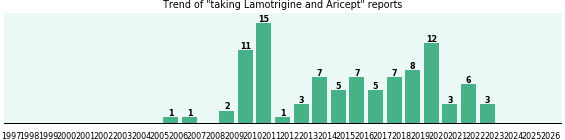
The phase IV clinical study analyzes what interactions people have when they take Lamotrigine and Aricept. It is created by eHealthMe based on reports of 97 people who take the same drugs from the FDA, and is updated regularly.
What is Lamotrigine?
Lamotrigine has active ingredients of lamotrigine. It is often used in bipolar disorder. eHealthMe is studying from 76,638 Lamotrigine users. Check the latest studies of Lamotrigine.
What is Aricept?
Aricept has active ingredients of donepezil hydrochloride. It is often used in alzheimer's disease. eHealthMe is studying from 24,756 Aricept users. Check the latest studies of Aricept.
97 people who take Lamotrigine and Aricept together, and have interactions are studied.
What are the common drug interactions of Lamotrigine and Aricept, by gender? *:
female:
- Headache (pain in head)
- Nausea (feeling of having an urge to vomit)
- Anxiety
- Pain
- Blood pressure increased
- Cerebrovascular accident (sudden death of some brain cells due to lack of oxygen when the blood flow to the brain is impaired by blockage or rupture)
- Constipation
- Gait disturbance
- Hypotension (abnormally low blood pressure)
- Insomnia (sleeplessness)
male:
- Somnolence (a state of near-sleep, a strong desire for sleep)
- Hallucination (an experience involving the perception of something not present)
- Dizziness
- Drug hypersensitivity
- Mental impairment (a condition affecting the body, perhaps through sight or hearing loss, a mobility difficulty or a health condition)
- Microangiopathy (disease of the capillaries (very small blood vessels), in which the capillary walls become so thick and weak that they bleed, leak protein)
- Neoplasm malignant (cancer tumour)
- Vision blurred
- Depression
- Gait disturbance
What are the common drug interactions of Lamotrigine and Aricept, by age (0-1 to 60+)? *:
0-1:
n/a
2-9:
n/a
10-19:
n/a
20-29:
n/a
30-39:
n/a
40-49:
- Hypotension (abnormally low blood pressure)
- Asthenia (weakness)
- Confusional state
- Disorientation (disability in which the senses of time, direction, and recognition of people and places)
- Dizziness
- Gait disturbance
- Incoherent (talking in a confused and unclear way)
- Pyrexia (fever)
- Subdural effusion (collection of fluid trapped between the surface of the brain and the outer lining of the brain)
- Syncope (loss of consciousness with an inability to maintain postural tone)
50-59:
- Arthralgia (joint pain)
- Asthenia (weakness)
- Blood viscosity increased
- Breast cancer
- Convulsion (muscles contract and relax rapidly and repeatedly, resulting in an uncontrolled shaking of the body)
- Depression
- Dizziness
- Drug hypersensitivity
- Granulocytopenia (lack of granulocyte)
- Hordeolum (small collection of pus (abscess) on the eyelid)
60+:
- Somnolence (a state of near-sleep, a strong desire for sleep)
- Hallucination (an experience involving the perception of something not present)
- Gait disturbance
- Aphasia (damage to the parts of the brain that control language)
- Cerebral arteriosclerosis (thickening and hardening of the walls of the arteries in the brain)
- Drug hypersensitivity
- Mental impairment (a condition affecting the body, perhaps through sight or hearing loss, a mobility difficulty or a health condition)
- Microangiopathy (disease of the capillaries (very small blood vessels), in which the capillary walls become so thick and weak that they bleed, leak protein)
- Neoplasm malignant (cancer tumour)
- Vision blurred
What are the existing conditions these people have? *
- Insomnia (sleeplessness): 18 people, 18.56%
- Pain: 15 people, 15.46%
- Depression: 13 people, 13.40%
- High Blood Pressure: 12 people, 12.37%
- Memory Loss: 11 people, 11.34%
- Hypertonic Bladder (bladder-storage function that causes a sudden urge to urinate): 10 people, 10.31%
- Seizures (abnormal excessive or synchronous neuronal activity in the brain): 10 people, 10.31%
- High Blood Cholesterol: 9 people, 9.28%
- Blood Pressure Abnormal: 8 people, 8.25%
- Cardiac Disorder: 8 people, 8.25%
* Approximation only. Some reports may have incomplete information.
Do you take Lamotrigine and Aricept?
- Personalize this study to your gender, age, symptoms and drugs
- Predict drug outcomes for up to one year with AI
- Get an AI agent to monitor your drugs continuously
Related studies:
Effectiveness of, side effects of, and alternative drugs to the 2 drugs:
- Lamotrigine (76,638 reports)
- Aricept (24,756 reports)
Browse all drug interactions of Lamotrigine and Aricept:
a b c d e f g h i j k l m n o p q r s t u v w x y zSub-studies by gender and age:
Female: 0-1 2-9 10-19 20-29 30-39 40-49 50-59 60+
Male: 0-1 2-9 10-19 20-29 30-39 40-49 50-59 60+
Browse all side effects of Lamotrigine:
a b c d e f g h i j k l m n o p q r s t u v w x y zBrowse all side effects of Aricept:
a b c d e f g h i j k l m n o p q r s t u v w x y zBrowse all interactions between Lamotrigine and drugs from A to Z:
a b c d e f g h i j k l m n o p q r s t u v w x y zBrowse all interactions between Aricept and drugs from A to Z:
a b c d e f g h i j k l m n o p q r s t u v w x y zRelated publications that referenced our studies
- Alonso-Navarro H, Montes JM, Plaza-Nieto JF, Jiménez-Jiménez FJ, "Cataplexy Possibly Associated With Lamotrigine", Journal of clinical psychopharmacology, 2016 Aug .
- Gupta MC, Khanna J, Mathur R, Mittal N, "Lamotrigine-induced fulminant hepatic failure: an unusual presentation", IMSEAR, 2015 Jan .
- Alonso-Navarro H, Montes JM, Plaza-Nieto JF, Jiménez-Jiménez FJ, "Cataplexy Possibly Associated With Lamotrigine", Journal of clinical psychopharmacology, 2016 Aug .
- Gupta MC, Khanna J, Mathur R, Mittal N, "Lamotrigine-induced fulminant hepatic failure: an unusual presentation", IMSEAR, 2015 Jan .
How the study uses the data?
The study uses data from the FDA. It is based on lamotrigine and donepezil hydrochloride (the active ingredients of Lamotrigine and Aricept, respectively), and Lamotrigine and Aricept (the brand names). Other drugs that have the same active ingredients (e.g. generic drugs) are not considered. Dosage of drugs is not considered in the study.
How to use the study?
DO NOT STOP MEDICATIONS without first consulting your doctor. If there are any serious or long term adverse effects discovered in the study, discuss the study with your doctor to ensure that proper medication management will be in place if applicable.
Who is eHealthMe?
With medical big data and proven AI/ML algorithms, eHealthMe provides a platform for everyone to run phase IV clinical trials. We study millions of patients and 5,000 more each day. Results of our real-world drug study have been referenced on 800+ peer-reviewed medical publications, including The Lancet, Mayo Clinic Proceedings, and Nature. Our analysis results are available to researchers, health care professionals, patients (testimonials), and software developers (open API).
WARNING, DISCLAIMER, USE FOR PUBLICATION
WARNING: Please DO NOT STOP MEDICATIONS without first consulting a physician since doing so could be hazardous to your health.
DISCLAIMER: All material available on eHealthMe.com is for informational purposes only, and is not a substitute for medical advice, diagnosis, or treatment provided by a qualified healthcare provider. All information is observation-only. Our phase IV clinical studies alone cannot establish cause-effect relationship. Different individuals may respond to medication in different ways. Every effort has been made to ensure that all information is accurate, up-to-date, and complete, but no guarantee is made to that effect. The use of the eHealthMe site and its content is at your own risk.
If you use this eHealthMe study on publication, please acknowledge it with a citation: study title, URL, accessed date.
Recent studies on eHealthMe:
- Sneezing and drugs of ingredients of mesalamine - 6 seconds ago
- Could Kayexalate cause Dyspnea? - 11 seconds ago
- Could Feldene cause Hepatomegaly? - 16 seconds ago
- Hypospadias and drugs of ingredients of alprazolam - 26 seconds ago
- Revlimid and Fatigue for Women aged 40-49 - 27 seconds ago
- Revlimid and Exhaustion, Fatigue, Lethargy, Tiredness, Weariness for Women aged 40-49 - 27 seconds ago
- Revlimid and Weariness for Women aged 40-49 - 27 seconds ago
- Revlimid and Lethargy for Women aged 40-49 - 28 seconds ago
- Revlimid and Exhaustion for Women aged 40-49 - 28 seconds ago
- Revlimid and Tiredness for Women aged 40-49 - 28 seconds ago