Lidocaine and Atacand drug interactions - a phase IV clinical study of FDA data
Summary:
Drug interactions are reported among people who take Lidocaine (lidocaine) and Atacand (candesartan cilexetil). Common drug interactions include weight decreased among females and anxiety among males.
The phase IV clinical study analyzes what interactions people have when they take Lidocaine and Atacand. It is created by eHealthMe based on reports of 86 people who take the same drugs from the FDA, and is updated regularly.
What is Lidocaine?
Lidocaine has active ingredients of lidocaine. It is often used in pain. eHealthMe is studying from 27,555 Lidocaine users. Check the latest studies of Lidocaine.
What is Atacand?
Atacand has active ingredients of candesartan cilexetil. It is often used in high blood pressure. eHealthMe is studying from 22,473 Atacand users. Check the latest studies of Atacand.
86 people who take Lidocaine and Atacand together, and have interactions are studied.
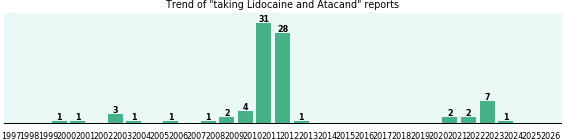
What are the common drug interactions of Lidocaine and Atacand, by gender? *:
female:
- Weight decreased
- Palpitations (feelings or sensations that your heart is pounding or racing)
- Dizziness
- Headache (pain in head)
- Abdominal distension
- Anaemia (lack of blood)
- Blood triglycerides increased
- Hypoaesthesia (reduced sense of touch or sensation)
- Insomnia (sleeplessness)
- Platelet count decreased
male:
- Anxiety
- Injury
- Coronary artery disease (plaque building up along the inner walls of the arteries of the heart, which narrows the arteries and restricts blood flow to the heart)
- Ingrowing nail
- Nephrolithiasis (calculi in the kidneys)
- Pain in extremity
- Paronychia (infection in the tissues adjacent to a nail on a finger or toe)
- Back pain
- Bone erosion
- Dental caries
What are the common drug interactions of Lidocaine and Atacand, by age (0-1 to 60+)? *:
0-1:
n/a
2-9:
n/a
10-19:
n/a
20-29:
- Abdominal distension
- Anaemia (lack of blood)
- Arterial occlusive disease (slow process through which arteries throughout the body become progressively narrowed and eventually completely blocked)
- Arteriosclerosis coronary artery (thickening and hardening of arteries- coronary artery)
- Blood triglycerides increased
- Burning sensation
- Carbuncle (a carbuncle is an abscess larger than a boil)
- Convulsion (muscles contract and relax rapidly and repeatedly, resulting in an uncontrolled shaking of the body)
- Cystitis (inflammation of the wall of the bladder)
- Dizziness
30-39:
- Depression
- Anxiety
- Decreased appetite
- Emotional distress
- Fear
- Injury
- Multi-organ failure (multisystem organ failure)
- Nervousness
- Overdose
- Renal failure (kidney dysfunction)
40-49:
- Dyspnoea (difficult or laboured respiration)
- Hepatic steatosis (fatty liver disease)
- Pleural effusion (water on the lungs)
- Pneumonia
- Pulmonary fibrosis (formation or development of excess fibrous connective tissue (fibrosis) in the lungs)
- Rash
- Upper respiratory tract infection
- Anal abscess
- Blood glucose decreased
- Diabetes mellitus (diabetes, caused by a deficiency of the pancreatic hormone insulin)
50-59:
- Blood triglycerides increased
- Platelet count decreased
- Insomnia (sleeplessness)
- Arterial occlusive disease (slow process through which arteries throughout the body become progressively narrowed and eventually completely blocked)
- Carbuncle (a carbuncle is an abscess larger than a boil)
- Drug ineffective
- Gallbladder disorder
- Haemoglobin decreased
- Kidney infection
- Lung neoplasm (tumour of lung)
60+:
- Burning sensation
- Loss of consciousness
- Anaemia (lack of blood)
- Hypoaesthesia (reduced sense of touch or sensation)
- Fall
- Full blood count decreased
- Injury
- Insomnia (sleeplessness)
- Renal failure (kidney dysfunction)
- Renal failure acute (rapid kidney dysfunction)
What are the existing conditions these people have? *
- Convulsion (muscles contract and relax rapidly and repeatedly, resulting in an uncontrolled shaking of the body): 26 people, 30.23%
- Anaesthesia: 18 people, 20.93%
- Ingrowing Nail: 16 people, 18.60%
- Multiple Myeloma (cancer of the plasma cells): 11 people, 12.79%
- Blood Pressure Abnormal: 11 people, 12.79%
- Metastases To Bone (cancer spreads to bone): 10 people, 11.63%
- High Blood Cholesterol: 10 people, 11.63%
- Joint Pain: 8 people, 9.30%
- Trigger Finger: 6 people, 6.98%
- Renal Disorder (kidney disease): 6 people, 6.98%
* Approximation only. Some reports may have incomplete information.
Do you take Lidocaine and Atacand?
- Personalize this study to your gender, age, symptoms and drugs
- Predict drug outcomes for up to one year with AI
- Get an AI agent to monitor your drugs continuously
Related studies:
Effectiveness of, side effects of, and alternative drugs to the 2 drugs:
Browse all drug interactions of Lidocaine and Atacand:
a b c d e f g h i j k l m n o p q r s t u v w x y zSub-studies by gender and age:
Female: 0-1 2-9 10-19 20-29 30-39 40-49 50-59 60+
Male: 0-1 2-9 10-19 20-29 30-39 40-49 50-59 60+
Browse all side effects of Lidocaine:
a b c d e f g h i j k l m n o p q r s t u v w x y zBrowse all side effects of Atacand:
a b c d e f g h i j k l m n o p q r s t u v w x y zBrowse all interactions between Lidocaine and drugs from A to Z:
a b c d e f g h i j k l m n o p q r s t u v w x y zBrowse all interactions between Atacand and drugs from A to Z:
a b c d e f g h i j k l m n o p q r s t u v w x y zHow the study uses the data?
The study uses data from the FDA. It is based on lidocaine and candesartan cilexetil (the active ingredients of Lidocaine and Atacand, respectively), and Lidocaine and Atacand (the brand names). Other drugs that have the same active ingredients (e.g. generic drugs) are not considered. Dosage of drugs is not considered in the study.
How to use the study?
DO NOT STOP MEDICATIONS without first consulting your doctor. If there are any serious or long term adverse effects discovered in the study, discuss the study with your doctor to ensure that proper medication management will be in place if applicable.
Who is eHealthMe?
With medical big data and proven AI/ML algorithms, eHealthMe provides a platform for everyone to run phase IV clinical trials. We study millions of patients and 5,000 more each day. Results of our real-world drug study have been referenced on 800+ peer-reviewed medical publications, including The Lancet, Mayo Clinic Proceedings, and Nature. Our analysis results are available to researchers, health care professionals, patients (testimonials), and software developers (open API).
WARNING, DISCLAIMER, USE FOR PUBLICATION
WARNING: Please DO NOT STOP MEDICATIONS without first consulting a physician since doing so could be hazardous to your health.
DISCLAIMER: All material available on eHealthMe.com is for informational purposes only, and is not a substitute for medical advice, diagnosis, or treatment provided by a qualified healthcare provider. All information is observation-only. Our phase IV clinical studies alone cannot establish cause-effect relationship. Different individuals may respond to medication in different ways. Every effort has been made to ensure that all information is accurate, up-to-date, and complete, but no guarantee is made to that effect. The use of the eHealthMe site and its content is at your own risk.
If you use this eHealthMe study on publication, please acknowledge it with a citation: study title, URL, accessed date.
Recent studies on eHealthMe:
- Could Humulin R cause Convulsion? - 2 seconds ago
- Drug interactions of Selenium Sulfide and Acidophilus - 3 seconds ago
- Could Duspatal cause Diastolic Dysfunction? - 5 seconds ago
- Could Ibu cause Incision Site Infection? - 5 seconds ago
- Could Calcium cause Hypopnea? - 6 seconds ago
- Drug interactions of Xolair and Maxzide - 9 seconds ago
- Drug interactions of Minocycline Hydrochloride and Thiamine Hydrochloride - 10 seconds ago
- Drug interactions of Zocor and Famotidine - 11 seconds ago
- Could Losartan Potassium cause Drug Eruption? - 11 seconds ago
- Could Indapamide cause Dermatitis? - 21 seconds ago