Maxzide-25 and Ambien drug interactions - a phase IV clinical study of FDA data
Summary:
Drug interactions are reported among people who take Maxzide-25 (hydrochlorothiazide; triamterene) and Ambien (zolpidem tartrate). Common drug interactions include bronchitis among females.
The phase IV clinical study analyzes what interactions people have when they take Maxzide-25 and Ambien. It is created by eHealthMe based on reports of 13 people who take the same drugs from the FDA, and is updated regularly.
What is Maxzide-25?
Maxzide-25 has active ingredients of hydrochlorothiazide; triamterene. It is often used in high blood pressure. eHealthMe is studying from 231 Maxzide-25 users. Check the latest studies of Maxzide-25.
What is Ambien?
Ambien has active ingredients of zolpidem tartrate. It is often used in insomnia. eHealthMe is studying from 93,519 Ambien users. Check the latest studies of Ambien.
13 people who take Maxzide-25 and Ambien together, and have interactions are studied.
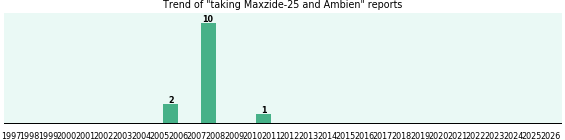
What are the common drug interactions of Maxzide-25 and Ambien, by gender? *:
female:
- Bronchitis (inflammation of the mucous membrane in the bronchial tubes)
- Eustachian tube dysfunction (eustachian tube problems like clearing the ears when flying, suffering infection, and recurring ear infection)
- Chest pain
- Dysuria (painful or difficult urination)
- Fall
- Hallucination (an experience involving the perception of something not present)
- Mental status changes (general changes in brain function, such as confusion, amnesia (memory loss), loss of alertness, loss of orientation)
- Papilloedema (optic disc swelling)
- Productive cough
- Rib fracture
male:
n/a
What are the common drug interactions of Maxzide-25 and Ambien, by age (0-1 to 60+)? *:
0-1:
n/a
2-9:
n/a
10-19:
n/a
20-29:
n/a
30-39:
n/a
40-49:
- Candidiasis (candidiasis or thrush is a fungal infection)
- Dysuria (painful or difficult urination)
- Papilloedema (optic disc swelling)
- Productive cough
50-59:
n/a
60+:
- Bronchitis (inflammation of the mucous membrane in the bronchial tubes)
- Eustachian tube dysfunction (eustachian tube problems like clearing the ears when flying, suffering infection, and recurring ear infection)
- Fall
- Hallucination (an experience involving the perception of something not present)
- Mental status changes (general changes in brain function, such as confusion, amnesia (memory loss), loss of alertness, loss of orientation)
- Rib fracture
- Otitis media acute (rapid inflammation of the middle ear)
- Pathological gambling
- Pharyngitis (inflammation of the pharynx, causing a sore throat)
- Psychiatric symptom
What are the existing conditions these people have? *
- Restless Leg Syndrome (a powerful urge to move your legs): 11 people, 84.62%
- Systemic Lupus Erythematosus (an autoimmune disease, which means the body's immune system mistakenly, attacks healthy tissue): 10 people, 76.92%
- Stress And Anxiety: 10 people, 76.92%
- Panic Disorder: 10 people, 76.92%
- Ear Barotrauma (discomfort and possible damage in the ear due to pressure differences between the inside and outside of the eardrum): 10 people, 76.92%
- Bronchitis (inflammation of the mucous membrane in the bronchial tubes): 10 people, 76.92%
- Allergic Rhinitis: 10 people, 76.92%
- Sinusitis (inflammation of sinus): 9 people, 69.23%
- Multiple Sclerosis (a nervous system disease that affects your brain and spinal cord. it damages the myelin sheath): 1 person, 7.69%
* Approximation only. Some reports may have incomplete information.
Do you take Maxzide-25 and Ambien?
- Personalize this study to your gender, age, symptoms and drugs
- Predict drug outcomes for up to one year with AI
- Get an AI agent to monitor your drugs continuously
Related studies:
Effectiveness of, side effects of, and alternative drugs to the 2 drugs:
- Maxzide-25 (231 reports)
- Ambien (93,519 reports)
Browse all drug interactions of Maxzide-25 and Ambien:
a b c d e f g h i j k l m n o p q r s t u v w x y zSub-studies by gender and age:
Female: 0-1 2-9 10-19 20-29 30-39 40-49 50-59 60+
Male: 0-1 2-9 10-19 20-29 30-39 40-49 50-59 60+
Browse all side effects of Maxzide-25:
a b c d e f g h i j k l m n o p q r s t u v w x y zBrowse all side effects of Ambien:
a b c d e f g h i j k l m n o p q r s t u v w x y zBrowse all interactions between Maxzide-25 and drugs from A to Z:
a b c d e f g h i j k l m n o p q r s t u v w x y zBrowse all interactions between Ambien and drugs from A to Z:
a b c d e f g h i j k l m n o p q r s t u v w x y zRelated publications that referenced our studies
- Hsu FG, Sheu MJ, Lin CL, Hsieh YW, Lai SW, "Use of Zolpidem and Risk of Acute Pyelonephritis in Women: A Population‐Based Case‐Control Study in Taiwan", The Journal of Clinical Pharmacology, 2017 Mar .
- Lin SC, Su YC, Huang YS, Lee CC, "Zolpidem increased cancer risk in patients with sleep disorder: A 3-year follow-up study", Journal of Medical Sciences, 2016 Mar .
- Sun Y, Lin CC, Lu CJ, Hsu CY, Kao CH, "Association between zolpidem and suicide: a nationwide population-based case-control study", InMayo Clinic Proceedings, 2016 Mar .
- Liao KF, Lin CL, Lai SW, Chen WC, "Zolpidem use associated with increased risk of pyogenic liver abscess: a case-control study in Taiwan", Medicine, 2015 Jan .
- Hsu FG, Sheu MJ, Lin CL, Hsieh YW, Lai SW, "Use of Zolpidem and Risk of Acute Pyelonephritis in Women: A Population‐Based Case‐Control Study in Taiwan", The Journal of Clinical Pharmacology, 2017 Mar .
- Lin SC, Su YC, Huang YS, Lee CC, "Zolpidem increased cancer risk in patients with sleep disorder: A 3-year follow-up study", Journal of Medical Sciences, 2016 Mar .
- Sun Y, Lin CC, Lu CJ, Hsu CY, Kao CH, "Association between zolpidem and suicide: a nationwide population-based case-control study", InMayo Clinic Proceedings, 2016 Mar .
- Liao KF, Lin CL, Lai SW, Chen WC, "Zolpidem use associated with increased risk of pyogenic liver abscess: a case-control study in Taiwan", Medicine, 2015 Jan .
How the study uses the data?
The study uses data from the FDA. It is based on hydrochlorothiazide; triamterene and zolpidem tartrate (the active ingredients of Maxzide-25 and Ambien, respectively), and Maxzide-25 and Ambien (the brand names). Other drugs that have the same active ingredients (e.g. generic drugs) are not considered. Dosage of drugs is not considered in the study.
How to use the study?
DO NOT STOP MEDICATIONS without first consulting your doctor. If there are any serious or long term adverse effects discovered in the study, discuss the study with your doctor to ensure that proper medication management will be in place if applicable.
Who is eHealthMe?
With medical big data and proven AI/ML algorithms, eHealthMe provides a platform for everyone to run phase IV clinical trials. We study millions of patients and 5,000 more each day. Results of our real-world drug study have been referenced on 800+ peer-reviewed medical publications, including The Lancet, Mayo Clinic Proceedings, and Nature. Our analysis results are available to researchers, health care professionals, patients (testimonials), and software developers (open API).
WARNING, DISCLAIMER, USE FOR PUBLICATION
WARNING: Please DO NOT STOP MEDICATIONS without first consulting a physician since doing so could be hazardous to your health.
DISCLAIMER: All material available on eHealthMe.com is for informational purposes only, and is not a substitute for medical advice, diagnosis, or treatment provided by a qualified healthcare provider. All information is observation-only. Our phase IV clinical studies alone cannot establish cause-effect relationship. Different individuals may respond to medication in different ways. Every effort has been made to ensure that all information is accurate, up-to-date, and complete, but no guarantee is made to that effect. The use of the eHealthMe site and its content is at your own risk.
If you use this eHealthMe study on publication, please acknowledge it with a citation: study title, URL, accessed date.
Recent studies on eHealthMe:
- Drug interactions of Suboxone and Zyrtec - now
- Could Estrace cause Infusion Site Urticaria? - a second ago
- Could Escitalopram cause Blindness Cortical? - 21 seconds ago
- Drug interactions of Armodafinil and Qvar - 46 seconds ago
- Could Prilosec cause Oesophageal Discomfort? - 47 seconds ago
- Could Meridia cause Swallowing Difficulty? - a minute ago
- Drug interactions of Zofran and Acetaminophen And Hydrocodone Bitartrate - a minute ago
- Could Alvesco cause Pressure Ulcer? - a minute ago
- Drug interactions of Cetirizine Hydrochloride and Tobramycin - a minute ago
- Drug interactions of Caduet and Reclast - a minute ago