Paxil cr and Ortho tri-cyclen drug interactions - a phase IV clinical study of FDA data
Summary:
Drug interactions are reported among people who take Paxil cr (paroxetine hydrochloride) and Ortho tri-cyclen (ethinyl estradiol; norgestimate). Common drug interactions include crying among females and ascites among males.
The phase IV clinical study analyzes what interactions people have when they take Paxil cr and Ortho tri-cyclen. It is created by eHealthMe based on reports of 15 people who take the same drugs from the FDA, and is updated regularly.
What is Paxil cr?
Paxil cr has active ingredients of paroxetine hydrochloride. It is often used in stress and anxiety. eHealthMe is studying from 8,322 Paxil cr users. Check the latest studies of Paxil cr.
What is Ortho tri-cyclen?
Ortho tri-cyclen has active ingredients of ethinyl estradiol; norgestimate. It is often used in birth control. eHealthMe is studying from 5,699 Ortho tri-cyclen users. Check the latest studies of Ortho tri-cyclen.
15 people who take Paxil cr and Ortho tri-cyclen together, and have interactions are studied.
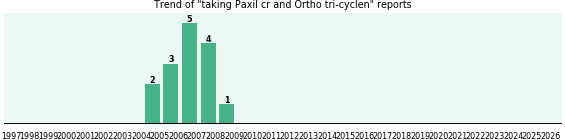
What are the common drug interactions of Paxil Cr and Ortho Tri-Cyclen, by gender? *:
female:
- Crying
- Agitation (state of anxiety or nervous excitement)
- Conversion disorder (neurological symptoms, such as numbness, blindness, paralysis, or fits without a definable organic cause)
- Derealisation
- Dissociation
- Drug ineffective
- Feeling of despair
- Hair colour changes
- Hypoaesthesia (reduced sense of touch or sensation)
- Nausea (feeling of having an urge to vomit)
male:
- Ascites (accumulation of fluid in the abdominal cavity)
- Cardiomegaly (increased size of heart than normal)
- Pleural effusion (water on the lungs)
- Skin oedema (swelling of skin)
- Cardiac failure
- Foetal disorder (fetus disease)
- Drug exposure during pregnancy
- Hydrops foetalis (fetus characterized by an accumulation of fluid)
- Intra-uterine death
- Localised oedema (fluid retention in a particular part of the body)
What are the common drug interactions of Paxil Cr and Ortho Tri-Cyclen, by age (0-1 to 60+)? *:
0-1:
n/a
2-9:
n/a
10-19:
- Diabetes mellitus (diabetes, caused by a deficiency of the pancreatic hormone insulin)
- Diabetes mellitus inadequate control
- Gastric disorder (disease of stomach)
- Glucose tolerance impaired (blood glucose is raised beyond normal levels, but not high enough to warrant a diabetes diagnosis)
- Hyperglycaemia (high blood sugar)
- Hyperinsulinaemia (excess levels of insulin circulating in the blood)
- Metabolic syndrome (a combination of the medical disorders that, when occurring together, increase the risk of developing cardiovascular disease)
- Obesity (having too much body fat)
- Weight increased
20-29:
- Hair colour changes
- Headache (pain in head)
- Hypoaesthesia (reduced sense of touch or sensation)
- Motion sickness (travel sickness)
- Nausea (feeling of having an urge to vomit)
- Crying
- Agitation (state of anxiety or nervous excitement)
- Conversion disorder (neurological symptoms, such as numbness, blindness, paralysis, or fits without a definable organic cause)
- Derealisation
- Dissociation
30-39:
- Constipation
- Drug ineffective
- Increased appetite
40-49:
n/a
50-59:
n/a
60+:
n/a
What are the existing conditions these people have? *
- Depression: 13 people, 86.67%
- Pain: 2 people, 13.33%
- Nausea (feeling of having an urge to vomit): 2 people, 13.33%
- Multiple Allergies (allergy to multiple agents): 2 people, 13.33%
- Irritable Bowel Syndrome: 2 people, 13.33%
- Hypothyroidism (abnormally low activity of the thyroid gland, resulting in retardation of growth and mental development): 2 people, 13.33%
- Bladder Spasm: 2 people, 13.33%
- Asthma: 2 people, 13.33%
- Post-Traumatic Stress Disorder: 1 person, 6.67%
- Polycystic Ovary Disease (cysts in the ovaries that occurs when the follicle stops developing): 1 person, 6.67%
* Approximation only. Some reports may have incomplete information.
Do you take Paxil cr and Ortho tri-cyclen?
- Personalize this study to your gender, age, symptoms and drugs
- Predict drug outcomes for up to one year with AI
- Get an AI agent to monitor your drugs continuously
Related studies:
Effectiveness of, side effects of, and alternative drugs to the 2 drugs:
- Paxil cr (8,322 reports)
- Ortho tri-cyclen (5,699 reports)
Browse all drug interactions of Paxil cr and Ortho tri-cyclen:
a b c d e f g h i j k l m n o p q r s t u v w x y zSub-studies by gender and age:
Female: 0-1 2-9 10-19 20-29 30-39 40-49 50-59 60+
Male: 0-1 2-9 10-19 20-29 30-39 40-49 50-59 60+
Browse all side effects of Paxil cr:
a b c d e f g h i j k l m n o p q r s t u v w x y zBrowse all side effects of Ortho tri-cyclen:
a b c d e f g h i j k l m n o p q r s t u v w x y zBrowse all interactions between Paxil cr and drugs from A to Z:
a b c d e f g h i j k l m n o p q r s t u v w x y zBrowse all interactions between Ortho tri-cyclen and drugs from A to Z:
a b c d e f g h i j k l m n o p q r s t u v w x y zRelated publications that referenced our studies
- Coskun M, Adak I, Akaltun I, "Bilateral gynecomastia in a preadolescent boy while under treatment with methylphenidate and paroxetine", Journal of clinical psychopharmacology, 2014 Aug .
- Coskun M, Adak I, Akaltun I, "Bilateral gynecomastia in a preadolescent boy while under treatment with methylphenidate and paroxetine", Journal of clinical psychopharmacology, 2014 Aug .
How the study uses the data?
The study uses data from the FDA. It is based on paroxetine hydrochloride and ethinyl estradiol; norgestimate (the active ingredients of Paxil cr and Ortho tri-cyclen, respectively), and Paxil cr and Ortho tri-cyclen (the brand names). Other drugs that have the same active ingredients (e.g. generic drugs) are not considered. Dosage of drugs is not considered in the study.
How to use the study?
DO NOT STOP MEDICATIONS without first consulting your doctor. If there are any serious or long term adverse effects discovered in the study, discuss the study with your doctor to ensure that proper medication management will be in place if applicable.
Who is eHealthMe?
With medical big data and proven AI/ML algorithms, eHealthMe provides a platform for everyone to run phase IV clinical trials. We study millions of patients and 5,000 more each day. Results of our real-world drug study have been referenced on 800+ peer-reviewed medical publications, including The Lancet, Mayo Clinic Proceedings, and Nature. Our analysis results are available to researchers, health care professionals, patients (testimonials), and software developers (open API).
WARNING, DISCLAIMER, USE FOR PUBLICATION
WARNING: Please DO NOT STOP MEDICATIONS without first consulting a physician since doing so could be hazardous to your health.
DISCLAIMER: All material available on eHealthMe.com is for informational purposes only, and is not a substitute for medical advice, diagnosis, or treatment provided by a qualified healthcare provider. All information is observation-only. Our phase IV clinical studies alone cannot establish cause-effect relationship. Different individuals may respond to medication in different ways. Every effort has been made to ensure that all information is accurate, up-to-date, and complete, but no guarantee is made to that effect. The use of the eHealthMe site and its content is at your own risk.
If you use this eHealthMe study on publication, please acknowledge it with a citation: study title, URL, accessed date.
Recent studies on eHealthMe:
- Drug interactions of Alphagan and Diovan - 3 seconds ago
- Could Albuterol Sulfate cause Menopausal Symptoms? - 4 seconds ago
- Drug interactions of Tegretol and Sutent - 4 seconds ago
- Drug interactions of Colace and Cobalamin - 8 seconds ago
- Drug interactions of Hydromorphone Hydrochloride and Almotriptan Malate - 12 seconds ago
- Could Akynzeo cause Indigestion? - 23 seconds ago
- Could Gentamicin cause Ventricular Hypertrophy? - 23 seconds ago
- Could Oracort cause Erythema Multiforme? - 25 seconds ago
- Could Combivent cause Mobility Decreased? - 37 seconds ago
- Could Zetia cause Joint Pain? - 37 seconds ago