Singulair and Tapazole drug interactions - a phase IV clinical study of FDA data
Summary:
Drug interactions are reported among people who take Singulair (montelukast sodium) and Tapazole (methimazole). Common drug interactions include bone disorder among females.
The phase IV clinical study analyzes what interactions people have when they take Singulair and Tapazole. It is created by eHealthMe based on reports of 72 people who take the same drugs from the FDA, and is updated regularly.
What is Singulair?
Singulair has active ingredients of montelukast sodium. It is often used in asthma. eHealthMe is studying from 129,752 Singulair users. Check the latest studies of Singulair.
What is Tapazole?
Tapazole has active ingredients of methimazole. It is often used in hyperthyroidism. eHealthMe is studying from 2,477 Tapazole users. Check the latest studies of Tapazole.
72 people who take Singulair and Tapazole together, and have interactions are studied.
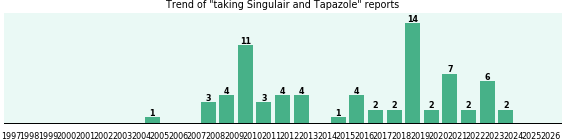
What are the common drug interactions of Singulair and Tapazole, by gender? *:
female:
- Bone disorder
- Weight decreased
- Dyspnoea (difficult or laboured respiration)
- Fall
- Nausea (feeling of having an urge to vomit)
- Pyrexia (fever)
- Cellulitis (infection under the skin)
- Gait disturbance
- Anxiety
- Asthenia (weakness)
male:
n/a
What are the common drug interactions of Singulair and Tapazole, by age (0-1 to 60+)? *:
0-1:
n/a
2-9:
n/a
10-19:
n/a
20-29:
n/a
30-39:
- Ageusia (loss of taste functions of the tongue)
- Anosmia (partial or complete loss of the sense of smell)
- Anaphylactic reaction (serious allergic reaction)
- Bronchospasm (spasm of bronchial smooth muscle producing narrowing of the bronchi)
- Drug hypersensitivity
- Dyspnoea (difficult or laboured respiration)
- Hunger
- Hypotension (abnormally low blood pressure)
- Postural orthostatic tachycardia syndrome (abnormal increase in heart rate on becoming upright)
- Sleep apnoea syndrome (a sleep-related disorder in which the effort to breathe is diminished or absent)
40-49:
- Left ventricular hypertrophy (the thickening of the myocardium (muscle) of the left ventricle of the heart)
- Mitral valve incompetence (inefficient heart valve)
- Oedema peripheral (superficial swelling)
- Orthopnoea (shortness of breath (dyspnea) when lying down)
- Productive cough
- Sinus tachycardia (a heart rhythm with elevated rate of impulses originating from the sinoatrial node)
- Tricuspid valve incompetence (inefficient heart valve)
- Abdominal discomfort
- Abdominal distension
- Adrenocortical insufficiency acute (suddenly adrenal glands do not produce adequate amounts of steroid hormones)
50-59:
- Burning sensation
- Rash pruritic (redness with itching)
60+:
- Bone disorder
- Swelling
- Fall
- Fatigue (feeling of tiredness)
- Bronchial secretion retention
- Cellulitis (infection under the skin)
- Gait disturbance
- Muscle atrophy (a decrease in the mass of the muscle)
- Nausea (feeling of having an urge to vomit)
- Accident
What are the existing conditions these people have? *
- High Blood Pressure: 30 people, 41.67%
- Hypersensitivity: 27 people, 37.50%
- Thyroid Diseases: 26 people, 36.11%
- Productive Cough: 25 people, 34.72%
- Bronchopulmonary Aspergillosis Allergic (allergic lung disorder caused by aspergillus fungi): 25 people, 34.72%
- Bronchitis (inflammation of the mucous membrane in the bronchial tubes): 25 people, 34.72%
- Blood Immunoglobulin E Increased: 25 people, 34.72%
- Depression: 23 people, 31.94%
- Stress And Anxiety: 19 people, 26.39%
- Sputum Discolored: 18 people, 25.00%
* Approximation only. Some reports may have incomplete information.
Do you take Singulair and Tapazole?
- Personalize this study to your gender, age, symptoms and drugs
- Predict drug outcomes for up to one year with AI
- Get an AI agent to monitor your drugs continuously
Related studies:
Effectiveness of, side effects of, and alternative drugs to the 2 drugs:
Browse all drug interactions of Singulair and Tapazole:
a b c d e f g h i j k l m n o p q r s t u v w x y zSub-studies by gender and age:
Female: 0-1 2-9 10-19 20-29 30-39 40-49 50-59 60+
Male: 0-1 2-9 10-19 20-29 30-39 40-49 50-59 60+
Browse all side effects of Singulair:
a b c d e f g h i j k l m n o p q r s t u v w x y zBrowse all side effects of Tapazole:
a b c d e f g h i j k l m n o p q r s t u v w x y zBrowse all interactions between Singulair and drugs from A to Z:
a b c d e f g h i j k l m n o p q r s t u v w x y zBrowse all interactions between Tapazole and drugs from A to Z:
a b c d e f g h i j k l m n o p q r s t u v w x y zRelated publications that referenced our studies
- Das S, Mondal S, Dey JK, Bandyopadhyay S, Saha I, Tripathi SK, "A case of montelukast induced hypercholesterolemia, severe hypertriglyceridemia and pancreatitis", Journal of Young Pharmacists, 2013 Jun .
- Das S, Mondal S, Dey JK, Bandyopadhyay S, Saha I, Tripathi SK, "A case of montelukast induced hypercholesterolemia, severe hypertriglyceridemia and pancreatitis", Journal of Young Pharmacists, 2013 Jun .
How the study uses the data?
The study uses data from the FDA. It is based on montelukast sodium and methimazole (the active ingredients of Singulair and Tapazole, respectively), and Singulair and Tapazole (the brand names). Other drugs that have the same active ingredients (e.g. generic drugs) are not considered. Dosage of drugs is not considered in the study.
How to use the study?
DO NOT STOP MEDICATIONS without first consulting your doctor. If there are any serious or long term adverse effects discovered in the study, discuss the study with your doctor to ensure that proper medication management will be in place if applicable.
Who is eHealthMe?
With medical big data and proven AI/ML algorithms, eHealthMe provides a platform for everyone to run phase IV clinical trials. We study millions of patients and 5,000 more each day. Results of our real-world drug study have been referenced on 800+ peer-reviewed medical publications, including The Lancet, Mayo Clinic Proceedings, and Nature. Our analysis results are available to researchers, health care professionals, patients (testimonials), and software developers (open API).
WARNING, DISCLAIMER, USE FOR PUBLICATION
WARNING: Please DO NOT STOP MEDICATIONS without first consulting a physician since doing so could be hazardous to your health.
DISCLAIMER: All material available on eHealthMe.com is for informational purposes only, and is not a substitute for medical advice, diagnosis, or treatment provided by a qualified healthcare provider. All information is observation-only. Our phase IV clinical studies alone cannot establish cause-effect relationship. Different individuals may respond to medication in different ways. Every effort has been made to ensure that all information is accurate, up-to-date, and complete, but no guarantee is made to that effect. The use of the eHealthMe site and its content is at your own risk.
If you use this eHealthMe study on publication, please acknowledge it with a citation: study title, URL, accessed date.
Recent studies on eHealthMe:
- Could Namenda cause Eye Disorder? - 3 seconds ago
- Drug interactions of Ibu and Omnitrope - 6 seconds ago
- Could Maxzide cause Rotator Cuff Syndrome? - 10 seconds ago
- Drug interactions of Periactin and Ambien - 11 seconds ago
- Could Erleada cause Hyperhidrosis? - 13 seconds ago
- Could Pentam cause Infusion Related Reaction? - 19 seconds ago
- Paroxysmal Nocturnal Haemoglobinuria and Heavy Or Prolong Menstrual Bleeding - 22 seconds ago
- Tarka vs. Zocor, side effect and effectiveness comparison - 22 seconds ago
- Paraesthesia and Headache - 24 seconds ago
- Could Adriamycin Pfs cause Drowsiness? - 29 seconds ago