Turmeric and Uloric drug interactions - a phase IV clinical study of FDA data
Summary:
Drug interactions are reported among people who take Turmeric (turmeric) and Uloric (febuxostat). Common drug interactions include dyspnoea exertional among females and drug hypersensitivity among males.
The phase IV clinical study analyzes what interactions people have when they take Turmeric and Uloric. It is created by eHealthMe based on reports of 23 people who take the same drugs from the FDA, and is updated regularly.
What is Turmeric?
Turmeric has active ingredients of turmeric. It is often used in inflammation. eHealthMe is studying from 16,563 Turmeric users. Check the latest studies of Turmeric.
What is Uloric?
Uloric has active ingredients of febuxostat. It is often used in gout. eHealthMe is studying from 8,067 Uloric users. Check the latest studies of Uloric.
23 people who take Turmeric and Uloric together, and have interactions are studied.
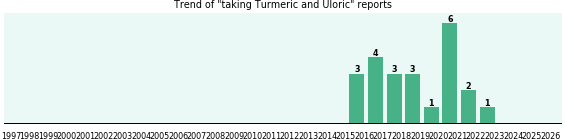
What are the common drug interactions of Turmeric and Uloric, by gender? *:
female:
- Dyspnoea exertional (breathlessness or shortness of breath)
- Infection
- Loss of consciousness
- Oxygen saturation decreased
- Pneumonia
- Sepsis (a severe blood infection that can lead to organ failure and death)
- Thrombosis (formation of a blood clot inside a blood vessel)
- Breast cancer
- Constipation
- Device related infection
male:
- Drug hypersensitivity
- Allergic sinusitis
- Limb discomfort (discomfort in leg)
- Onychoclasis (breaking of the nails)
- Post procedural haemorrhage (post procedural bleeding)
- Renal cyst (kidney cyst)
- Tremor (trembling or shaking movements in one or more parts of your body)
- Blister (small pocket of fluid within the upper layers of the skin caused by forceful rubbing (friction), burning, freezing, chemical exposure)
- Choking (mechanical obstruction of the flow of air from the environment into the lungs)
- Death
What are the common drug interactions of Turmeric and Uloric, by age (0-1 to 60+)? *:
0-1:
n/a
2-9:
n/a
10-19:
n/a
20-29:
n/a
30-39:
n/a
40-49:
n/a
50-59:
n/a
60+:
- Loss of consciousness
- Diarrhoea
- Pneumonia
- Sepsis (a severe blood infection that can lead to organ failure and death)
- Thrombosis (formation of a blood clot inside a blood vessel)
- Breast cancer
- Bruxism (habitual grinding of the teeth, typically during sleep)
- Constipation
- Death
- Device related infection
What are the existing conditions these people have? *
- Primary Myelofibrosis (primary disorder of the bone marrow): 7 people, 30.43%
- Narcolepsy (brain's inability to regulate sleep-wake cycles normally): 6 people, 26.09%
- Polycythaemia Vera (blood disorder in which the bone marrow makes too many red blood cells): 5 people, 21.74%
- Joint Pain: 5 people, 21.74%
- Bone Pain: 5 people, 21.74%
- Primary Pulmonary Hypertension (primary high blood pressure that affects the arteries in the lungs and the right side of your heart): 3 people, 13.04%
- Rheumatoid Arthritis (a chronic progressive disease causing inflammation in the joints): 2 people, 8.70%
- Renal Cell Carcinoma (a kidney cancer): 2 people, 8.70%
- Cataplexy (loss of muscle tone accompanied by full conscious awareness): 2 people, 8.70%
* Approximation only. Some reports may have incomplete information.
Do you take Turmeric and Uloric?
- Personalize this study to your gender, age, symptoms and drugs
- Predict drug outcomes for up to one year with AI
- Get an AI agent to monitor your drugs continuously
Related studies:
Effectiveness of, side effects of, and alternative drugs to the 2 drugs:
Browse all drug interactions of Turmeric and Uloric:
a b c d e f g h i j k l m n o p q r s t u v w x y zSub-studies by gender and age:
Female: 0-1 2-9 10-19 20-29 30-39 40-49 50-59 60+
Male: 0-1 2-9 10-19 20-29 30-39 40-49 50-59 60+
Browse all side effects of Turmeric:
a b c d e f g h i j k l m n o p q r s t u v w x y zBrowse all side effects of Uloric:
a b c d e f g h i j k l m n o p q r s t u v w x y zBrowse all interactions between Turmeric and drugs from A to Z:
a b c d e f g h i j k l m n o p q r s t u v w x y zBrowse all interactions between Uloric and drugs from A to Z:
a b c d e f g h i j k l m n o p q r s t u v w x y zHow the study uses the data?
The study uses data from the FDA. It is based on turmeric and febuxostat (the active ingredients of Turmeric and Uloric, respectively), and Turmeric and Uloric (the brand names). Other drugs that have the same active ingredients (e.g. generic drugs) are not considered. Dosage of drugs is not considered in the study.
How to use the study?
DO NOT STOP MEDICATIONS without first consulting your doctor. If there are any serious or long term adverse effects discovered in the study, discuss the study with your doctor to ensure that proper medication management will be in place if applicable.
Who is eHealthMe?
With medical big data and proven AI/ML algorithms, eHealthMe provides a platform for everyone to run phase IV clinical trials. We study millions of patients and 5,000 more each day. Results of our real-world drug study have been referenced on 800+ peer-reviewed medical publications, including The Lancet, Mayo Clinic Proceedings, and Nature. Our analysis results are available to researchers, health care professionals, patients (testimonials), and software developers (open API).
WARNING, DISCLAIMER, USE FOR PUBLICATION
WARNING: Please DO NOT STOP MEDICATIONS without first consulting a physician since doing so could be hazardous to your health.
DISCLAIMER: All material available on eHealthMe.com is for informational purposes only, and is not a substitute for medical advice, diagnosis, or treatment provided by a qualified healthcare provider. All information is observation-only. Our phase IV clinical studies alone cannot establish cause-effect relationship. Different individuals may respond to medication in different ways. Every effort has been made to ensure that all information is accurate, up-to-date, and complete, but no guarantee is made to that effect. The use of the eHealthMe site and its content is at your own risk.
If you use this eHealthMe study on publication, please acknowledge it with a citation: study title, URL, accessed date.
Recent studies on eHealthMe:
- Multiple Allergies and Blood Testosterone Decreased - now
- Systemic Lupus Erythematosus and Flank Pain - 15 seconds ago
- Could Triamcinolone cause Haematuria? - 19 seconds ago
- Drug interactions of Patanase and Sertraline - 33 seconds ago
- Could Nuvaring cause Stress And Anxiety? - 34 seconds ago
- Thyroid Diseases and Chronic Kidney Disease - 39 seconds ago
- Drug interactions of Glipizide and Pravachol - 44 seconds ago
- Could Advair Hfa cause Metabolic Acidosis? - 59 seconds ago
- Could Claritin-D 24 Hour cause Headache? - a minute ago
- Drug interactions of Creon and Lortab - a minute ago