Valproic acid and Polyethylene glycol 3350 drug interactions - a phase IV clinical study of FDA data
Summary:
Drug interactions are reported among people who take Valproic acid (valproic acid) and Polyethylene glycol 3350 (polyethylene glycol 3350). Common drug interactions include dermatitis diaper among females and bacteraemia among males.
The phase IV clinical study analyzes what interactions people have when they take Valproic acid and Polyethylene glycol 3350. It is created by eHealthMe based on reports of 15 people who take the same drugs from the FDA, and is updated regularly.
What is Valproic acid?
Valproic acid has active ingredients of valproic acid. It is often used in epilepsy. eHealthMe is studying from 36,193 Valproic acid users. Check the latest studies of Valproic acid.
What is Polyethylene glycol 3350?
Polyethylene glycol 3350 has active ingredients of polyethylene glycol 3350. It is often used in constipation. eHealthMe is studying from 4,407 Polyethylene glycol 3350 users. Check the latest studies of Polyethylene glycol 3350.
15 people who take Valproic acid and Polyethylene glycol 3350 together, and have interactions are studied.
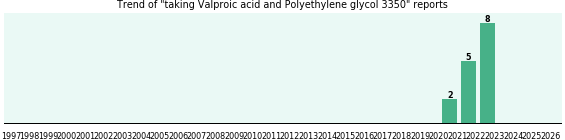
What are the common drug interactions of Valproic Acid and Polyethylene Glycol 3350, by gender? *:
female:
- Dermatitis diaper (diaper rash is a common form of inflamed skin)
- Diarrhoea
- Flatulence (flatus expelled through the anus)
- Ph urine decreased
- Skin irritation
- Abdominal discomfort
- Agitation (state of anxiety or nervous excitement)
- Depression
- Dizziness
- Dry mouth
male:
- Bacteraemia (presence of bacteria in the blood)
- Cytomegalovirus viraemia (cytomegalo virus in blood stream)
- Abdominal pain
- Agitation (state of anxiety or nervous excitement)
- Death
- Depressed mood
- Discomfort
- Drug ineffective
- Dry skin
- Eating disorder
What are the common drug interactions of Valproic Acid and Polyethylene Glycol 3350, by age (0-1 to 60+)? *:
0-1:
n/a
2-9:
- Depressed mood
10-19:
- Hospitalisation
- Infusion site pain
- Abdominal pain
- Agitation (state of anxiety or nervous excitement)
- Discomfort
- Drug ineffective
- Dry skin
- Eating disorder
- Gait disturbance
- Gastrointestinal pain
20-29:
- Skin irritation
- Death
- Dermatitis diaper (diaper rash is a common form of inflamed skin)
- Diarrhoea
- Flatulence (flatus expelled through the anus)
- Ph urine decreased
30-39:
n/a
40-49:
n/a
50-59:
n/a
60+:
- Bacteraemia (presence of bacteria in the blood)
- Cytomegalovirus viraemia (cytomegalo virus in blood stream)
- Encephalopathy (functioning of the brain is affected by some agent or condition)
- Fungaemia (fungi circulate in the blood)
- Opportunistic infection (a microorganism that normally does not cause disease but becomes pathogenic when the body's immune system is impaired and unable to fight)
- Diarrhoea
What are the existing conditions these people have? *
- Lennox-Gastaut Syndrome (epilepsy characterized by frequent seizures and different seizure types): 4 people, 26.67%
- Seizures (abnormal excessive or synchronous neuronal activity in the brain): 4 people, 26.67%
- Wheezing (a high-pitched whistling sound made while you breath): 1 person, 6.67%
- Catatonia (unresponsive to external stimuli): 1 person, 6.67%
- Cystic Fibrosis (disease of the secretary glands): 1 person, 6.67%
- Dementia (madness): 1 person, 6.67%
- Developmental Delay: 1 person, 6.67%
- Fever: 1 person, 6.67%
- Hypocalcaemia (levels of calcium in blood serum are abnormally low): 1 person, 6.67%
- Hypokalemia (low potassium): 1 person, 6.67%
* Approximation only. Some reports may have incomplete information.
Do you take Valproic acid and Polyethylene glycol 3350?
- Personalize this study to your gender, age, symptoms and drugs
- Predict drug outcomes for up to one year with AI
- Get an AI agent to monitor your drugs continuously
Related studies:
Effectiveness of, side effects of, and alternative drugs to the 2 drugs:
- Valproic acid (36,193 reports)
- Polyethylene glycol 3350 (4,407 reports)
Browse all drug interactions of Valproic acid and Polyethylene glycol 3350:
a b c d e f g h i j k l m n o p q r s t u v w x y zSub-studies by gender and age:
Female: 0-1 2-9 10-19 20-29 30-39 40-49 50-59 60+
Male: 0-1 2-9 10-19 20-29 30-39 40-49 50-59 60+
Browse all side effects of Valproic acid:
a b c d e f g h i j k l m n o p q r s t u v w x y zBrowse all side effects of Polyethylene glycol 3350:
a b c d e f g h i j k l m n o p q r s t u v w x y zBrowse all interactions between Valproic acid and drugs from A to Z:
a b c d e f g h i j k l m n o p q r s t u v w x y zBrowse all interactions between Polyethylene glycol 3350 and drugs from A to Z:
a b c d e f g h i j k l m n o p q r s t u v w x y zRelated publications that referenced our studies
- Gupta E, Kunjal R, Cury JD, "Severe hyponatremia due to valproic acid toxicity", Journal of clinical medicine research, 2015 Jan .
- Hwabejire JO, Lu J, Liu B, Li Y, Halaweish I, Alam HB, "Valproic acid for the treatment of hemorrhagic shock: a dose-optimization study", journal of surgical research, 2014 Jan .
- Gupta E, Kunjal R, Cury JD, "Severe hyponatremia due to valproic acid toxicity", Journal of clinical medicine research, 2015 Jan .
- Hwabejire JO, Lu J, Liu B, Li Y, Halaweish I, Alam HB, "Valproic acid for the treatment of hemorrhagic shock: a dose-optimization study", journal of surgical research, 2014 Jan .
How the study uses the data?
The study uses data from the FDA. It is based on valproic acid and polyethylene glycol 3350 (the active ingredients of Valproic acid and Polyethylene glycol 3350, respectively), and Valproic acid and Polyethylene glycol 3350 (the brand names). Other drugs that have the same active ingredients (e.g. generic drugs) are not considered. Dosage of drugs is not considered in the study.
How to use the study?
DO NOT STOP MEDICATIONS without first consulting your doctor. If there are any serious or long term adverse effects discovered in the study, discuss the study with your doctor to ensure that proper medication management will be in place if applicable.
Who is eHealthMe?
With medical big data and proven AI/ML algorithms, eHealthMe provides a platform for everyone to run phase IV clinical trials. We study millions of patients and 5,000 more each day. Results of our real-world drug study have been referenced on 800+ peer-reviewed medical publications, including The Lancet, Mayo Clinic Proceedings, and Nature. Our analysis results are available to researchers, health care professionals, patients (testimonials), and software developers (open API).
WARNING, DISCLAIMER, USE FOR PUBLICATION
WARNING: Please DO NOT STOP MEDICATIONS without first consulting a physician since doing so could be hazardous to your health.
DISCLAIMER: All material available on eHealthMe.com is for informational purposes only, and is not a substitute for medical advice, diagnosis, or treatment provided by a qualified healthcare provider. All information is observation-only. Our phase IV clinical studies alone cannot establish cause-effect relationship. Different individuals may respond to medication in different ways. Every effort has been made to ensure that all information is accurate, up-to-date, and complete, but no guarantee is made to that effect. The use of the eHealthMe site and its content is at your own risk.
If you use this eHealthMe study on publication, please acknowledge it with a citation: study title, URL, accessed date.
Recent studies on eHealthMe:
- Drug interactions of Prednisolone Acetate and Oncovin - now
- Zinecard and Heparin drug interactions for girls aged 10-19 - 3 seconds ago
- Corneal Oedema and drugs of ingredients of alendronate sodium - 13 seconds ago
- Alendronate Sodium and Paroxysmal Supraventricular Tachycardia for Women aged 60+ - 14 seconds ago
- Alendronate Sodium and Supraventricular Tachycardia for Women aged 60+ - 15 seconds ago
- Alendronate Sodium and Paroxysmal Supraventricular Tachycardia (Psvt) for Women aged 60+ - 15 seconds ago
- Alendronate Sodium and Psvt for Women aged 60+ - 15 seconds ago
- Alendronate Sodium and Svt for Women aged 60+ - 16 seconds ago
- Drug interactions of Myrbetriq and Flexeril - 16 seconds ago
- Caduet vs. Verapamil Hcl, side effect and effectiveness comparison - 20 seconds ago