Viagra and Nabumetone drug interactions - a phase IV clinical study of FDA data
Summary:
Drug interactions are reported among people who take Viagra (sildenafil citrate) and Nabumetone (nabumetone). Common drug interactions include bunion among females and intervertebral disc protrusion among males.
The phase IV clinical study analyzes what interactions people have when they take Viagra and Nabumetone. It is created by eHealthMe based on reports of 74 people who take the same drugs from the FDA, and is updated regularly.
What is Viagra?
Viagra has active ingredients of sildenafil citrate. It is often used in erection problems. eHealthMe is studying from 63,865 Viagra users. Check the latest studies of Viagra.
What is Nabumetone?
Nabumetone has active ingredients of nabumetone. It is often used in arthritis. eHealthMe is studying from 9,554 Nabumetone users. Check the latest studies of Nabumetone.
74 people who take Viagra and Nabumetone together, and have interactions are studied.
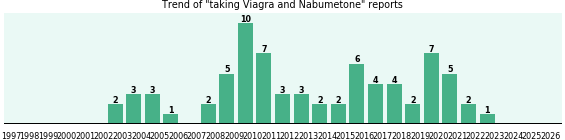
What are the common drug interactions of Viagra and Nabumetone, by gender? *:
female:
- Bunion (a painful swelling on the first joint of the big toe)
- Diarrhoea
- Drug ineffective
- Foot fracture
male:
- Intervertebral disc protrusion (spinal disc protrusion)
- Arthralgia (joint pain)
- Gait disturbance
- Gingival bleeding (bleeding gums)
- Hypoaesthesia (reduced sense of touch or sensation)
- Impaired healing
- Influenza
- Jaw disorder (jaw disease)
- Joint crepitation
- Lumbar radiculopathy (radicular pain in the low back and legs)
What are the common drug interactions of Viagra and Nabumetone, by age (0-1 to 60+)? *:
0-1:
n/a
2-9:
n/a
10-19:
n/a
20-29:
n/a
30-39:
- Arthralgia (joint pain)
- Back disorder
- Back pain
- Bone disorder
- Cardiovascular disorder (heart diseases)
- Deep vein thrombosis (blood clot in a major vein that usually develops in the legs and/or pelvis)
- Dry mouth
- Emphysema (chronic respiratory disease - over inflation of the air sacs (alveoli) in the lungs)
- Foramen magnum stenosis (opening is not large enough for the spinal cord to easily pass)
- Gait disturbance
40-49:
- Chronic kidney disease
- Anhedonia (inability to experience pleasure from activities usually found enjoyable)
- Anxiety
- Blood creatinine increased
- Depression
- Emotional distress
- Renal impairment (severely reduced kidney function)
- Renal injury (kidney injury)
- Cerebrovascular accident (sudden death of some brain cells due to lack of oxygen when the blood flow to the brain is impaired by blockage or rupture)
- Chest pain
50-59:
- Myocardial infarction (destruction of heart tissue resulting from obstruction of the blood supply to the heart muscle)
- Renal impairment (severely reduced kidney function)
- Anhedonia (inability to experience pleasure from activities usually found enjoyable)
- Anxiety
- Blood triglycerides increased
- Bone density decreased
- Cardiac failure congestive
- Chronic kidney disease
- Decreased appetite
- Diabetes mellitus (diabetes, caused by a deficiency of the pancreatic hormone insulin)
60+:
- Chronic kidney disease
- Diarrhoea
- Psoriasis (immune-mediated disease that affects the skin)
- Sensation of heaviness
- Sensation of pressure
- Drug effect decreased
- Penile pain
- Abdominal pain
- Abnormal dreams
- Adverse drug reaction
What are the existing conditions these people have? *
- Osteoporosis (bones weak and more likely to break): 15 people, 20.27%
- Narcolepsy (brain's inability to regulate sleep-wake cycles normally): 8 people, 10.81%
- Cataplexy (loss of muscle tone accompanied by full conscious awareness): 8 people, 10.81%
- High Blood Pressure: 7 people, 9.46%
- Gastroesophageal Reflux Disease (a condition in which stomach contents leak backward from the stomach into the oesophagus): 6 people, 8.11%
- Hiv Infection: 5 people, 6.76%
- High Blood Cholesterol: 5 people, 6.76%
- Back Pain: 5 people, 6.76%
- Psoriatic Arthropathy (inflammation of the skin and joints with kin condition which typically causes patches (plaques) of red, scaly skin to develop): 4 people, 5.41%
- Psoriasis (immune-mediated disease that affects the skin): 4 people, 5.41%
* Approximation only. Some reports may have incomplete information.
Do you take Viagra and Nabumetone?
- Personalize this study to your gender, age, symptoms and drugs
- Predict drug outcomes for up to one year with AI
- Get an AI agent to monitor your drugs continuously
Related studies:
Effectiveness of, side effects of, and alternative drugs to the 2 drugs:
- Viagra (63,865 reports)
- Nabumetone (9,554 reports)
Browse all drug interactions of Viagra and Nabumetone:
a b c d e f g h i j k l m n o p q r s t u v w x y zSub-studies by gender and age:
Female: 0-1 2-9 10-19 20-29 30-39 40-49 50-59 60+
Male: 0-1 2-9 10-19 20-29 30-39 40-49 50-59 60+
Browse all side effects of Viagra:
a b c d e f g h i j k l m n o p q r s t u v w x y zBrowse all side effects of Nabumetone:
a b c d e f g h i j k l m n o p q r s t u v w x y zBrowse all interactions between Viagra and drugs from A to Z:
a b c d e f g h i j k l m n o p q r s t u v w x y zBrowse all interactions between Nabumetone and drugs from A to Z:
a b c d e f g h i j k l m n o p q r s t u v w x y zRelated publications that referenced our studies
- Jeong SY, Jeon SJ, Kim YR, Choi SS, Kwak HS, "A Rare Case of Viagra Induced Toxic Encephalopathy", Investigative Magnetic Resonance Imaging, 2016 Sep .
- Hung SC, Liao KF, Hung HC, Lin CL, Lai SW, Lin CH, "Nabumetone use and risk of acute pancreatitis in a case-control study", Pancreatology, 2016 Jun .
- Jeong SY, Jeon SJ, Kim YR, Choi SS, Kwak HS, "A Rare Case of Viagra Induced Toxic Encephalopathy", Investigative Magnetic Resonance Imaging, 2016 Sep .
- Hung SC, Liao KF, Hung HC, Lin CL, Lai SW, Lin CH, "Nabumetone use and risk of acute pancreatitis in a case-control study", Pancreatology, 2016 Jun .
How the study uses the data?
The study uses data from the FDA. It is based on sildenafil citrate and nabumetone (the active ingredients of Viagra and Nabumetone, respectively), and Viagra and Nabumetone (the brand names). Other drugs that have the same active ingredients (e.g. generic drugs) are not considered. Dosage of drugs is not considered in the study.
How to use the study?
DO NOT STOP MEDICATIONS without first consulting your doctor. If there are any serious or long term adverse effects discovered in the study, discuss the study with your doctor to ensure that proper medication management will be in place if applicable.
Who is eHealthMe?
With medical big data and proven AI/ML algorithms, eHealthMe provides a platform for everyone to run phase IV clinical trials. We study millions of patients and 5,000 more each day. Results of our real-world drug study have been referenced on 800+ peer-reviewed medical publications, including The Lancet, Mayo Clinic Proceedings, and Nature. Our analysis results are available to researchers, health care professionals, patients (testimonials), and software developers (open API).
WARNING, DISCLAIMER, USE FOR PUBLICATION
WARNING: Please DO NOT STOP MEDICATIONS without first consulting a physician since doing so could be hazardous to your health.
DISCLAIMER: All material available on eHealthMe.com is for informational purposes only, and is not a substitute for medical advice, diagnosis, or treatment provided by a qualified healthcare provider. All information is observation-only. Our phase IV clinical studies alone cannot establish cause-effect relationship. Different individuals may respond to medication in different ways. Every effort has been made to ensure that all information is accurate, up-to-date, and complete, but no guarantee is made to that effect. The use of the eHealthMe site and its content is at your own risk.
If you use this eHealthMe study on publication, please acknowledge it with a citation: study title, URL, accessed date.
Recent studies on eHealthMe:
- Could Requip cause Herpes Zoster? - 24 seconds ago
- Could Sulfasalazine cause Constipation? - 28 seconds ago
- Drug interactions of Welchol and Marine Triglyceride - 29 seconds ago
- Could Sudafed cause Tooth Fracture? - 47 seconds ago
- Could Crestor cause Weight Loss? - 51 seconds ago
- Drug interactions of Avonex and Doxycycline - 58 seconds ago
- Could Strattera cause Nervous System Disorder? - a minute ago
- Could Lanoxin cause Intervertebral Disc Space Narrowing? - a minute ago
- Methadone Hydrochloride vs. Adderall, side effect and effectiveness comparison - a minute ago
- Drug interactions of Avelox and Pegasys - a minute ago