Ranexa and Viagra drug interactions - a phase IV clinical study of FDA data
Summary:
Drug interactions are reported among people who take Ranexa (ranolazine) and Viagra (sildenafil citrate). Common drug interactions include epilepsy among females and chronic kidney disease among males.
The phase IV clinical study analyzes what interactions people have when they take Ranexa and Viagra. It is created by eHealthMe based on reports of 57 people who take the same drugs from the FDA, and is updated regularly.
What is Ranexa?
Ranexa has active ingredients of ranolazine. It is often used in angina. eHealthMe is studying from 11,758 Ranexa users. Check the latest studies of Ranexa.
What is Viagra?
Viagra has active ingredients of sildenafil citrate. It is often used in erection problems. eHealthMe is studying from 63,865 Viagra users. Check the latest studies of Viagra.
57 people who take Ranexa and Viagra together, and have interactions are studied.
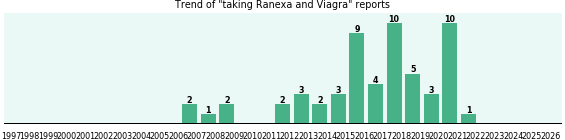
What are the common drug interactions of Ranexa and Viagra, by gender? *:
female:
- Epilepsy (common and diverse set of chronic neurological disorders characterized by seizures)
- Liver disorder (liver diseases)
- Anaemia (lack of blood)
- Chronic obstructive pulmonary disease (a progressive disease that makes it hard to breathe)
- Cough
- Renal failure acute (rapid kidney dysfunction)
- Rhabdomyolysis (a condition in which damaged skeletal muscle tissue breaks down)
- Rhinorrhoea (watery mucus discharge from the nose)
- Transaminases increased
male:
- Chronic kidney disease
- Renal failure (kidney dysfunction)
- Activities of daily living impaired
- Back disorder
- Cataract (clouding of the lens inside the eye)
- Cervical vertebral fracture
- Electric shock
- General physical health deterioration (weak health status)
- Hernia (hernia happens when part of an internal organ or tissue bulges through a weak area of muscle)
- Joint injury
What are the common drug interactions of Ranexa and Viagra, by age (0-1 to 60+)? *:
0-1:
n/a
2-9:
n/a
10-19:
n/a
20-29:
n/a
30-39:
n/a
40-49:
- Chronic kidney disease
- Epilepsy (common and diverse set of chronic neurological disorders characterized by seizures)
- Nephrogenic anaemia (anaemia due to kidney disease)
- Renal failure (kidney dysfunction)
- Anaemia (lack of blood)
- Cough
- Dyspepsia (indigestion)
- Renal failure acute (rapid kidney dysfunction)
- Rhabdomyolysis (a condition in which damaged skeletal muscle tissue breaks down)
- Rhinorrhoea (watery mucus discharge from the nose)
50-59:
- Coronary artery disease (plaque building up along the inner walls of the arteries of the heart, which narrows the arteries and restricts blood flow to the heart)
- Drug ineffective
- Accident at work
- Activities of daily living impaired
- Back disorder
- Cataract (clouding of the lens inside the eye)
- Cervical vertebral fracture
- Dyspnoea (difficult or laboured respiration)
- Electric shock
- General physical health deterioration (weak health status)
60+:
- Chronic kidney disease
- Renal failure (kidney dysfunction)
- Coronary artery disease (plaque building up along the inner walls of the arteries of the heart, which narrows the arteries and restricts blood flow to the heart)
- Death
- Fluid overload (too much fluid in the blood)
- Gastrooesophageal reflux disease (stomach contents (food or liquid) leak backwards from the stomach into the oesophagus)
- Muscular weakness (muscle weakness)
- Pain in extremity
- Pneumonia
- Syncope (loss of consciousness with an inability to maintain postural tone)
What are the existing conditions these people have? *
- High Blood Cholesterol: 16 people, 28.07%
- Gastroesophageal Reflux Disease (a condition in which stomach contents leak backward from the stomach into the oesophagus): 14 people, 24.56%
- Cardiac Disorder: 9 people, 15.79%
- Diabetes: 9 people, 15.79%
- High Blood Pressure: 8 people, 14.04%
- Pain: 7 people, 12.28%
- Sleep Disorder: 6 people, 10.53%
- Stable Angina (a constant chest pain): 5 people, 8.77%
- Hypersensitivity: 4 people, 7.02%
- Indigestion: 4 people, 7.02%
* Approximation only. Some reports may have incomplete information.
Do you take Ranexa and Viagra?
- Personalize this study to your gender, age, symptoms and drugs
- Predict drug outcomes for up to one year with AI
- Get an AI agent to monitor your drugs continuously
Related studies:
Effectiveness of, side effects of, and alternative drugs to the 2 drugs:
Browse all drug interactions of Ranexa and Viagra:
a b c d e f g h i j k l m n o p q r s t u v w x y zSub-studies by gender and age:
Female: 0-1 2-9 10-19 20-29 30-39 40-49 50-59 60+
Male: 0-1 2-9 10-19 20-29 30-39 40-49 50-59 60+
Browse all side effects of Ranexa:
a b c d e f g h i j k l m n o p q r s t u v w x y zBrowse all side effects of Viagra:
a b c d e f g h i j k l m n o p q r s t u v w x y zBrowse all interactions between Ranexa and drugs from A to Z:
a b c d e f g h i j k l m n o p q r s t u v w x y zBrowse all interactions between Viagra and drugs from A to Z:
a b c d e f g h i j k l m n o p q r s t u v w x y zRelated publications that referenced our studies
- Jeong SY, Jeon SJ, Kim YR, Choi SS, Kwak HS, "A Rare Case of Viagra Induced Toxic Encephalopathy", Investigative Magnetic Resonance Imaging, 2016 Sep .
- Jeong SY, Jeon SJ, Kim YR, Choi SS, Kwak HS, "A Rare Case of Viagra Induced Toxic Encephalopathy", Investigative Magnetic Resonance Imaging, 2016 Sep .
How the study uses the data?
The study uses data from the FDA. It is based on ranolazine and sildenafil citrate (the active ingredients of Ranexa and Viagra, respectively), and Ranexa and Viagra (the brand names). Other drugs that have the same active ingredients (e.g. generic drugs) are not considered. Dosage of drugs is not considered in the study.
How to use the study?
DO NOT STOP MEDICATIONS without first consulting your doctor. If there are any serious or long term adverse effects discovered in the study, discuss the study with your doctor to ensure that proper medication management will be in place if applicable.
Who is eHealthMe?
With medical big data and proven AI/ML algorithms, eHealthMe provides a platform for everyone to run phase IV clinical trials. We study millions of patients and 5,000 more each day. Results of our real-world drug study have been referenced on 800+ peer-reviewed medical publications, including The Lancet, Mayo Clinic Proceedings, and Nature. Our analysis results are available to researchers, health care professionals, patients (testimonials), and software developers (open API).
WARNING, DISCLAIMER, USE FOR PUBLICATION
WARNING: Please DO NOT STOP MEDICATIONS without first consulting a physician since doing so could be hazardous to your health.
DISCLAIMER: All material available on eHealthMe.com is for informational purposes only, and is not a substitute for medical advice, diagnosis, or treatment provided by a qualified healthcare provider. All information is observation-only. Our phase IV clinical studies alone cannot establish cause-effect relationship. Different individuals may respond to medication in different ways. Every effort has been made to ensure that all information is accurate, up-to-date, and complete, but no guarantee is made to that effect. The use of the eHealthMe site and its content is at your own risk.
If you use this eHealthMe study on publication, please acknowledge it with a citation: study title, URL, accessed date.
Recent studies on eHealthMe:
- Drug interactions of Hydroxychloroquine Sulfate and Escitalopram - a second ago
- Drug interactions of Betaxolol Hydrochloride and Prednisolone - 7 seconds ago
- Could Doxycycline cause Excessive Or Unwanted Hair In Women? - 18 seconds ago
- Could Multivitamin cause Retinal Detachment? - 24 seconds ago
- Fall and Constipation - 35 seconds ago
- Drug interactions of Atorvastatin Calcium and Sennosides - 58 seconds ago
- Osteoarthritis and Eosinophilia - a minute ago
- Weight Loss and Thyroid Diseases - a minute ago
- Cystic Fibrosis and Ill-Defined Disorder - a minute ago
- Drug interactions of Profen and Mirena - a minute ago