Ranitidine hydrochloride and Viagra drug interactions - a phase IV clinical study of FDA data
Summary:
Drug interactions are reported among people who take Ranitidine hydrochloride (ranitidine hydrochloride) and Viagra (sildenafil citrate). Common drug interactions include anorgasmia among females and chronic kidney disease among males.
The phase IV clinical study analyzes what interactions people have when they take Ranitidine hydrochloride and Viagra. It is created by eHealthMe based on reports of 38 people who take the same drugs from the FDA, and is updated regularly.
What is Ranitidine hydrochloride?
Ranitidine hydrochloride has active ingredients of ranitidine hydrochloride. It is often used in gastroesophageal reflux disease. eHealthMe is studying from 76,413 Ranitidine hydrochloride users. Check the latest studies of Ranitidine hydrochloride.
What is Viagra?
Viagra has active ingredients of sildenafil citrate. It is often used in erection problems. eHealthMe is studying from 63,865 Viagra users. Check the latest studies of Viagra.
38 people who take Ranitidine hydrochloride and Viagra together, and have interactions are studied.
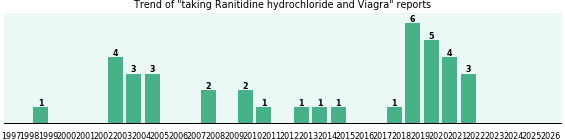
What are the common drug interactions of Ranitidine Hydrochloride and Viagra, by gender? *:
female:
- Anorgasmia (type of sexual dysfunction in which a person cannot achieve orgasm, even with adequate stimulation)
- Circulatory collapse
- Decreased appetite
- Dyspnoea (difficult or laboured respiration)
- Dyspnoea exertional (breathlessness or shortness of breath)
- Epistaxis (bleed from the nose)
- Fall
- Haemorrhage subcutaneous (bleeding from skin)
- Hypoxia (low oxygen in tissues)
- Infection
male:
- Chronic kidney disease
- Renal failure (kidney dysfunction)
- Dyspepsia (indigestion)
- Blood cholesterol increased
- Colitis ulcerative (inflammation of colon with ulcer)
- Coronary artery occlusion (complete obstruction of blood flow in a coronary artery)
- Faeces discoloured
- Flushing (the warm, red condition of human skin)
- Granuloma (a small area of inflammation due to tissue injury)
- Headache (pain in head)
What are the common drug interactions of Ranitidine Hydrochloride and Viagra, by age (0-1 to 60+)? *:
0-1:
n/a
2-9:
n/a
10-19:
n/a
20-29:
- Chronic kidney disease
- Renal injury (kidney injury)
30-39:
- Chronic kidney disease
- Anxiety
- Depression
- Renal failure (kidney dysfunction)
- Renal injury (kidney injury)
40-49:
- Chronic kidney disease
- Renal failure (kidney dysfunction)
- Hyperparathyroidism secondary (an abnormally high concentration of parathyroid hormone in the blood, resulting in weakening of the bones through loss of calcium-secondary)
- Nephrogenic anaemia (anaemia due to kidney disease)
- Cardio-respiratory arrest (sudden dysfunction of heart and lungs)
- Chest pain
- Clamminess (moist, sticky, and cold to the touch)
- Dyspepsia (indigestion)
- Eye rolling
- Myocardial infarction (destruction of heart tissue resulting from obstruction of the blood supply to the heart muscle)
50-59:
- Chronic kidney disease
- Gastritis (inflammation of stomach)
- Colitis ulcerative (inflammation of colon with ulcer)
- Drug effect decreased
- Faeces discoloured
- Granuloma (a small area of inflammation due to tissue injury)
- Headache (pain in head)
- Nephrolithiasis (calculi in the kidneys)
- Pollakiuria (abnormally frequent passage of relatively small quantities or urine)
- Polyp
60+:
- Chronic kidney disease
- Renal failure (kidney dysfunction)
- Fall
- Haemorrhage subcutaneous (bleeding from skin)
- Herpes zoster
- Hypoxia (low oxygen in tissues)
- Infection
- Loss of consciousness
- Lymphocyte count decreased
- Malaise (a feeling of general discomfort or uneasiness)
What are the existing conditions these people have? *
- Pain: 14 people, 36.84%
- High Blood Pressure: 9 people, 23.68%
- Infection: 8 people, 21.05%
- High Blood Cholesterol: 8 people, 21.05%
- Indigestion: 6 people, 15.79%
- Cardiac Disorder: 5 people, 13.16%
- Depression: 5 people, 13.16%
- Gout (uric acid crystals building up in the body): 4 people, 10.53%
- Abdominal Pain Upper: 3 people, 7.89%
- Psoriasis (immune-mediated disease that affects the skin): 3 people, 7.89%
* Approximation only. Some reports may have incomplete information.
Do you take Ranitidine hydrochloride and Viagra?
- Personalize this study to your gender, age, symptoms and drugs
- Predict drug outcomes for up to one year with AI
- Get an AI agent to monitor your drugs continuously
Related studies:
Effectiveness of, side effects of, and alternative drugs to the 2 drugs:
- Ranitidine hydrochloride (76,413 reports)
- Viagra (63,865 reports)
Browse all drug interactions of Ranitidine hydrochloride and Viagra:
a b c d e f g h i j k l m n o p q r s t u v w x y zSub-studies by gender and age:
Female: 0-1 2-9 10-19 20-29 30-39 40-49 50-59 60+
Male: 0-1 2-9 10-19 20-29 30-39 40-49 50-59 60+
Browse all side effects of Ranitidine hydrochloride:
a b c d e f g h i j k l m n o p q r s t u v w x y zBrowse all side effects of Viagra:
a b c d e f g h i j k l m n o p q r s t u v w x y zBrowse all interactions between Ranitidine hydrochloride and drugs from A to Z:
a b c d e f g h i j k l m n o p q r s t u v w x y zBrowse all interactions between Viagra and drugs from A to Z:
a b c d e f g h i j k l m n o p q r s t u v w x y zRelated publications that referenced our studies
- Jeong SY, Jeon SJ, Kim YR, Choi SS, Kwak HS, "A Rare Case of Viagra Induced Toxic Encephalopathy", Investigative Magnetic Resonance Imaging, 2016 Sep .
- Jeong SY, Jeon SJ, Kim YR, Choi SS, Kwak HS, "A Rare Case of Viagra Induced Toxic Encephalopathy", Investigative Magnetic Resonance Imaging, 2016 Sep .
How the study uses the data?
The study uses data from the FDA. It is based on ranitidine hydrochloride and sildenafil citrate (the active ingredients of Ranitidine hydrochloride and Viagra, respectively), and Ranitidine hydrochloride and Viagra (the brand names). Other drugs that have the same active ingredients (e.g. generic drugs) are not considered. Dosage of drugs is not considered in the study.
How to use the study?
DO NOT STOP MEDICATIONS without first consulting your doctor. If there are any serious or long term adverse effects discovered in the study, discuss the study with your doctor to ensure that proper medication management will be in place if applicable.
Who is eHealthMe?
With medical big data and proven AI/ML algorithms, eHealthMe provides a platform for everyone to run phase IV clinical trials. We study millions of patients and 5,000 more each day. Results of our real-world drug study have been referenced on 800+ peer-reviewed medical publications, including The Lancet, Mayo Clinic Proceedings, and Nature. Our analysis results are available to researchers, health care professionals, patients (testimonials), and software developers (open API).
WARNING, DISCLAIMER, USE FOR PUBLICATION
WARNING: Please DO NOT STOP MEDICATIONS without first consulting a physician since doing so could be hazardous to your health.
DISCLAIMER: All material available on eHealthMe.com is for informational purposes only, and is not a substitute for medical advice, diagnosis, or treatment provided by a qualified healthcare provider. All information is observation-only. Our phase IV clinical studies alone cannot establish cause-effect relationship. Different individuals may respond to medication in different ways. Every effort has been made to ensure that all information is accurate, up-to-date, and complete, but no guarantee is made to that effect. The use of the eHealthMe site and its content is at your own risk.
If you use this eHealthMe study on publication, please acknowledge it with a citation: study title, URL, accessed date.
Recent studies on eHealthMe:
- Lidoderm and Light-Headedness When Standing Up for Women aged 50-59 - now
- Lidoderm and Vertigo for Women aged 50-59 - now
- Lidoderm and Loss Of Balance for Women aged 50-59 - a second ago
- Lidoderm and Lightheadedness - Dizzy for Women aged 50-59 - a second ago
- Lidoderm and Lightheadedness for Women aged 50-59 - 2 seconds ago
- Could Isentress cause Flatulence? - 2 seconds ago
- Drug interactions of Phenergan and Phenytoin - 3 seconds ago
- Celecoxib and High Blood Pressure for Men aged 30-39 - 8 seconds ago
- Celecoxib and Blood Pressure Increased for Men aged 30-39 - 9 seconds ago
- Celecoxib and Htn for Men aged 30-39 - 9 seconds ago