Ganoderma side effects, by duration, gender and age (a phase IV clinical study of FDA data)
Summary:
Side effects are reported by people who take Ganoderma (reishi mushroom). Common side effects include cerebral haemorrhage among females and alanine aminotransferase increased among males.
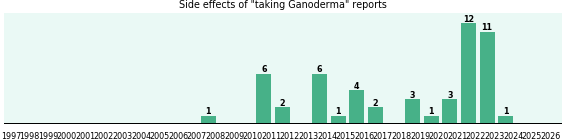
The phase IV clinical study is created by eHealthMe based on 53 reports from the FDA, and is updated regularly.
What is Ganoderma?
Ganoderma has active ingredients of reishi mushroom. eHealthMe is studying from 82 Ganoderma users. Check the latest studies of Ganoderma.
53 people who take Ganoderma and have side effects are studied.
What are the common side effects of Ganoderma, by gender? *:
female:
- Cerebral haemorrhage (bleeding within the brain)
- Breast cancer
- Abdominal pain
- Abdominal pain upper
- Abdominal symptom
- Acute hepatic failure
- Alopecia (absence of hair from areas of the body)
- Asthenia (weakness)
- Back pain
- Chest pain
male:
- Alanine aminotransferase increased
- Death
- Liver disorder (liver diseases)
- Malignant neoplasm progression (cancer tumour came back)
- Proteinuria (presence of protein in the urine)
- Tooth abscess (pus formation in tooth)
- Foot fracture
- Amnesia (deficit in memory caused by brain damage, disease, or psychological trauma)
- Arthritis (form of joint disorder that involves inflammation of one or more joints)
- Asthenia (weakness)
What are the common side effects of Ganoderma, by age (0-1 to 60+) *:
0-1:
n/a
2-9:
n/a
10-19:
n/a
20-29:
n/a
30-39:
n/a
40-49:
- Acute hepatic failure
- Alopecia (absence of hair from areas of the body)
- Bone marrow failure
- Malignant neoplasm progression (cancer tumour came back)
50-59:
- Abdominal pain
- Abdominal symptom
- Breast cancer
- Drug level below therapeutic
- Hepatocellular carcinoma (liver cancer)
60+:
- Alanine aminotransferase increased
- Cerebral haemorrhage (bleeding within the brain)
- Asthenia (weakness)
- Abdominal pain upper
- Bone pain
- Breast cancer
- Chloropsia (a visual defect in which all objects appear green)
- Death
- Decreased appetite
- Drug resistance (reduction in effectiveness of a drug)
What are the common side effects of Ganoderma, by the time people have been on the drug (< 1 month to 10+ years)? *:
< 1 month:
- Asthenia (weakness)
- Bone marrow failure
- Hepatocellular carcinoma (liver cancer)
- Proteinuria (presence of protein in the urine)
1 - 6 months:
- Drug level below therapeutic
6 - 12 months:
n/a
1 - 2 years:
n/a
2 - 5 years:
n/a
5 - 10 years:
n/a
10+ years:
n/a
not specified:
- Breast cancer
- Foot fracture
- Abdominal pain upper
- Abdominal symptom
- Acute hepatic failure
- Alopecia (absence of hair from areas of the body)
- Amnesia (deficit in memory caused by brain damage, disease, or psychological trauma)
- Arthritis (form of joint disorder that involves inflammation of one or more joints)
- Back pain
- Bone pain
* Approximation only. Some reports may have incomplete information.
Do you take Ganoderma?
- Personalize this study to your gender and age- Predict drug outcomes for up to one year with AI
- Get an AI agent to monitor your drugs continuously
How to use the study?
DO NOT STOP MEDICATIONS without first consulting your doctor. If there are any serious or long term adverse effects discovered in the study, discuss the study with your doctor to ensure that proper medication management will be in place if applicable.
How the study uses the data?
The study is based on reishi mushroom (the active ingredients of Ganoderma) and Ganoderma (the brand name). Other drugs that have the same active ingredients (e.g. generic drugs) are not considered.
Related studies are listed below in case you need more information:
Alternative drugs to, pros and cons of Ganoderma:
- Ganoderma (82 reports)
All Ganoderma side effects from A to Z:
a b c d e f g h i j k l m n o p q r s t u v w x y zWho is eHealthMe?
With medical big data and proven AI/ML algorithms, eHealthMe provides a platform for everyone to run phase IV clinical trials. We study millions of patients and 5,000 more each day. Results of our real-world drug study have been referenced on 800+ peer-reviewed medical publications, including The Lancet, Mayo Clinic Proceedings, and Nature. Our analysis results are available to researchers, health care professionals, patients (testimonials), and software developers (open API).
WARNING, DISCLAIMER, USE FOR PUBLICATION
WARNING: Please DO NOT STOP MEDICATIONS without first consulting a physician since doing so could be hazardous to your health.
DISCLAIMER: All material available on eHealthMe.com is for informational purposes only, and is not a substitute for medical advice, diagnosis, or treatment provided by a qualified healthcare provider. All information is observation-only. Our phase IV clinical studies alone cannot establish cause-effect relationship. Different individuals may respond to medication in different ways. Every effort has been made to ensure that all information is accurate, up-to-date, and complete, but no guarantee is made to that effect. The use of the eHealthMe site and its content is at your own risk.
If you use this eHealthMe study on publication, please acknowledge it with a citation: study title, URL, accessed date.
Recent studies on eHealthMe:
- Drug interactions of Cozaar and Infed - a minute ago
- Could Zidovudine cause Paroxysmal Supraventricular Tachycardia? - a minute ago
- Could Baby Aspirin cause Oral Mucosal Blistering? - a minute ago
- Hypertensive Crisis and Appetite Decreased - a minute ago
- Hypertensive Crisis and Appetite - Decreased - a minute ago
- Drug interactions of Rabeprazole and Trichlormethiazide - a minute ago
- Could Valtrex cause Calcium Deficiency? - a minute ago
- Benzamycin vs. Septra, side effect and effectiveness comparison - a minute ago
- Could Flovent cause Oral Pruritus? - a minute ago
- Could Neurontin cause Uterine Fibroids? - a minute ago