Lucentis and Conjunctivitis - a phase IV clinical study of FDA data
Summary:
Conjunctivitis is reported as a side effect among people who take Lucentis (ranibizumab), especially for people who are female, 60+ old, have been taking the drug for < 1 month also take Avastin, and have Age-related macular degeneration.
The phase IV clinical study analyzes which people have Conjunctivitis when taking Lucentis. It is created by eHealthMe based on reports of 25,577 people who have side effects when taking Lucentis from the FDA, and is updated regularly.
What is Lucentis?
Lucentis has active ingredients of ranibizumab. It is often used in macular degeneration. eHealthMe is studying from 25,647 Lucentis users. Check the latest studies of Lucentis.
What is Conjunctivitis?
Conjunctivitis (pink eye) is found to be associated with 1,298 drugs and 1,644 conditions by eHealthMe. Check the latest studies of Conjunctivitis.
eHealthMe: drug outcomes in the real world
eHealthMe runs one of the largest post-marketing drug safety studies in the world. We study millions of patients and 5,000 more each day. Our data-driven phase IV clinical trials have been referenced on 800+ peer-reviewed medical publications including The Lancet, Mayo Clinic Proceedings, and Nature. Tools to study our phase IV findings are available to the public, anonymous and free >>>.
25,577 people reported to have side effects when taking Lucentis.
Among them, 74 people (0.29%) have Conjunctivitis.
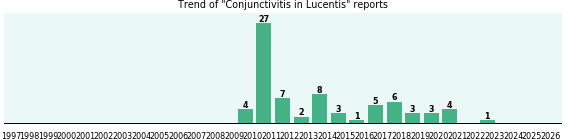
Among these 74 people:
How long have people been on Lucentis when they have Conjunctivitis? *
- < 1 month: 66.67 %
- 1 - 6 months: 0.0 %
- 6 - 12 months: 0.0 %
- 1 - 2 years: 33.33 %
- 2 - 5 years: 0.0 %
- 5 - 10 years: 0.0 %
- 10+ years: 0.0 %
What is the gender of people who have Conjunctivitis when taking Lucentis? *
- female: 71.01 %
- male: 28.99 %
What is the age of people who have Conjunctivitis when taking Lucentis? *
- 0-1: 0.0 %
- 2-9: 0.0 %
- 10-19: 0.0 %
- 20-29: 2.08 %
- 30-39: 0.0 %
- 40-49: 0.0 %
- 50-59: 4.17 %
- 60+: 93.75 %
What are other drugs people take besides Lucentis? *
- Avastin: 13 people, 17.57%
- Vigamox: 6 people, 8.11%
- Eylea: 5 people, 6.76%
- Combigan: 5 people, 6.76%
- Iopidine: 4 people, 5.41%
- Simvastatin: 4 people, 5.41%
- Methylprednisolone Acetate: 3 people, 4.05%
- Chloramphenicol: 2 people, 2.70%
- Zestril: 2 people, 2.70%
- Durezol: 2 people, 2.70%
What are other side effects people have besides Conjunctivitis? *
- Visual Acuity Reduced (reduced clearness of vision): 17 people, 22.97%
- Drug Ineffective: 13 people, 17.57%
- Visual Impairment: 11 people, 14.86%
- Vision Blurred: 11 people, 14.86%
- Eye Pain: 9 people, 12.16%
- Ocular Hyperaemia (an abnormally large amount of blood in eye): 9 people, 12.16%
- Intraocular Pressure Increased: 8 people, 10.81%
- Dry Eyes (lack of adequate tears): 7 people, 9.46%
- Scotoma (an area of diminished vision within the visual field): 6 people, 8.11%
- Eye Disorder: 6 people, 8.11%
What are the existing conditions these people have? *
- Age-Related Macular Degeneration: 14 people, 18.92%
- Retinal Vessel Occlusion (a blockage in one of the small arteries): 6 people, 8.11%
- Choroidal Neovascularisation (creation of new blood vessels in vascular layer of eye): 6 people, 8.11%
- Diabetic Retinal Oedema (excessive build-up of fluid in the retina due to diabetes): 4 people, 5.41%
- Retinal Disorder (disease of retina): 3 people, 4.05%
- Cystoid Macular Oedema (fluid accumulation after cataract surgery): 3 people, 4.05%
- Diabetes: 2 people, 2.70%
- Diabetic Eye Disease: 2 people, 2.70%
- Diabetic Retinopathy (damage to the retina caused by complications of diabetes): 2 people, 2.70%
- High Blood Cholesterol: 2 people, 2.70%
* Approximation only. Some reports may have incomplete information.
Do you take Lucentis and have Conjunctivitis?
- Check whether Conjunctivitis is associated with a drug or a condition
- Predict drug outcomes for up to one year with AI
- Get an AI agent to monitor your drugs continuously
Related studies:
Effectiveness of, long term effects of, and alternative drugs to Lucentis:
- Lucentis (25,647 reports)
Conjunctivitis treatments and more:
- Conjunctivitis (22,439 reports)
How severe was Conjunctivitis and when was it recovered:
Expand to all the drugs that have ingredients of ranibizumab:
Sub-studies by gender and age:
Female: 0-1 2-9 10-19 20-29 30-39 40-49 50-59 60+
Male: 0-1 2-9 10-19 20-29 30-39 40-49 50-59 60+
Browse all side effects of Lucentis:
a b c d e f g h i j k l m n o p q r s t u v w x y zBrowse all the drugs that are associated with Conjunctivitis:
- Conjunctivitis (1,298 drugs)
Browse all the conditions that are associated with Conjunctivitis:
- Conjunctivitis (1,644 conditions)
How the study uses the data?
The study uses data from the FDA. It is based on ranibizumab (the active ingredients of Lucentis) and Lucentis (the brand name). Other drugs that have the same active ingredients (e.g. generic drugs) are not considered. Dosage of drugs is not considered in the study.
How to use the study?
DO NOT STOP MEDICATIONS without first consulting your doctor. If there are any serious or long term adverse effects discovered in the study, discuss the study with your doctor to ensure that proper medication management will be in place if applicable.
Who is eHealthMe?
With medical big data and proven AI/ML algorithms, eHealthMe provides a platform for everyone to run phase IV clinical trials. We study millions of patients and 5,000 more each day. Results of our real-world drug study have been referenced on 800+ peer-reviewed medical publications, including The Lancet, Mayo Clinic Proceedings, and Nature. Our analysis results are available to researchers, health care professionals, patients (testimonials), and software developers (open API).
WARNING, DISCLAIMER, USE FOR PUBLICATION
WARNING: Please DO NOT STOP MEDICATIONS without first consulting a physician since doing so could be hazardous to your health.
DISCLAIMER: All material available on eHealthMe.com is for informational purposes only, and is not a substitute for medical advice, diagnosis, or treatment provided by a qualified healthcare provider. All information is observation-only. Our phase IV clinical studies alone cannot establish cause-effect relationship. Different individuals may respond to medication in different ways. Every effort has been made to ensure that all information is accurate, up-to-date, and complete, but no guarantee is made to that effect. The use of the eHealthMe site and its content is at your own risk.
If you use this eHealthMe study on publication, please acknowledge it with a citation: study title, URL, accessed date.
Recent studies on eHealthMe:
- Disturbance In Attention and drugs of ingredients of penicillin g potassium - 4 seconds ago
- Could Zyrtec-D 12 Hour cause Multiple Sclerosis? - 18 seconds ago
- Macular Degeneration and drugs of ingredients of gramicidin; neomycin sulfate; polymyxin b sulfate - 38 seconds ago
- Oxazepam vs. St. John'S Wort, side effect and effectiveness comparison - 45 seconds ago
- Could Synthroid cause Salivary Gland Pain? - 49 seconds ago
- Could Cyclobenzaprine Hydrochloride cause Scar? - 50 seconds ago
- Drug Rash With Eosinophilia And Systemic Symptoms and drugs of ingredients of isoniazid - a minute ago
- Could Rabeprazole cause Glucose Tolerance Impaired? - a minute ago
- Could Temazepam cause Comminuted Fracture? - a minute ago
- Could Celebrex cause Localised Exfoliation? - a minute ago