Sitagliptin phosphate and Bladder cancer - a phase IV clinical study of FDA data
Summary:
Bladder cancer is reported as a side effect among people who take Sitagliptin phosphate (sitagliptin phosphate), especially for people who are male, 60+ old, have been taking the drug for 1 - 2 years also take Actos, and have Type 2 diabetes.
The phase IV clinical study analyzes which people have Bladder cancer when taking Sitagliptin phosphate. It is created by eHealthMe based on reports of 3,765 people who have side effects when taking Sitagliptin phosphate from the FDA, and is updated regularly.
What is Sitagliptin phosphate?
Sitagliptin phosphate has active ingredients of sitagliptin phosphate. eHealthMe is studying from 3,787 Sitagliptin phosphate users. Check the latest studies of Sitagliptin phosphate.
What is Bladder cancer?
Bladder cancer is found to be associated with 727 drugs and 1,027 conditions by eHealthMe. Check the latest studies of Bladder cancer.
3,765 people reported to have side effects when taking Sitagliptin phosphate.
Among them, 40 people (1.06%) have Bladder cancer.
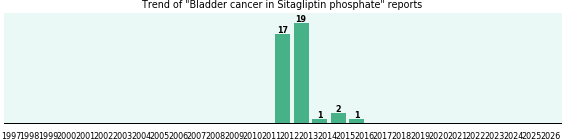
Among these 40 people:
How long have people been on Sitagliptin phosphate when they have Bladder cancer? *
- < 1 month: 0.0 %
- 1 - 6 months: 0.0 %
- 6 - 12 months: 0.0 %
- 1 - 2 years: 100 %
- 2 - 5 years: 0.0 %
- 5 - 10 years: 0.0 %
- 10+ years: 0.0 %
What is the gender of people who have Bladder cancer when taking Sitagliptin phosphate? *
- female: 28.21 %
- male: 71.79 %
What is the age of people who have Bladder cancer when taking Sitagliptin phosphate? *
- 0-1: 0.0 %
- 2-9: 0.0 %
- 10-19: 0.0 %
- 20-29: 0.0 %
- 30-39: 5.26 %
- 40-49: 0.0 %
- 50-59: 10.53 %
- 60+: 84.21 %
What are other drugs people take besides Sitagliptin phosphate? *
- Actos: 17 people, 42.50%
- Metformin: 4 people, 10.00%
- Actoplus Met: 3 people, 7.50%
- Lantus: 2 people, 5.00%
- Glipizide: 2 people, 5.00%
- Rosiglitazone: 2 people, 5.00%
- Metformin Hydrochloride: 2 people, 5.00%
- Formoterol Fumarate: 1 person, 2.50%
- Fosamax: 1 person, 2.50%
- Furosemide: 1 person, 2.50%
What are other side effects people have besides Bladder cancer? *
- High Blood Pressure: 4 people, 10.00%
- Bladder Transitional Cell Carcinoma (types of bladder cancer): 2 people, 5.00%
- Acute Kidney Failure: 2 people, 5.00%
- Urinary Tract Infection: 2 people, 5.00%
- Ureteric Cancer: 2 people, 5.00%
- High Blood Cholesterol: 2 people, 5.00%
- Depression: 1 person, 2.50%
- Calculus Bladder (bladder stone): 1 person, 2.50%
- Cardiac Disorder: 1 person, 2.50%
- Cardiac Failure Congestive: 1 person, 2.50%
What are the existing conditions these people have? *
- Type 2 Diabetes: 38 people, 95.00%
- Stable Angina (a constant chest pain): 1 person, 2.50%
- Hair Loss: 1 person, 2.50%
- Diabetes: 1 person, 2.50%
- Depression: 1 person, 2.50%
- Chronic Obstructive Pulmonary Disease (a progressive disease that makes it hard to breathe): 1 person, 2.50%
- Cardiac Disorder: 1 person, 2.50%
- Asthma: 1 person, 2.50%
- Alopecia Areata (patchy baldness that typically begins with rapid hair loss): 1 person, 2.50%
* Approximation only. Some reports may have incomplete information.
Do you take Sitagliptin phosphate and have Bladder cancer?
- Check whether Bladder cancer is associated with a drug or a condition
- Predict drug outcomes for up to one year with AI
- Get an AI agent to monitor your drugs continuously
Related studies:
Effectiveness of, long term effects of, and alternative drugs to Sitagliptin phosphate:
- Sitagliptin phosphate (3,787 reports)
Bladder cancer treatments and more:
- Bladder cancer (75,593 reports)
How severe was Bladder cancer and when was it recovered:
Expand to all the drugs that have ingredients of sitagliptin phosphate:
Sub-studies by gender and age:
Female: 0-1 2-9 10-19 20-29 30-39 40-49 50-59 60+
Male: 0-1 2-9 10-19 20-29 30-39 40-49 50-59 60+
Browse all side effects of Sitagliptin phosphate:
a b c d e f g h i j k l m n o p q r s t u v w x y zBrowse all the drugs that are associated with Bladder cancer:
- Bladder cancer (727 drugs)
Browse all the conditions that are associated with Bladder cancer:
- Bladder cancer (1,027 conditions)
Related publications that referenced our studies
- Liao KF, Lin CL, Lai SW, Chen WC, "Sitagliptin use and risk of acute pancreatitis in type 2 diabetes mellitus: a population-based case-control study in Taiwan", European journal of internal medicine, 2016 Jan .
- Belice T, Yuce S, Kizilkaya B, Kurt A, Cure E, "Noncardiac pulmonary edema induced by sitagliptin treatment", Journal of family medicine and primary care, 2014 Jan .
- Misgar, R. A., Bhat, J. A., Wani, A. I., & Bashir, M. I., "Sitagliptin induced splenic infarcts", Clinical Diabetology, 2014 Jan .
- Stricklin SM, Stoecker WV, Rader RK, Hood AF, Litt JZ, Schuman TP, "Persistent edematous-plaque photosensitivity observed with sitagliptin phosphate (Januvia?)", Dermatology online journal, 2012 Feb .
- Liao KF, Lin CL, Lai SW, Chen WC, "Sitagliptin use and risk of acute pancreatitis in type 2 diabetes mellitus: a population-based case-control study in Taiwan", European journal of internal medicine, 2016 Jan .
- Belice T, Yuce S, Kizilkaya B, Kurt A, Cure E, "Noncardiac pulmonary edema induced by sitagliptin treatment", Journal of family medicine and primary care, 2014 Jan .
- Misgar, R. A., Bhat, J. A., Wani, A. I., & Bashir, M. I., "Sitagliptin induced splenic infarcts", Clinical Diabetology, 2014 Jan .
- Stricklin SM, Stoecker WV, Rader RK, Hood AF, Litt JZ, Schuman TP, "Persistent edematous-plaque photosensitivity observed with sitagliptin phosphate (Januvia?)", Dermatology online journal, 2012 Feb .
How the study uses the data?
The study uses data from the FDA. It is based on sitagliptin phosphate (the active ingredients of Sitagliptin phosphate) and Sitagliptin phosphate (the brand name). Other drugs that have the same active ingredients (e.g. generic drugs) are not considered. Dosage of drugs is not considered in the study.
How to use the study?
DO NOT STOP MEDICATIONS without first consulting your doctor. If there are any serious or long term adverse effects discovered in the study, discuss the study with your doctor to ensure that proper medication management will be in place if applicable.
Who is eHealthMe?
With medical big data and proven AI/ML algorithms, eHealthMe provides a platform for everyone to run phase IV clinical trials. We study millions of patients and 5,000 more each day. Results of our real-world drug study have been referenced on 800+ peer-reviewed medical publications, including The Lancet, Mayo Clinic Proceedings, and Nature. Our analysis results are available to researchers, health care professionals, patients (testimonials), and software developers (open API).
WARNING, DISCLAIMER, USE FOR PUBLICATION
WARNING: Please DO NOT STOP MEDICATIONS without first consulting a physician since doing so could be hazardous to your health.
DISCLAIMER: All material available on eHealthMe.com is for informational purposes only, and is not a substitute for medical advice, diagnosis, or treatment provided by a qualified healthcare provider. All information is observation-only. Our phase IV clinical studies alone cannot establish cause-effect relationship. Different individuals may respond to medication in different ways. Every effort has been made to ensure that all information is accurate, up-to-date, and complete, but no guarantee is made to that effect. The use of the eHealthMe site and its content is at your own risk.
If you use this eHealthMe study on publication, please acknowledge it with a citation: study title, URL, accessed date.
Recent studies on eHealthMe:
- Could Vitamin D cause Serotonin Syndrome? - 4 seconds ago
- Could Clomid cause Insomnia? - 5 seconds ago
- Could Vancomycin Hcl cause Urticaria? - a minute ago
- Could Viagra cause Face Oedema? - a minute ago
- How effective is Glucosamine for Joint Pain? - a minute ago
- Drug interactions of Vitamin B and Duopa - a minute ago
- Lupron Depot-3 vs. Norco, side effect and effectiveness comparison - a minute ago
- Orthostatic Hypotension and Pneumonia - a minute ago
- Could Jardiance cause Aortic Aneurysm? - a minute ago
- Gastrointestinal Infection and Stress And Anxiety - 2 minutes ago