Breast microcalcification: treatments, associated drugs and conditions
Summary:
Breast microcalcification: deposits of calcium that can be seen on a mammogram of the breast.
We study 282 people who have Breast microcalcification. The information that eHealthMe analyzes includes:
- Medications that treat Breast microcalcification and their effectiveness- 24 drugs that are associated with Breast microcalcification
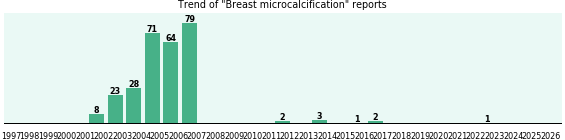
Number of reports submitted per year:
All the drugs that are associated with Breast microcalcification:
- Breast microcalcification (24 drugs)
Do you take any medication?
- You can use our AI-powered tools to monitor drug safety and effectiveness.Who is eHealthMe?
With medical big data and proven AI/ML algorithms, eHealthMe provides a platform for everyone to run phase IV clinical trials. We study millions of patients and 5,000 more each day. Results of our real-world drug study have been referenced on 800+ peer-reviewed medical publications, including The Lancet, Mayo Clinic Proceedings, and Nature. Our analysis results are available to researchers, health care professionals, patients (testimonials), and software developers (open API).
How we gather our data?
Healthcare data is obtained from a number of sources including the Food and Drug Administration (FDA). This information is aggregated and used to produce personalized reports that patients can reference. Browse all conditions on eHealthMe.
Recent studies on eHealthMe:
- Could Tecfidera cause Faecal Incontinence? - 4 seconds ago
- Could Abrilada cause Foot Fracture? - 4 seconds ago
- Could Clozaril cause Dry Mouth? - 5 seconds ago
- Allopurinol and Mouth Haemorrhage for Men aged 50-59 - 6 seconds ago
- Meropenem and Hyperkalaemia for Men aged 40-49 - 8 seconds ago
- Meropenem and Blood Potassium Increased for Men aged 40-49 - 8 seconds ago
- Meropenem and Elevated Potassium for Men aged 40-49 - 8 seconds ago
- Meropenem and Potassium - High for Men aged 40-49 - 9 seconds ago
- Meropenem and High Potassium for Men aged 40-49 - 9 seconds ago
- Meropenem and Hyperkalemia for Men aged 40-49 - 9 seconds ago