Allegra and Tranexamic acid drug interactions - a phase IV clinical study of FDA data
Summary:
Drug interactions are reported among people who take Allegra (fexofenadine hydrochloride) and Tranexamic acid (tranexamic acid). Common drug interactions include blood urea increased among females and rib fracture among males.
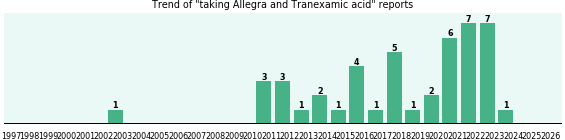
The phase IV clinical study analyzes what interactions people have when they take Allegra and Tranexamic acid. It is created by eHealthMe based on reports of 45 people who take the same drugs from the FDA, and is updated regularly.
What is Allegra?
Allegra has active ingredients of fexofenadine hydrochloride. It is often used in allergies. eHealthMe is studying from 75,498 Allegra users. Check the latest studies of Allegra.
What is Tranexamic acid?
Tranexamic acid has active ingredients of tranexamic acid. It is often used in heavy or prolong menstrual bleeding. eHealthMe is studying from 8,687 Tranexamic acid users. Check the latest studies of Tranexamic acid.
eHealthMe: drug outcomes in the real world
eHealthMe runs one of the largest post-marketing drug safety studies in the world. We study millions of patients and 5,000 more each day. Our data-driven phase IV clinical trials have been referenced on 800+ peer-reviewed medical publications including The Lancet, Mayo Clinic Proceedings, and Nature. Tools to study our phase IV findings are available to the public, anonymous and free >>>.
45 people who take Allegra and Tranexamic acid together, and have interactions are studied.
What are the common drug interactions of Allegra and Tranexamic Acid, by gender? *:
female:
- Blood urea increased
- Cellulitis (infection under the skin)
- Cerebral haemorrhage (bleeding within the brain)
- Cerebral infarction (less blood supply to brain resulting tissue damage)
- Chest pain
- Coagulopathy (blood's ability to clot is impaired)
- Dermatitis (inflammation of the skin resulting from direct irritation by an external agent or an allergic reaction to it)
- Dermatitis contact (skin reaction (dermatitis) resulting from exposure to allergens)
- Disturbance in attention
- Dizziness
male:
- Rib fracture
- Cardio-respiratory arrest (sudden dysfunction of heart and lungs)
- Pyrexia (fever)
- Anxiety
- Depression
- Haemoptysis (blood-stained sputum from the bronchi, larynx, trachea, or lungs)
- Laryngeal disorder (disease of larynx related to voice)
- Libido increased (increased sexual urge to have sex)
- Post procedural complication
- Therapeutic response decreased (less preventive response)
What are the common drug interactions of Allegra and Tranexamic Acid, by age (0-1 to 60+)? *:
0-1:
n/a
2-9:
n/a
10-19:
n/a
20-29:
- Blood creatine phosphokinase increased
- Gastroenteritis (inflammation of stomach and intestine)
- Hyperlipidaemia (presence of excess lipids in the blood)
- Hyperuricaemia (level of uric acid in the blood that is abnormally high)
- Iron deficiency anaemia
- Nasopharyngitis (inflammation of the nasopharynx)
- Osteonecrosis (death of bone)
- Otitis externa (external ear infection)
- Purpura (purplish discoloration of the skin)
- Subarachnoid haemorrhage (blood leaks into the space between two membranes that surround the brain)
30-39:
- Pneumonia
- Respiratory failure (inadequate gas exchange by the respiratory system)
- Rib fracture
- Sleep-related eating disorder (abnormal eating patterns during the night)
- Weight decreased
- Haemoptysis (blood-stained sputum from the bronchi, larynx, trachea, or lungs)
- Laryngeal disorder (disease of larynx related to voice)
- Post procedural complication
- Vocal cord paralysis
- Disability
40-49:
- Rash maculo-papular (red area on the skin that is covered with small confluent bumps)
- Toxic epidermal necrolysis (a rare, life-threatening skin condition that is usually caused by a reaction to drugs causes wide spread skin destruction)
- Stevens-johnson syndrome (an immune-complex-mediated hypersensitivity disorder. it ranges from mild skin and mucous membrane lesions to a severe)
- Abdominal pain
- Alanine aminotransferase increased
- Anorexia (eating disorder characterized by immoderate food restriction and irrational fear of gaining weight)
- Application site pruritus (application site severe itching of the skin)
- Aspartate aminotransferase increased
- Back pain
- Blister (small pocket of fluid within the upper layers of the skin caused by forceful rubbing (friction), burning, freezing, chemical exposure)
50-59:
- Pneumonitis (inflammation of the walls of the alveoli in the lungs)
60+:
- Pyrexia (fever)
- Muscle abscess (pus in muscle)
- Pneumonia
- Renal impairment (severely reduced kidney function)
- Haemolytic anaemia (anaemia due to haemolysis)
- Oedema peripheral (superficial swelling)
- Pneumocystis jiroveci pneumonia (fungal infection of the lungs)
- Albumin urine present
- Ammonia increased
- Arthralgia (joint pain)
What are the existing conditions these people have? *
- Narcolepsy (brain's inability to regulate sleep-wake cycles normally): 13 people, 28.89%
- Cataplexy (loss of muscle tone accompanied by full conscious awareness): 10 people, 22.22%
- Rash Maculo-Papular (red area on the skin that is covered with small confluent bumps): 6 people, 13.33%
- Productive Cough: 6 people, 13.33%
- Back Pain: 6 people, 13.33%
- Constipation: 6 people, 13.33%
- Cough: 6 people, 13.33%
- Coughing Up Blood: 6 people, 13.33%
- Dermatitis Acneiform (dermatoses including acne vulgaris, rosacea, folliculitis, and perioral dermatitis): 6 people, 13.33%
- Erythema Multiforme (a type of hypersensitivity reaction): 6 people, 13.33%
* Approximation only. Some reports may have incomplete information.
Do you take Allegra and Tranexamic acid?
- Personalize this study to your gender, age, symptoms and drugs
- Predict drug outcomes for up to one year with AI
- Get an AI agent to monitor your drugs continuously
Related studies:
Effectiveness of, side effects of, and alternative drugs to the 2 drugs:
- Allegra (75,498 reports)
- Tranexamic acid (8,687 reports)
Browse all drug interactions of Allegra and Tranexamic acid:
a b c d e f g h i j k l m n o p q r s t u v w x y zSub-studies by gender and age:
Female: 0-1 2-9 10-19 20-29 30-39 40-49 50-59 60+
Male: 0-1 2-9 10-19 20-29 30-39 40-49 50-59 60+
Browse all side effects of Allegra:
a b c d e f g h i j k l m n o p q r s t u v w x y zBrowse all side effects of Tranexamic acid:
a b c d e f g h i j k l m n o p q r s t u v w x y zBrowse all interactions between Allegra and drugs from A to Z:
a b c d e f g h i j k l m n o p q r s t u v w x y zBrowse all interactions between Tranexamic acid and drugs from A to Z:
a b c d e f g h i j k l m n o p q r s t u v w x y zHow the study uses the data?
The study uses data from the FDA. It is based on fexofenadine hydrochloride and tranexamic acid (the active ingredients of Allegra and Tranexamic acid, respectively), and Allegra and Tranexamic acid (the brand names). Other drugs that have the same active ingredients (e.g. generic drugs) are not considered. Dosage of drugs is not considered in the study.
How to use the study?
DO NOT STOP MEDICATIONS without first consulting your doctor. If there are any serious or long term adverse effects discovered in the study, discuss the study with your doctor to ensure that proper medication management will be in place if applicable.
Who is eHealthMe?
With medical big data and proven AI/ML algorithms, eHealthMe provides a platform for everyone to run phase IV clinical trials. We study millions of patients and 5,000 more each day. Results of our real-world drug study have been referenced on 800+ peer-reviewed medical publications, including The Lancet, Mayo Clinic Proceedings, and Nature. Our analysis results are available to researchers, health care professionals, patients (testimonials), and software developers (open API).
WARNING, DISCLAIMER, USE FOR PUBLICATION
WARNING: Please DO NOT STOP MEDICATIONS without first consulting a physician since doing so could be hazardous to your health.
DISCLAIMER: All material available on eHealthMe.com is for informational purposes only, and is not a substitute for medical advice, diagnosis, or treatment provided by a qualified healthcare provider. All information is observation-only. Our phase IV clinical studies alone cannot establish cause-effect relationship. Different individuals may respond to medication in different ways. Every effort has been made to ensure that all information is accurate, up-to-date, and complete, but no guarantee is made to that effect. The use of the eHealthMe site and its content is at your own risk.
If you use this eHealthMe study on publication, please acknowledge it with a citation: study title, URL, accessed date.
Recent studies on eHealthMe:
- Arthritis and Drug Ineffective - now
- Could Probiotics cause Hyponatraemia Aggravated? - a second ago
- Could Celexa cause Vomiting Aggravated? - a second ago
- Could Centrum Silver cause Neuritis? - 2 seconds ago
- Drug interactions of Nifedipine and Amoxicillin - 10 seconds ago
- Could Atrovent cause Decreased Activity? - 15 seconds ago
- Asthma and Localised Infection - 19 seconds ago
- Could Pristiq cause Dizziness Aggravated? - 20 seconds ago
- Could Oxycodone Hydrochloride cause Hypoalbuminaemia? - 21 seconds ago
- Could Tacrolimus cause Hypoacusis? - 23 seconds ago