Atenolol and Deltasone drug interactions - a phase IV clinical study of FDA data
Summary:
Drug interactions are reported among people who take Atenolol (atenolol) and Deltasone (prednisone). Common drug interactions include abasia among females and headache among males.
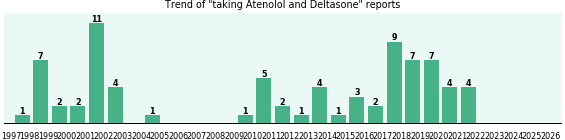
The phase IV clinical study analyzes what interactions people have when they take Atenolol and Deltasone. It is created by eHealthMe based on reports of 78 people who take the same drugs from the FDA, and is updated regularly.
What is Atenolol?
Atenolol has active ingredients of atenolol. It is often used in high blood pressure. eHealthMe is studying from 176,618 Atenolol users. Check the latest studies of Atenolol.
What is Deltasone?
Deltasone has active ingredients of prednisone. eHealthMe is studying from 4,243 Deltasone users. Check the latest studies of Deltasone.
eHealthMe: drug outcomes in the real world
eHealthMe runs one of the largest post-marketing drug safety studies in the world. We study millions of patients and 5,000 more each day. Our data-driven phase IV clinical trials have been referenced on 800+ peer-reviewed medical publications including The Lancet, Mayo Clinic Proceedings, and Nature. Tools to study our phase IV findings are available to the public, anonymous and free >>>.
78 people who take Atenolol and Deltasone together, and have interactions are studied.
What are the common drug interactions of Atenolol and Deltasone, by gender? *:
female:
- Abasia (inability to walk)
- Dyspepsia (indigestion)
- Infusion related reaction
- Supraventricular tachycardia (rapid heart rhythm originating at or above the atrioventricular node)
- Vomiting
- Anaemia (lack of blood)
- Bronchitis (inflammation of the mucous membrane in the bronchial tubes)
- Bursitis (inflammation of a bursa, typically one in the knee, elbow, or shoulder)
- Hyperparathyroidism secondary (an abnormally high concentration of parathyroid hormone in the blood, resulting in weakening of the bones through loss of calcium-secondary)
- Nephrogenic anaemia (anaemia due to kidney disease)
male:
- Headache (pain in head)
- Renal failure (kidney dysfunction)
- Cerebrovascular accident (sudden death of some brain cells due to lack of oxygen when the blood flow to the brain is impaired by blockage or rupture)
- Chronic kidney disease
- Drug ineffective
- Fatigue (feeling of tiredness)
- Fear
- Injury
- Multi-organ failure (multisystem organ failure)
- Psychotic disorder
What are the common drug interactions of Atenolol and Deltasone, by age (0-1 to 60+)? *:
0-1:
n/a
2-9:
n/a
10-19:
- Appetite increased (increased appetite is when you want to eat much more often or in larger quantities than your body requires)
- Fatigue (feeling of tiredness)
- Psychotic disorder
- Sedation
- Weight increased
- Schizophrenia (a mental disorder characterized by a breakdown of thought processes)
- Anaemia (lack of blood)
- Aplasia pure red cell (type of anaemia affecting the precursors to red blood cells but not to white blood cells)
- Arthralgia (joint pain)
- Bone disorder
20-29:
- Abdominal pain upper
- Azotaemia (excess of urea or other nitrogenous compounds in the blood)
- Dehydration (dryness resulting from the removal of water)
- Diarrhoea
- Kidney transplant rejection
- Nausea (feeling of having an urge to vomit)
- Renal failure (kidney dysfunction)
- Vomiting
- Weight decreased
30-39:
- Infusion related reaction
- Supraventricular tachycardia (rapid heart rhythm originating at or above the atrioventricular node)
- Muscle spasticity (tight or stiff muscles and an inability to control those muscles)
- Pruritus generalised (generalized itching)
40-49:
- Alopecia (absence of hair from areas of the body)
- Asthma
- Benign breast neoplasm (benign (non-cancerous) tumours of the breast)
- Bronchitis (inflammation of the mucous membrane in the bronchial tubes)
- Bursitis (inflammation of a bursa, typically one in the knee, elbow, or shoulder)
- Calcaneal spur (heel spur)
- Coeliac disease (simple food intolerance)
- Diabetes mellitus non insulin-dependent
- Dyspepsia (indigestion)
- Gastric ulcer (stomach ulcer)
50-59:
- Aggression
- Cardiac disorder
- Cardiomegaly (increased size of heart than normal)
- Hypotension (abnormally low blood pressure)
- Pulmonary oedema (fluid accumulation in the lungs)
- Abdominal pain
- Aphasia (damage to the parts of the brain that control language)
- Atrioventricular block complete (heart block complete)
- Back pain
- Bundle branch block left (absence of transmission of electric impulses from the atrioventricular (av) bundle of his to the left ventricle)
60+:
- Chronic kidney disease
- Renal failure (kidney dysfunction)
- Anaemia (lack of blood)
- Angina pectoris (chest pain due to ischemia of the heart muscle)
- Angioneurotic oedema (swelling that occurs just beneath the surface of the skin or mucous membranes)
- Angiopathy (generic term for a disease of the blood vessels)
- Balance disorder
- Blood in stool
- Burning sensation
- Chest pain
What are the existing conditions these people have? *
- Pain: 17 people, 21.79%
- High Blood Cholesterol: 16 people, 20.51%
- Gastroesophageal Reflux Disease (a condition in which stomach contents leak backward from the stomach into the oesophagus): 15 people, 19.23%
- Stress And Anxiety: 15 people, 19.23%
- Incontinence (lack of moderation or self-control): 10 people, 12.82%
- Depression: 10 people, 12.82%
- Inflammation: 10 people, 12.82%
- Infection: 8 people, 10.26%
- Diabetes: 8 people, 10.26%
- Back Pain: 8 people, 10.26%
* Approximation only. Some reports may have incomplete information.
Do you take Atenolol and Deltasone?
- Personalize this study to your gender, age, symptoms and drugs
- Predict drug outcomes for up to one year with AI
- Get an AI agent to monitor your drugs continuously
Related studies:
Effectiveness of, side effects of, and alternative drugs to the 2 drugs:
Browse all drug interactions of Atenolol and Deltasone:
a b c d e f g h i j k l m n o p q r s t u v w x y zSub-studies by gender and age:
Female: 0-1 2-9 10-19 20-29 30-39 40-49 50-59 60+
Male: 0-1 2-9 10-19 20-29 30-39 40-49 50-59 60+
Browse all side effects of Atenolol:
a b c d e f g h i j k l m n o p q r s t u v w x y zBrowse all side effects of Deltasone:
a b c d e f g h i j k l m n o p q r s t u v w x y zBrowse all interactions between Atenolol and drugs from A to Z:
a b c d e f g h i j k l m n o p q r s t u v w x y zBrowse all interactions between Deltasone and drugs from A to Z:
a b c d e f g h i j k l m n o p q r s t u v w x y zHow the study uses the data?
The study uses data from the FDA. It is based on atenolol and prednisone (the active ingredients of Atenolol and Deltasone, respectively), and Atenolol and Deltasone (the brand names). Other drugs that have the same active ingredients (e.g. generic drugs) are not considered. Dosage of drugs is not considered in the study.
How to use the study?
DO NOT STOP MEDICATIONS without first consulting your doctor. If there are any serious or long term adverse effects discovered in the study, discuss the study with your doctor to ensure that proper medication management will be in place if applicable.
Who is eHealthMe?
With medical big data and proven AI/ML algorithms, eHealthMe provides a platform for everyone to run phase IV clinical trials. We study millions of patients and 5,000 more each day. Results of our real-world drug study have been referenced on 800+ peer-reviewed medical publications, including The Lancet, Mayo Clinic Proceedings, and Nature. Our analysis results are available to researchers, health care professionals, patients (testimonials), and software developers (open API).
WARNING, DISCLAIMER, USE FOR PUBLICATION
WARNING: Please DO NOT STOP MEDICATIONS without first consulting a physician since doing so could be hazardous to your health.
DISCLAIMER: All material available on eHealthMe.com is for informational purposes only, and is not a substitute for medical advice, diagnosis, or treatment provided by a qualified healthcare provider. All information is observation-only. Our phase IV clinical studies alone cannot establish cause-effect relationship. Different individuals may respond to medication in different ways. Every effort has been made to ensure that all information is accurate, up-to-date, and complete, but no guarantee is made to that effect. The use of the eHealthMe site and its content is at your own risk.
If you use this eHealthMe study on publication, please acknowledge it with a citation: study title, URL, accessed date.
Recent studies on eHealthMe:
- Drug interactions of Sudafed and Allegra D 24 Hour - 3 seconds ago
- Could Yasmin cause Hallucinations Aggravated? - 3 seconds ago
- Drug interactions of Albuterol and Ultravist 300 - 10 seconds ago
- Drug interactions of Tretinoin and Thiotepa - 12 seconds ago
- Could Mucinex cause Mania? - 12 seconds ago
- Could Keflex cause Mental Status Changes? - 13 seconds ago
- Drug interactions of Ibu and Tamsulosin - 19 seconds ago
- Could Naglazyme cause Spinal Decompression? - 19 seconds ago
- Could Paracetamol cause Lipase Increased? - 22 seconds ago
- Drug interactions of Ozempic and Biotin - 24 seconds ago