Cetirizine hydrochloride and Viibryd drug interactions - a phase IV clinical study of FDA data
Summary:
Drug interactions are reported among people who take Cetirizine hydrochloride (cetirizine hydrochloride) and Viibryd (vilazodone hydrochloride). Common drug interactions include menstruation irregular among females and blood pressure decreased among males.
The phase IV clinical study analyzes what interactions people have when they take Cetirizine hydrochloride and Viibryd. It is created by eHealthMe based on reports of 60 people who take the same drugs from the FDA, and is updated regularly.
What is Cetirizine hydrochloride?
Cetirizine hydrochloride has active ingredients of cetirizine hydrochloride. It is often used in allergies. eHealthMe is studying from 34,910 Cetirizine hydrochloride users. Check the latest studies of Cetirizine hydrochloride.
What is Viibryd?
Viibryd has active ingredients of vilazodone hydrochloride. It is often used in depression. eHealthMe is studying from 11,106 Viibryd users. Check the latest studies of Viibryd.
eHealthMe: drug outcomes in the real world
eHealthMe runs one of the largest post-marketing drug safety studies in the world. We study millions of patients and 5,000 more each day. Our data-driven phase IV clinical trials have been referenced on 800+ peer-reviewed medical publications including The Lancet, Mayo Clinic Proceedings, and Nature. Tools to study our phase IV findings are available to the public, anonymous and free >>>.
60 people who take Cetirizine hydrochloride and Viibryd together, and have interactions are studied.
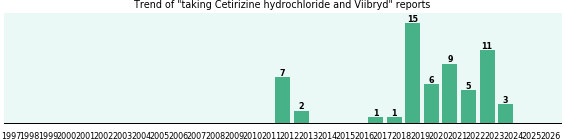
What are the common drug interactions of Cetirizine Hydrochloride and Viibryd, by gender? *:
female:
- Menstruation irregular
- Paranoia (psychotic disorder characterized by delusions of persecution with or without grandeur)
- Psychotic disorder
- Vaginal haemorrhage (vaginal bleeding)
- Vertigo
- Withdrawal syndrome (a discontinuation syndrome is a set of symptoms occurred due to discontinuation of substance)
- Pain
- Palpitations (feelings or sensations that your heart is pounding or racing)
- Fatigue (feeling of tiredness)
- Menorrhagia (an abnormally heavy bleeding and prolonged menstrual period at regular intervals)
male:
- Blood pressure decreased
- Post-traumatic stress disorder
- Sciatica (a set of symptoms including pain caused by general compression or irritation of one of five spinal nerve roots of each sciatic nerve)
- Shoulder operation
What are the common drug interactions of Cetirizine Hydrochloride and Viibryd, by age (0-1 to 60+)? *:
0-1:
n/a
2-9:
n/a
10-19:
- Myasthenia gravis (a chronic condition that causes muscles to tire and weaken easily)
20-29:
- Concussion (short loss of normal brain function in response to a head injury)
- Contusion (a type of hematoma of tissue in which capillaries)
- Galactorrhoea (secretion of breast milk in men)
- Heart rate increased
- Pain
- Post concussion syndrome
- Respiration (transport of oxygen from the outside air to the cells within tissues)
- Surgery
- Vestibular disorder (disorders of the body's balance (vestibular) system in the inner ear)
- Abdominal pain
30-39:
- Arthralgia (joint pain)
- Synovial cyst (cyst of joint filled with synovial fluid)
- Tardive dyskinesia (a disorder that involves involuntary movements)
- Weight increased
- Weight decreased
- Back pain
- Drug abuse
- Drug diversion
- Fatigue (feeling of tiredness)
- Hallucination (an experience involving the perception of something not present)
40-49:
- Diarrhoea
- Dyspepsia (indigestion)
- Hallucination, visual (seeing things that aren't there)
- Nausea (feeling of having an urge to vomit)
- Weight decreased
50-59:
- Feeling jittery
- Abdominal discomfort
- Hyperhidrosis (abnormally increased sweating)
- Nausea (feeling of having an urge to vomit)
- Hypoaesthesia (reduced sense of touch or sensation)
- Muscle spasticity (tight or stiff muscles and an inability to control those muscles)
- Palpitations (feelings or sensations that your heart is pounding or racing)
- Paraesthesia (sensation of tingling, tickling, prickling, pricking, or burning of a person's skin with no apparent long-term physical effect)
- Decreased appetite
- Diarrhoea
60+:
- Fall
- Post procedural haemorrhage (post procedural bleeding)
- Pneumonia
- Skeletal injury (bone and supporting muscle injury)
- Tendon injury
- Rhinitis (a medical term for irritation and inflammation of the mucous membrane inside the nose)
- Sinusitis (inflammation of sinus)
- Malaise (a feeling of general discomfort or uneasiness)
- Nephrolithiasis (calculi in the kidneys)
- Chest pain
What are the existing conditions these people have? *
- Narcolepsy (brain's inability to regulate sleep-wake cycles normally): 31 people, 51.67%
- Cataplexy (loss of muscle tone accompanied by full conscious awareness): 28 people, 46.67%
- Primary Immunodeficiency Syndrome: 6 people, 10.00%
- Immunodeficiency: 6 people, 10.00%
- Hypogammaglobulinaemia (an abnormally low concentration of gamma globulin in the blood and increased risk of infection): 6 people, 10.00%
- Drowsiness: 5 people, 8.33%
- Malignant Peritoneal Neoplasm (cancer tumour of peritoneum): 4 people, 6.67%
- Polycystic Ovary Disease (cysts in the ovaries that occurs when the follicle stops developing): 3 people, 5.00%
- Obsessive-Compulsive Disorder (an anxiety disorder characterized by intrusive thoughts that produce uneasiness, apprehension, fear, or worry;): 3 people, 5.00%
- Asthma: 3 people, 5.00%
* Approximation only. Some reports may have incomplete information.
Do you take Cetirizine hydrochloride and Viibryd?
- Personalize this study to your gender, age, symptoms and drugs
- Predict drug outcomes for up to one year with AI
- Get an AI agent to monitor your drugs continuously
Related studies:
Effectiveness of, side effects of, and alternative drugs to the 2 drugs:
- Cetirizine hydrochloride (34,910 reports)
- Viibryd (11,106 reports)
Browse all drug interactions of Cetirizine hydrochloride and Viibryd:
a b c d e f g h i j k l m n o p q r s t u v w x y zSub-studies by gender and age:
Female: 0-1 2-9 10-19 20-29 30-39 40-49 50-59 60+
Male: 0-1 2-9 10-19 20-29 30-39 40-49 50-59 60+
Browse all side effects of Cetirizine hydrochloride:
a b c d e f g h i j k l m n o p q r s t u v w x y zBrowse all side effects of Viibryd:
a b c d e f g h i j k l m n o p q r s t u v w x y zBrowse all interactions between Cetirizine hydrochloride and drugs from A to Z:
a b c d e f g h i j k l m n o p q r s t u v w x y zBrowse all interactions between Viibryd and drugs from A to Z:
a b c d e f g h i j k l m n o p q r s t u v w x y zHow the study uses the data?
The study uses data from the FDA. It is based on cetirizine hydrochloride and vilazodone hydrochloride (the active ingredients of Cetirizine hydrochloride and Viibryd, respectively), and Cetirizine hydrochloride and Viibryd (the brand names). Other drugs that have the same active ingredients (e.g. generic drugs) are not considered. Dosage of drugs is not considered in the study.
How to use the study?
DO NOT STOP MEDICATIONS without first consulting your doctor. If there are any serious or long term adverse effects discovered in the study, discuss the study with your doctor to ensure that proper medication management will be in place if applicable.
Who is eHealthMe?
With medical big data and proven AI/ML algorithms, eHealthMe provides a platform for everyone to run phase IV clinical trials. We study millions of patients and 5,000 more each day. Results of our real-world drug study have been referenced on 800+ peer-reviewed medical publications, including The Lancet, Mayo Clinic Proceedings, and Nature. Our analysis results are available to researchers, health care professionals, patients (testimonials), and software developers (open API).
WARNING, DISCLAIMER, USE FOR PUBLICATION
WARNING: Please DO NOT STOP MEDICATIONS without first consulting a physician since doing so could be hazardous to your health.
DISCLAIMER: All material available on eHealthMe.com is for informational purposes only, and is not a substitute for medical advice, diagnosis, or treatment provided by a qualified healthcare provider. All information is observation-only. Our phase IV clinical studies alone cannot establish cause-effect relationship. Different individuals may respond to medication in different ways. Every effort has been made to ensure that all information is accurate, up-to-date, and complete, but no guarantee is made to that effect. The use of the eHealthMe site and its content is at your own risk.
If you use this eHealthMe study on publication, please acknowledge it with a citation: study title, URL, accessed date.
Recent studies on eHealthMe:
- Could Botox cause Mental Impairment? - 5 seconds ago
- Could Navelbine cause Acute Respiratory Failure? - 5 seconds ago
- Could Seroquel cause Ankylosing Spondylitis? - 10 seconds ago
- Could Tysabri cause Pain Of Skin? - 11 seconds ago
- Could Seroquel cause Skin Burning Sensation? - 11 seconds ago
- Drug interactions of Corlanor and Ativan - 11 seconds ago
- Could Sertraline Hydrochloride cause Dry Skin? - 15 seconds ago
- Could Ibu cause Oral Infection? - 19 seconds ago
- Weight Loss and Nervousness - 19 seconds ago
- Could Nasonex cause Renal Injury? - 20 seconds ago