Cisplatin and Claritin drug interactions - a phase IV clinical study of FDA data
Summary:
Drug interactions are reported among people who take Cisplatin (cisplatin) and Claritin (loratadine). Common drug interactions include malaise among females and nausea among males.
The phase IV clinical study analyzes what interactions people have when they take Cisplatin and Claritin. It is created by eHealthMe based on reports of 86 people who take the same drugs from the FDA, and is updated regularly.
What is Cisplatin?
Cisplatin has active ingredients of cisplatin. It is often used in chemotherapy. eHealthMe is studying from 92,837 Cisplatin users. Check the latest studies of Cisplatin.
What is Claritin?
Claritin has active ingredients of loratadine. It is often used in allergies. eHealthMe is studying from 77,315 Claritin users. Check the latest studies of Claritin.
86 people who take Cisplatin and Claritin together, and have interactions are studied.
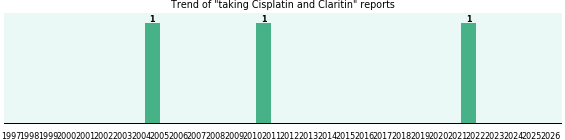
What are the common drug interactions of Cisplatin and Claritin, by gender? *:
female:
- Malaise (a feeling of general discomfort or uneasiness)
- Pain
- Platelet count decreased
- Constipation
- Pneumonia
- Dizziness
- Myalgia (muscle pain)
- Decreased appetite
- Emotional distress
- Neuropathy peripheral (surface nerve damage)
male:
- Nausea (feeling of having an urge to vomit)
- Vomiting
- Pancytopenia (medical condition in which there is a reduction in the number of red and white blood cells, as well as platelets)
- Rash
- Staphylococcal bacteraemia (a bacterial infection of blood)
- Stomatitis (inflammation of mucous membrane of mouth)
- Weight decreased
- Apathy
- Arthritis (form of joint disorder that involves inflammation of one or more joints)
- Astigmatism (refractive error of the eye in which parallel rays of light from an external source do not converge on a single focal point on the retina)
What are the common drug interactions of Cisplatin and Claritin, by age (0-1 to 60+)? *:
0-1:
n/a
2-9:
n/a
10-19:
n/a
20-29:
- Drug ineffective
- Orthostatic hypotension (a medical condition consisting of a sudden decrease in blood pressure when a person stands up)
30-39:
- Abdominal discomfort
- Decreased appetite
- Dyspepsia (indigestion)
- Nausea (feeling of having an urge to vomit)
- Ovarian cancer recurrent (reoccurrence of ovary cancer)
- Retroperitoneal lymphadenopathy (disease of lymph node between peritoneum and the posterior abdominal wall)
40-49:
- Pyrexia (fever)
- Device related infection
- Insomnia (sleeplessness)
- Pain
- Staphylococcal bacteraemia (a bacterial infection of blood)
- Apathy
- Arthralgia (joint pain)
- Arthritis (form of joint disorder that involves inflammation of one or more joints)
- Astigmatism (refractive error of the eye in which parallel rays of light from an external source do not converge on a single focal point on the retina)
- Bronchitis (inflammation of the mucous membrane in the bronchial tubes)
50-59:
- Fatigue (feeling of tiredness)
- Nausea (feeling of having an urge to vomit)
- Neutropenia (an abnormally low number of neutrophils)
- Abdominal distension
- Abdominal pain
- Alopecia (absence of hair from areas of the body)
- Blood glucose increased
- Body temperature increased
- Brain oedema (excess accumulation of fluid in the intracellular or extracellular spaces of the brain)
- Diarrhoea
60+:
- Nausea (feeling of having an urge to vomit)
- Vomiting
- Blood creatinine increased
- Contusion (a type of hematoma of tissue in which capillaries)
- Emotional distress
- Epistaxis (bleed from the nose)
- Influenza like illness
- Platelet count decreased
- Red blood cell count decreased
- Pleural effusion (water on the lungs)
What are the existing conditions these people have? *
- Nausea (feeling of having an urge to vomit): 16 people, 18.60%
- High Blood Pressure: 10 people, 11.63%
- Pain: 9 people, 10.47%
- Ovarian Cancer (cancer of ovary): 9 people, 10.47%
- Constipation: 8 people, 9.30%
- Gastroesophageal Reflux Disease (a condition in which stomach contents leak backward from the stomach into the oesophagus): 7 people, 8.14%
- Diarrhea: 6 people, 6.98%
- Cough: 6 people, 6.98%
- Non-Hodgkin's Lymphoma (malignant (cancer) cells form in the lymph system): 5 people, 5.81%
- Multiple Myeloma (cancer of the plasma cells): 5 people, 5.81%
* Approximation only. Some reports may have incomplete information.
Do you take Cisplatin and Claritin?
- Personalize this study to your gender, age, symptoms and drugs
- Predict drug outcomes for up to one year with AI
- Get an AI agent to monitor your drugs continuously
Related studies:
Effectiveness of, side effects of, and alternative drugs to the 2 drugs:
Browse all drug interactions of Cisplatin and Claritin:
a b c d e f g h i j k l m n o p q r s t u v w x y zSub-studies by gender and age:
Female: 0-1 2-9 10-19 20-29 30-39 40-49 50-59 60+
Male: 0-1 2-9 10-19 20-29 30-39 40-49 50-59 60+
Browse all side effects of Cisplatin:
a b c d e f g h i j k l m n o p q r s t u v w x y zBrowse all side effects of Claritin:
a b c d e f g h i j k l m n o p q r s t u v w x y zBrowse all interactions between Cisplatin and drugs from A to Z:
a b c d e f g h i j k l m n o p q r s t u v w x y zBrowse all interactions between Claritin and drugs from A to Z:
a b c d e f g h i j k l m n o p q r s t u v w x y zRelated publications that referenced our studies
- Schlumbrecht MP, Hehr K, "Cisplatin-induced bradycardia and the importance of the QT interval", Journal of Oncology Pharmacy Practice, 2015 Jan .
- Schlumbrecht MP, Hehr K, "Cisplatin-induced bradycardia and the importance of the QT interval", Journal of Oncology Pharmacy Practice, 2015 Jan .
How the study uses the data?
The study uses data from the FDA. It is based on cisplatin and loratadine (the active ingredients of Cisplatin and Claritin, respectively), and Cisplatin and Claritin (the brand names). Other drugs that have the same active ingredients (e.g. generic drugs) are not considered. Dosage of drugs is not considered in the study.
How to use the study?
DO NOT STOP MEDICATIONS without first consulting your doctor. If there are any serious or long term adverse effects discovered in the study, discuss the study with your doctor to ensure that proper medication management will be in place if applicable.
Who is eHealthMe?
With medical big data and proven AI/ML algorithms, eHealthMe provides a platform for everyone to run phase IV clinical trials. We study millions of patients and 5,000 more each day. Results of our real-world drug study have been referenced on 800+ peer-reviewed medical publications, including The Lancet, Mayo Clinic Proceedings, and Nature. Our analysis results are available to researchers, health care professionals, patients (testimonials), and software developers (open API).
WARNING, DISCLAIMER, USE FOR PUBLICATION
WARNING: Please DO NOT STOP MEDICATIONS without first consulting a physician since doing so could be hazardous to your health.
DISCLAIMER: All material available on eHealthMe.com is for informational purposes only, and is not a substitute for medical advice, diagnosis, or treatment provided by a qualified healthcare provider. All information is observation-only. Our phase IV clinical studies alone cannot establish cause-effect relationship. Different individuals may respond to medication in different ways. Every effort has been made to ensure that all information is accurate, up-to-date, and complete, but no guarantee is made to that effect. The use of the eHealthMe site and its content is at your own risk.
If you use this eHealthMe study on publication, please acknowledge it with a citation: study title, URL, accessed date.
Recent studies on eHealthMe:
- Multiple Myeloma and Peripheral Neuropathy Aggravated - 4 seconds ago
- Could Albuterol Sulfate cause Haematochezia? - 11 seconds ago
- Could Vimpat cause Hypotension Aggravated? - 12 seconds ago
- Could Lipitor cause Hangover? - 18 seconds ago
- Could Invanz cause High Blood Pressure? - 21 seconds ago
- Could Wellbutrin Sr cause Back Pain? - 25 seconds ago
- Could Melatonin cause Hypothermia? - 25 seconds ago
- Could Duphalac cause Hyperkalemia? - 29 seconds ago
- Hepatitis C and Disease Progression - 38 seconds ago
- Drug interactions of Yasmin and Metformin - 39 seconds ago