Depakene and Unasyn drug interactions - a phase IV clinical study of FDA data
Summary:
Drug interactions are reported among people who take Depakene (valproic acid) and Unasyn (ampicillin sodium; sulbactam sodium). Common drug interactions include carpal tunnel syndrome among females and pneumonia among males.
The phase IV clinical study analyzes what interactions people have when they take Depakene and Unasyn. It is created by eHealthMe based on reports of 47 people who take the same drugs from the FDA, and is updated regularly.
What is Depakene?
Depakene has active ingredients of valproic acid. It is often used in epilepsy. eHealthMe is studying from 14,776 Depakene users. Check the latest studies of Depakene.
What is Unasyn?
Unasyn has active ingredients of ampicillin sodium; sulbactam sodium. eHealthMe is studying from 4,474 Unasyn users. Check the latest studies of Unasyn.
47 people who take Depakene and Unasyn together, and have interactions are studied.
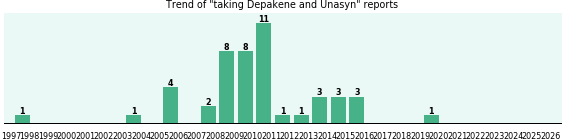
What are the common drug interactions of Depakene and Unasyn, by gender? *:
female:
- Carpal tunnel syndrome (nerve compression at wrist results numbness weakness, pain , swelling)
- Cellulitis (infection under the skin)
- Cerebral ischaemia (insufficient blood flow to the brain to meet metabolic demand)
- Chest pain
- Chronic obstructive pulmonary disease (a progressive disease that makes it hard to breathe)
- Chronic sinusitis (long lasting inflammation of the paranasal sinuses)
- Claustrophobia (fear of having no escape and being closed in small spaces)
- Clavicle fracture
- Colitis ulcerative (inflammation of colon with ulcer)
- Complex regional pain syndrome (long lasting pain condition most often affecting one of the limbs (arms, legs, hands, or feet))
male:
- Pneumonia
- Haemorrhagic diathesis (bleeding tendency)
- Erythropenia (a deficiency in the number of red blood cells)
- Gastric hypomotility (less movement of stomach)
- Gastrooesophageal reflux disease (stomach contents (food or liquid) leak backwards from the stomach into the oesophagus)
- Hyperchlorhydria (gastric acid levels are higher in stomach)
- Interstitial lung disease
- Leukopenia (less number of white blood cells in blood)
- Stress cardiomyopathy (stress-induced chronic disease of the heart muscle)
- Urinary tract infection
What are the common drug interactions of Depakene and Unasyn, by age (0-1 to 60+)? *:
0-1:
- Constipation
- Gastric hypomotility (less movement of stomach)
- Gastrooesophageal reflux disease (stomach contents (food or liquid) leak backwards from the stomach into the oesophagus)
- Hyperchlorhydria (gastric acid levels are higher in stomach)
- Urinary tract infection
- Vesicoureteric reflux (urine flows from the bladder, back up the ureter, and back into the kidneys)
2-9:
n/a
10-19:
n/a
20-29:
- Convulsion (muscles contract and relax rapidly and repeatedly, resulting in an uncontrolled shaking of the body)
- Drug level decreased
30-39:
- Disease progression
- Hydrocephalus (water on the brain)
- Hypothyroidism (abnormally low activity of the thyroid gland, resulting in retardation of growth and mental development)
- Inflammation
- Neutrophil count decreased (less than normal number of neutrophil a type of blood cell)
- Osteomyelitis (infection of bone)
- Platelet count decreased
- Radiation injury (injuries are caused by radiation)
- Septic shock (shock due to blood infection)
- Type 2 diabetes mellitus
40-49:
- Abdominal pain
- Coronary artery disease (plaque building up along the inner walls of the arteries of the heart, which narrows the arteries and restricts blood flow to the heart)
- Depression
- Drug level decreased
- Enteritis (inflammation of the small intestine)
- Epstein-barr virus antigen positive
- Gastrointestinal disorder (functional problems of gastrointestinal tract)
- Granulocytopenia (lack of granulocyte)
- Immunosuppressant drug level increased
- Lymphadenopathy (disease or enlargement of lymph nodes)
50-59:
- Thrombocytopenia (decrease of platelets in blood)
- Disseminated intravascular coagulation (systemic activation of blood coagulation)
- Toxic epidermal necrolysis (a rare, life-threatening skin condition that is usually caused by a reaction to drugs causes wide spread skin destruction)
- Erythropenia (a deficiency in the number of red blood cells)
- Leukopenia (less number of white blood cells in blood)
- Stress cardiomyopathy (stress-induced chronic disease of the heart muscle)
- Altered state of consciousness (altered state of mind)
- Anaplastic astrocytoma (tumour of the glial (supportive) tissue of the brain)
- Blood pressure increased
- Diabetes mellitus (diabetes, caused by a deficiency of the pancreatic hormone insulin)
60+:
- Pneumonia
- Neutrophil count decreased (less than normal number of neutrophil a type of blood cell)
- Hypernatraemia (an abnormally high plasma concentration of sodium ions)
- Interstitial lung disease
- Arteriosclerosis (thickening and hardening of arteries)
- Hyponatraemia (abnormally low level of sodium in the blood; associated with dehydration)
- Cardio-respiratory arrest (sudden dysfunction of heart and lungs)
- Neutropenia (an abnormally low number of neutrophils)
- Respiratory failure (inadequate gas exchange by the respiratory system)
- Cerebral infarction (less blood supply to brain resulting tissue damage)
What are the existing conditions these people have? *
- Pneumonia: 9 people, 19.15%
- Insomnia (sleeplessness): 6 people, 12.77%
- Pneumonia Aspiration (bronchopneumonia that develops due to the entrance of foreign materials into the bronchial tree): 5 people, 10.64%
- Diabetes: 5 people, 10.64%
- Staphylococcal Infection (an infection with staphylococcus bacteria): 4 people, 8.51%
- Aortic Valve Atresia (congenital malformation of the aortic valve): 4 people, 8.51%
- Cerebral Infarction (less blood supply to brain resulting tissue damage): 4 people, 8.51%
- Constipation: 4 people, 8.51%
- Gastroesophageal Reflux Disease (a condition in which stomach contents leak backward from the stomach into the oesophagus): 3 people, 6.38%
- Appetite - Decreased (decreased appetite occurs when you have a reduced desire to eat): 3 people, 6.38%
* Approximation only. Some reports may have incomplete information.
Do you take Depakene and Unasyn?
- Personalize this study to your gender, age, symptoms and drugs
- Predict drug outcomes for up to one year with AI
- Get an AI agent to monitor your drugs continuously
Related studies:
Effectiveness of, side effects of, and alternative drugs to the 2 drugs:
Browse all drug interactions of Depakene and Unasyn:
a b c d e f g h i j k l m n o p q r s t u v w x y zSub-studies by gender and age:
Female: 0-1 2-9 10-19 20-29 30-39 40-49 50-59 60+
Male: 0-1 2-9 10-19 20-29 30-39 40-49 50-59 60+
Browse all side effects of Depakene:
a b c d e f g h i j k l m n o p q r s t u v w x y zBrowse all side effects of Unasyn:
a b c d e f g h i j k l m n o p q r s t u v w x y zBrowse all interactions between Depakene and drugs from A to Z:
a b c d e f g h i j k l m n o p q r s t u v w x y zBrowse all interactions between Unasyn and drugs from A to Z:
a b c d e f g h i j k l m n o p q r s t u v w x y zRelated publications that referenced our studies
- Gupta E, Kunjal R, Cury JD, "Severe hyponatremia due to valproic acid toxicity", Journal of clinical medicine research, 2015 Jan .
- Hwabejire JO, Lu J, Liu B, Li Y, Halaweish I, Alam HB, "Valproic acid for the treatment of hemorrhagic shock: a dose-optimization study", journal of surgical research, 2014 Jan .
- Gupta E, Kunjal R, Cury JD, "Severe hyponatremia due to valproic acid toxicity", Journal of clinical medicine research, 2015 Jan .
- Hwabejire JO, Lu J, Liu B, Li Y, Halaweish I, Alam HB, "Valproic acid for the treatment of hemorrhagic shock: a dose-optimization study", journal of surgical research, 2014 Jan .
How the study uses the data?
The study uses data from the FDA. It is based on valproic acid and ampicillin sodium; sulbactam sodium (the active ingredients of Depakene and Unasyn, respectively), and Depakene and Unasyn (the brand names). Other drugs that have the same active ingredients (e.g. generic drugs) are not considered. Dosage of drugs is not considered in the study.
How to use the study?
DO NOT STOP MEDICATIONS without first consulting your doctor. If there are any serious or long term adverse effects discovered in the study, discuss the study with your doctor to ensure that proper medication management will be in place if applicable.
Who is eHealthMe?
With medical big data and proven AI/ML algorithms, eHealthMe provides a platform for everyone to run phase IV clinical trials. We study millions of patients and 5,000 more each day. Results of our real-world drug study have been referenced on 800+ peer-reviewed medical publications, including The Lancet, Mayo Clinic Proceedings, and Nature. Our analysis results are available to researchers, health care professionals, patients (testimonials), and software developers (open API).
WARNING, DISCLAIMER, USE FOR PUBLICATION
WARNING: Please DO NOT STOP MEDICATIONS without first consulting a physician since doing so could be hazardous to your health.
DISCLAIMER: All material available on eHealthMe.com is for informational purposes only, and is not a substitute for medical advice, diagnosis, or treatment provided by a qualified healthcare provider. All information is observation-only. Our phase IV clinical studies alone cannot establish cause-effect relationship. Different individuals may respond to medication in different ways. Every effort has been made to ensure that all information is accurate, up-to-date, and complete, but no guarantee is made to that effect. The use of the eHealthMe site and its content is at your own risk.
If you use this eHealthMe study on publication, please acknowledge it with a citation: study title, URL, accessed date.
Recent studies on eHealthMe:
- Revlimid and Loss Of Hearing for Men aged 60+ - now
- Revlimid and Decreased Hearing for Men aged 60+ - a second ago
- Revlimid and Deafness for Men aged 60+ - 2 seconds ago
- Revlimid and Hearing Loss for Men aged 60+ - 2 seconds ago
- Could Fintepla cause Drug Ineffective? - 17 seconds ago
- Could Pyridoxine Hydrochloride cause Appetite - Decreased? - 21 seconds ago
- Could Pyridoxine Hydrochloride cause Appetite Decreased? - 21 seconds ago
- Could Propofol cause Hepatitis C? - 24 seconds ago
- Drug interactions of Fludara and Alprazolam - 27 seconds ago
- Could Propacet 100 cause Coronary Heart Disease? - 31 seconds ago