Dothiepin hydrochloride and Folic acid drug interactions - a phase IV clinical study of FDA data
Summary:
Drug interactions are reported among people who take Dothiepin hydrochloride (dothiepin hydrochloride) and Folic acid (folic acid). Common drug interactions include constipation among females and myocardial ischaemia among males.
The phase IV clinical study analyzes what interactions people have when they take Dothiepin hydrochloride and Folic acid. It is created by eHealthMe based on reports of 47 people who take the same drugs from the FDA, and is updated regularly.
What is Dothiepin hydrochloride?
Dothiepin hydrochloride has active ingredients of dothiepin hydrochloride. It is often used in depression. eHealthMe is studying from 830 Dothiepin hydrochloride users. Check the latest studies of Dothiepin hydrochloride.
What is Folic acid?
Folic acid has active ingredients of folic acid. It is often used in rheumatoid arthritis. eHealthMe is studying from 165,025 Folic acid users. Check the latest studies of Folic acid.
47 people who take Dothiepin hydrochloride and Folic acid together, and have interactions are studied.
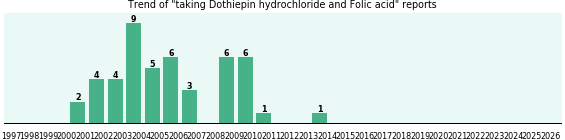
What are the common drug interactions of Dothiepin Hydrochloride and Folic Acid, by gender? *:
female:
- Constipation
- Urinary tract infection
- Bronchiectasis (abnormal widening of the bronchi or their branches, causing a risk of infection)
- Left ventricular failure (left ventricle fails to contract forcefully)
- Pancytopenia (medical condition in which there is a reduction in the number of red and white blood cells, as well as platelets)
- Pneumonia
- Breast cancer
- Facial palsy (paralysis of face nerve)
- Obliterative bronchiolitis (bronchiolar inflammation)
- Ovarian cancer (cancer of ovary)
male:
- Myocardial ischaemia (the blood flow through one or more of the blood vessels that lead to heart (coronary arteries) is decreased)
- Cardiac arrest
- Oral discomfort (pain or irritation in mouth)
- Ear pain
- Musculoskeletal stiffness (stiffness of the body's muscles, joints, tendons, ligaments and nerves)
- Neck pain
- Tinnitus (a ringing in the ears)
- Vision blurred
- Angina pectoris (chest pain due to ischemia of the heart muscle)
- Bile duct cancer
What are the common drug interactions of Dothiepin Hydrochloride and Folic Acid, by age (0-1 to 60+)? *:
0-1:
n/a
2-9:
n/a
10-19:
n/a
20-29:
n/a
30-39:
- Cyanosis (lack of oxygen in body leads to blue appearance of skin ,mucous membrane nails)
- Face oedema (swelling of face)
- Myocardial ischaemia (the blood flow through one or more of the blood vessels that lead to heart (coronary arteries) is decreased)
- Myocarditis (inflammation of heart muscle myocardium)
- Wheezing (a high-pitched whistling sound made while you breath)
40-49:
- Breast cancer
- Asthma
- Rash
50-59:
- Eczema (patches of skin become rough and inflamed, with itching and bleeding blisters)
- Hypoaesthesia oral (reduced sense of touch or sensation in mouth)
- Oral discomfort (pain or irritation in mouth)
- Ovarian cancer (cancer of ovary)
- Bile duct cancer
- Cellulitis (infection under the skin)
- Colitis ulcerative (inflammation of colon with ulcer)
- Constipation
- Dermatitis psoriasiform (large white or silver flakes on the skin)
- Herpes simplex (herpes simplex is a common viral infection)
60+:
- Bronchiectasis (abnormal widening of the bronchi or their branches, causing a risk of infection)
- Constipation
- Obliterative bronchiolitis (bronchiolar inflammation)
- Pulmonary fibrosis (formation or development of excess fibrous connective tissue (fibrosis) in the lungs)
- Tuberculosis (a bacterial infection by mycobacterium tuberculosis)
- Upper respiratory tract infection
- Ear pain
- Musculoskeletal stiffness (stiffness of the body's muscles, joints, tendons, ligaments and nerves)
- Neck pain
- Tinnitus (a ringing in the ears)
What are the existing conditions these people have? *
- High Blood Pressure: 5 people, 10.64%
- Pain: 4 people, 8.51%
- Osteoporosis (bones weak and more likely to break): 4 people, 8.51%
- Insomnia (sleeplessness): 4 people, 8.51%
- Breast Cancer: 4 people, 8.51%
- Psoriatic Arthropathy (inflammation of the skin and joints with kin condition which typically causes patches (plaques) of red, scaly skin to develop): 3 people, 6.38%
* Approximation only. Some reports may have incomplete information.
Do you take Dothiepin hydrochloride and Folic acid?
- Personalize this study to your gender, age, symptoms and drugs
- Predict drug outcomes for up to one year with AI
- Get an AI agent to monitor your drugs continuously
Related studies:
Effectiveness of, side effects of, and alternative drugs to the 2 drugs:
- Dothiepin hydrochloride (830 reports)
- Folic acid (165,025 reports)
Browse all drug interactions of Dothiepin hydrochloride and Folic acid:
a b c d e f g h i j k l m n o p q r s t u v w x y zSub-studies by gender and age:
Female: 0-1 2-9 10-19 20-29 30-39 40-49 50-59 60+
Male: 0-1 2-9 10-19 20-29 30-39 40-49 50-59 60+
Browse all side effects of Dothiepin hydrochloride:
a b c d e f g h i j k l m n o p q r s t u v w x y zBrowse all side effects of Folic acid:
a b c d e f g h i j k l m n o p q r s t u v w x y zBrowse all interactions between Dothiepin hydrochloride and drugs from A to Z:
a b c d e f g h i j k l m n o p q r s t u v w x y zBrowse all interactions between Folic acid and drugs from A to Z:
a b c d e f g h i j k l m n o p q r s t u v w x y zHow the study uses the data?
The study uses data from the FDA. It is based on dothiepin hydrochloride and folic acid (the active ingredients of Dothiepin hydrochloride and Folic acid, respectively), and Dothiepin hydrochloride and Folic acid (the brand names). Other drugs that have the same active ingredients (e.g. generic drugs) are not considered. Dosage of drugs is not considered in the study.
How to use the study?
DO NOT STOP MEDICATIONS without first consulting your doctor. If there are any serious or long term adverse effects discovered in the study, discuss the study with your doctor to ensure that proper medication management will be in place if applicable.
Who is eHealthMe?
With medical big data and proven AI/ML algorithms, eHealthMe provides a platform for everyone to run phase IV clinical trials. We study millions of patients and 5,000 more each day. Results of our real-world drug study have been referenced on 800+ peer-reviewed medical publications, including The Lancet, Mayo Clinic Proceedings, and Nature. Our analysis results are available to researchers, health care professionals, patients (testimonials), and software developers (open API).
WARNING, DISCLAIMER, USE FOR PUBLICATION
WARNING: Please DO NOT STOP MEDICATIONS without first consulting a physician since doing so could be hazardous to your health.
DISCLAIMER: All material available on eHealthMe.com is for informational purposes only, and is not a substitute for medical advice, diagnosis, or treatment provided by a qualified healthcare provider. All information is observation-only. Our phase IV clinical studies alone cannot establish cause-effect relationship. Different individuals may respond to medication in different ways. Every effort has been made to ensure that all information is accurate, up-to-date, and complete, but no guarantee is made to that effect. The use of the eHealthMe site and its content is at your own risk.
If you use this eHealthMe study on publication, please acknowledge it with a citation: study title, URL, accessed date.
Recent studies on eHealthMe:
- Could Oxycodone Hydrochloride cause Poor Venous Access? - 5 seconds ago
- Could Gabapentin cause Ejection Fraction? - 6 seconds ago
- Could Bactroban cause Obstructive Airways Disorder? - 8 seconds ago
- Could Venclexta cause Fever? - 8 seconds ago
- Drug interactions of Ofloxacin and Prednisolone - 21 seconds ago
- Could Gleevec cause Heart Rate Decreased? - 44 seconds ago
- Drug interactions of Strattera and Tramadol - 48 seconds ago
- Could Valium cause Change Of Bowel Habit? - 48 seconds ago
- Crohn'S Disease and Formication - 49 seconds ago
- Drug interactions of Sulfamethoxazole and Diphen - 49 seconds ago