Enablex and Finasteride drug interactions - a phase IV clinical study of FDA data
Summary:
Drug interactions are reported among people who take Enablex (darifenacin hydrobromide) and Finasteride (finasteride). Common drug interactions include muscle spasms among females and activities of daily living impaired among males.
The phase IV clinical study analyzes what interactions people have when they take Enablex and Finasteride. It is created by eHealthMe based on reports of 18 people who take the same drugs from the FDA, and is updated regularly.
What is Enablex?
Enablex has active ingredients of darifenacin hydrobromide. It is often used in urge incontinence. eHealthMe is studying from 4,934 Enablex users. Check the latest studies of Enablex.
What is Finasteride?
Finasteride has active ingredients of finasteride. It is often used in prostate examination abnormal. eHealthMe is studying from 44,177 Finasteride users. Check the latest studies of Finasteride.
18 people who take Enablex and Finasteride together, and have interactions are studied.
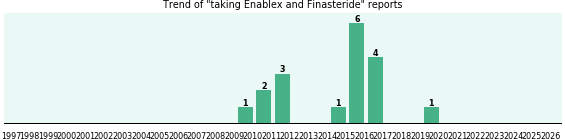
What are the common drug interactions of Enablex and Finasteride, by gender? *:
female:
- Muscle spasms (muscle contraction)
- Neck pain
- Pain in extremity
male:
- Activities of daily living impaired
- Asthenia (weakness)
- Oropharyngeal pain
- Abdominal distension
- Acute coronary syndrome (acute chest pain and other symptoms that happen because the heart does not get blood)
- Agitation (state of anxiety or nervous excitement)
- Amnesia (deficit in memory caused by brain damage, disease, or psychological trauma)
- Angina unstable (chest pain due to ischemia of the heart muscle- unstable)
- Anxiety
- Apraxia (disorder that affects a person's ability to organize the movements of the muscles used in speech)
What are the common drug interactions of Enablex and Finasteride, by age (0-1 to 60+)? *:
0-1:
n/a
2-9:
n/a
10-19:
n/a
20-29:
n/a
30-39:
n/a
40-49:
n/a
50-59:
- Drug administration error
- Drug ineffective
- Hypertonic bladder (bladder-storage function that causes a sudden urge to urinate)
- Urinary retention (the inability to completely or partially empty the bladder)
60+:
- Abdominal pain upper
- Neck pain
- Apraxia (disorder that affects a person's ability to organize the movements of the muscles used in speech)
- Arrhythmia (irregular heartbeat)
- Arterial occlusive disease (slow process through which arteries throughout the body become progressively narrowed and eventually completely blocked)
- Arteriosclerosis (thickening and hardening of arteries)
- Arthralgia (joint pain)
- Asthenia (weakness)
- Ataxia (loss of full control of bodily movements)
- Back pain
What are the existing conditions these people have? *
- Parkinson's Disease: 6 people, 33.33%
- Prostatic Disorder: 2 people, 11.11%
- Gait Disturbance: 2 people, 11.11%
- High Blood Cholesterol: 2 people, 11.11%
- Urinary Tract Infection: 1 person, 5.56%
- High Blood Pressure: 1 person, 5.56%
- Atrial Fibrillation/flutter (atrial fibrillation and flutter are abnormal heart rhythms in which the atria, or upper chambers of the heart, are out of sync with the ventricles): 1 person, 5.56%
- Bladder Disorder: 1 person, 5.56%
- Bronchitis (inflammation of the mucous membrane in the bronchial tubes): 1 person, 5.56%
- Erection Problems: 1 person, 5.56%
* Approximation only. Some reports may have incomplete information.
Do you take Enablex and Finasteride?
- Personalize this study to your gender, age, symptoms and drugs
- Predict drug outcomes for up to one year with AI
- Get an AI agent to monitor your drugs continuously
Related studies:
Effectiveness of, side effects of, and alternative drugs to the 2 drugs:
- Enablex (4,934 reports)
- Finasteride (44,177 reports)
Browse all drug interactions of Enablex and Finasteride:
a b c d e f g h i j k l m n o p q r s t u v w x y zSub-studies by gender and age:
Female: 0-1 2-9 10-19 20-29 30-39 40-49 50-59 60+
Male: 0-1 2-9 10-19 20-29 30-39 40-49 50-59 60+
Browse all side effects of Enablex:
a b c d e f g h i j k l m n o p q r s t u v w x y zBrowse all side effects of Finasteride:
a b c d e f g h i j k l m n o p q r s t u v w x y zBrowse all interactions between Enablex and drugs from A to Z:
a b c d e f g h i j k l m n o p q r s t u v w x y zBrowse all interactions between Finasteride and drugs from A to Z:
a b c d e f g h i j k l m n o p q r s t u v w x y zRelated publications that referenced our studies
- Fouda AM, Bazeed AM, "Hematuria and Hematospermia Associated with the Use of Finasteride for the Treatment of Androgenic Alopecia: A Case Report", Drug Safety-Case Reports, 2017 Dec .
- Fouda AM, Bazeed AM, "Hematuria and Hematospermia Associated with the Use of Finasteride for the Treatment of Androgenic Alopecia: A Case Report", Drug Safety-Case Reports, 2017 Dec .
How the study uses the data?
The study uses data from the FDA. It is based on darifenacin hydrobromide and finasteride (the active ingredients of Enablex and Finasteride, respectively), and Enablex and Finasteride (the brand names). Other drugs that have the same active ingredients (e.g. generic drugs) are not considered. Dosage of drugs is not considered in the study.
How to use the study?
DO NOT STOP MEDICATIONS without first consulting your doctor. If there are any serious or long term adverse effects discovered in the study, discuss the study with your doctor to ensure that proper medication management will be in place if applicable.
Who is eHealthMe?
With medical big data and proven AI/ML algorithms, eHealthMe provides a platform for everyone to run phase IV clinical trials. We study millions of patients and 5,000 more each day. Results of our real-world drug study have been referenced on 800+ peer-reviewed medical publications, including The Lancet, Mayo Clinic Proceedings, and Nature. Our analysis results are available to researchers, health care professionals, patients (testimonials), and software developers (open API).
WARNING, DISCLAIMER, USE FOR PUBLICATION
WARNING: Please DO NOT STOP MEDICATIONS without first consulting a physician since doing so could be hazardous to your health.
DISCLAIMER: All material available on eHealthMe.com is for informational purposes only, and is not a substitute for medical advice, diagnosis, or treatment provided by a qualified healthcare provider. All information is observation-only. Our phase IV clinical studies alone cannot establish cause-effect relationship. Different individuals may respond to medication in different ways. Every effort has been made to ensure that all information is accurate, up-to-date, and complete, but no guarantee is made to that effect. The use of the eHealthMe site and its content is at your own risk.
If you use this eHealthMe study on publication, please acknowledge it with a citation: study title, URL, accessed date.
Recent studies on eHealthMe:
- Could Retrovir cause Rashes? - 4 seconds ago
- Could Vitamin B2 cause Death? - 5 seconds ago
- Drug interactions of Mycophenolic Acid and Buspirone Hcl - 15 seconds ago
- Drug interactions of Naproxen and Oxybutynin - 23 seconds ago
- Hair Loss and Fibromyalgia - 26 seconds ago
- Nephrogenic Anaemia and Prostate Cancer - 26 seconds ago
- Drug interactions of Xanax and Depakene - 29 seconds ago
- Bladder Disorder and Gastroesophageal Reflux Disease - 29 seconds ago
- Could Paracetamol cause Strabismus? - 30 seconds ago
- Could Cefazolin cause Mouth Ulcers? - 30 seconds ago