Evista and Asacol drug interactions - a phase IV clinical study of FDA data
Summary:
Drug interactions are reported among people who take Evista (raloxifene hydrochloride) and Asacol (mesalamine). Common drug interactions include vitreous detachment among females and accident among males.
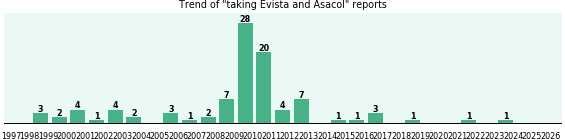
The phase IV clinical study analyzes what interactions people have when they take Evista and Asacol. It is created by eHealthMe based on reports of 96 people who take the same drugs from the FDA, and is updated regularly.
What is Evista?
Evista has active ingredients of raloxifene hydrochloride. It is often used in osteoporosis. eHealthMe is studying from 25,891 Evista users. Check the latest studies of Evista.
What is Asacol?
Asacol has active ingredients of mesalamine. It is often used in ulcerative colitis. eHealthMe is studying from 20,618 Asacol users. Check the latest studies of Asacol.
96 people who take Evista and Asacol together, and have interactions are studied.
What are the common drug interactions of Evista and Asacol, by gender? *:
female:
- Vitreous detachment (a condition of the eye in which the vitreous humour separates from the retina)
- Abdominal pain
- Dysphagia (a condition in which swallowing is difficult or painful)
- Platelet count increased
- Lumbar spinal stenosis (a medical condition in which the spinal canal narrows and compresses the spinal cord and nerves at the level of the lumbar bone)
- Tooth extraction
- Nasal congestion (blockage of the nasal passages usually due to membranes lining the nose becoming swollen from inflamed blood vessels)
- Scab (a hard coating on the skin formed during the wound healing)
- Hypogammaglobulinaemia (an abnormally low concentration of gamma globulin in the blood and increased risk of infection)
- Osteonecrosis of jaw (death of bone of jaw)
male:
- Accident
- Arthralgia (joint pain)
- Contusion (a type of hematoma of tissue in which capillaries)
- Drug ineffective
- Fall
- Fatigue (feeling of tiredness)
- Hypertension (high blood pressure)
- Impaired healing
- Macular degeneration (painless eye condition that leads to the gradual loss of central vision)
- Malaise (a feeling of general discomfort or uneasiness)
What are the common drug interactions of Evista and Asacol, by age (0-1 to 60+)? *:
0-1:
n/a
2-9:
n/a
10-19:
n/a
20-29:
n/a
30-39:
n/a
40-49:
n/a
50-59:
- Renal failure (kidney dysfunction)
- Uterine leiomyoma (uterine benign tumour derived from smooth muscle)
- Pain
- Sepsis (a severe blood infection that can lead to organ failure and death)
- Appendicitis (inflammation of the appendix)
- Aptyalism (deficiency or absence of saliva)
- Asthma
- Bone erosion
- Bone fragmentation
- Bone pain
60+:
- Pain in extremity
- Drug ineffective
- Back pain
- Bacterial infection
- Breast calcifications (deposits of calcium that can be seen on a mammogram of the breast)
- Breast mass
- Breast pain
- Contrast media allergy (reaction associated with the use of intravenous contrast material during radiology)
- Contusion (a type of hematoma of tissue in which capillaries)
- Diarrhoea
What are the existing conditions these people have? *
- Systemic Lupus Erythematosus (an autoimmune disease, which means the body's immune system mistakenly, attacks healthy tissue): 28 people, 29.17%
- Crohn's Disease (a condition that causes inflammation of the gastrointestinal tract): 20 people, 20.83%
- Osteopenia (a condition where bone mineral density is lower than normal): 12 people, 12.50%
- Thrombocytopenia (decrease of platelets in blood): 11 people, 11.46%
* Approximation only. Some reports may have incomplete information.
Do you take Evista and Asacol?
- Personalize this study to your gender, age, symptoms and drugs
- Predict drug outcomes for up to one year with AI
- Get an AI agent to monitor your drugs continuously
Related studies:
Effectiveness of, side effects of, and alternative drugs to the 2 drugs:
Browse all drug interactions of Evista and Asacol:
a b c d e f g h i j k l m n o p q r s t u v w x y zSub-studies by gender and age:
Female: 0-1 2-9 10-19 20-29 30-39 40-49 50-59 60+
Male: 0-1 2-9 10-19 20-29 30-39 40-49 50-59 60+
Browse all side effects of Evista:
a b c d e f g h i j k l m n o p q r s t u v w x y zBrowse all side effects of Asacol:
a b c d e f g h i j k l m n o p q r s t u v w x y zBrowse all interactions between Evista and drugs from A to Z:
a b c d e f g h i j k l m n o p q r s t u v w x y zBrowse all interactions between Asacol and drugs from A to Z:
a b c d e f g h i j k l m n o p q r s t u v w x y zRelated publications that referenced our studies
- Jacobsson H, Eriksen J, Karlén P, "Mesalazine-induced renal calculi", The American journal of case reports, 2015 Jan .
- Jacobsson H, Eriksen J, Karlén P, "Mesalazine-induced renal calculi", The American journal of case reports, 2015 Jan .
How the study uses the data?
The study uses data from the FDA. It is based on raloxifene hydrochloride and mesalamine (the active ingredients of Evista and Asacol, respectively), and Evista and Asacol (the brand names). Other drugs that have the same active ingredients (e.g. generic drugs) are not considered. Dosage of drugs is not considered in the study.
How to use the study?
DO NOT STOP MEDICATIONS without first consulting your doctor. If there are any serious or long term adverse effects discovered in the study, discuss the study with your doctor to ensure that proper medication management will be in place if applicable.
Who is eHealthMe?
With medical big data and proven AI/ML algorithms, eHealthMe provides a platform for everyone to run phase IV clinical trials. We study millions of patients and 5,000 more each day. Results of our real-world drug study have been referenced on 800+ peer-reviewed medical publications, including The Lancet, Mayo Clinic Proceedings, and Nature. Our analysis results are available to researchers, health care professionals, patients (testimonials), and software developers (open API).
WARNING, DISCLAIMER, USE FOR PUBLICATION
WARNING: Please DO NOT STOP MEDICATIONS without first consulting a physician since doing so could be hazardous to your health.
DISCLAIMER: All material available on eHealthMe.com is for informational purposes only, and is not a substitute for medical advice, diagnosis, or treatment provided by a qualified healthcare provider. All information is observation-only. Our phase IV clinical studies alone cannot establish cause-effect relationship. Different individuals may respond to medication in different ways. Every effort has been made to ensure that all information is accurate, up-to-date, and complete, but no guarantee is made to that effect. The use of the eHealthMe site and its content is at your own risk.
If you use this eHealthMe study on publication, please acknowledge it with a citation: study title, URL, accessed date.
Recent studies on eHealthMe:
- Could Felbatol cause Fever? - a second ago
- Drug interactions of Cortef and Ranexa - 2 seconds ago
- Drug interactions of Metochlopramide and Ondansetron - 2 seconds ago
- Could Finasteride cause Lobar Pneumonia? - 7 seconds ago
- Drug interactions of Olanzapine and Breo Ellipta - 8 seconds ago
- Could Temazepam cause Femur Fracture? - 20 seconds ago
- Drug interactions of Clonazepam and Zestril - 22 seconds ago
- Drug interactions of Ammonium Lactate and Ketoconazole - 24 seconds ago
- Could Dyazide cause Stomatitis? - 26 seconds ago
- Drug interactions of Tamsulosin Hydrochloride and Diclofenac - 28 seconds ago