Lorazepam and Motrin ib drug interactions - a phase IV clinical study of FDA data
Summary:
Drug interactions are reported among people who take Lorazepam (lorazepam) and Motrin ib (ibuprofen). Common drug interactions include nasopharyngitis among females and alopecia among males.
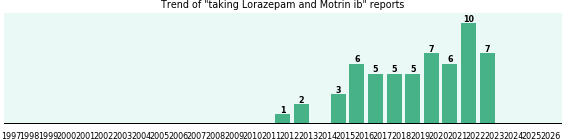
The phase IV clinical study analyzes what interactions people have when they take Lorazepam and Motrin ib. It is created by eHealthMe based on reports of 57 people who take the same drugs from the FDA, and is updated regularly.
What is Lorazepam?
Lorazepam has active ingredients of lorazepam. It is often used in stress and anxiety. eHealthMe is studying from 165,639 Lorazepam users. Check the latest studies of Lorazepam.
What is Motrin ib?
Motrin ib has active ingredients of ibuprofen. It is often used in pain. eHealthMe is studying from 3,772 Motrin ib users. Check the latest studies of Motrin ib.
57 people who take Lorazepam and Motrin ib together, and have interactions are studied.
What are the common drug interactions of Lorazepam and Motrin Ib, by gender? *:
female:
- Nasopharyngitis (inflammation of the nasopharynx)
- Neoplasm malignant (cancer tumour)
- Nervousness
- Nonspecific reaction (unspecified reaction)
- Oropharyngeal pain
- Palpitations (feelings or sensations that your heart is pounding or racing)
- Pollakiuria (abnormally frequent passage of relatively small quantities or urine)
- Productive cough
- Pruritus (severe itching of the skin)
- Rash
male:
- Alopecia (absence of hair from areas of the body)
- Epistaxis (bleed from the nose)
- Balance disorder
- Chronic obstructive pulmonary disease (a progressive disease that makes it hard to breathe)
- Constipation
- Dysgeusia (disorder of the sense of taste)
- Eating disorder
- Emphysema (chronic respiratory disease - over inflation of the air sacs (alveoli) in the lungs)
- Fatigue (feeling of tiredness)
- Gait disturbance
What are the common drug interactions of Lorazepam and Motrin Ib, by age (0-1 to 60+)? *:
0-1:
n/a
2-9:
n/a
10-19:
n/a
20-29:
n/a
30-39:
- Agitation (state of anxiety or nervous excitement)
- Blood sodium decreased
- Chest pain
- Disease progression
- Dyspnoea (difficult or laboured respiration)
- Injection site erythema (redness at injection site)
- Injection site mass
- Injection site pain
- Low density lipoprotein
- Seizure (abnormal excessive or synchronous neuronal activity in the brain)
40-49:
- Aggression
- Alopecia (absence of hair from areas of the body)
- Decreased appetite
- Mood swings (an extreme or rapid change in mood)
- Poor quality sleep
- Dyspnoea (difficult or laboured respiration)
- Fall
- Gait disturbance
- Hair colour changes
- Hair disorder
50-59:
- Alcohol abuse
- Cellulitis (infection under the skin)
- Cough
- Depression
- Diarrhoea
- Fungal sepsis (whole body infection by fungus)
- Hepatic enzyme increased
- Hypophagia (reduced food intake)
- Nasopharyngitis (inflammation of the nasopharynx)
- Nausea (feeling of having an urge to vomit)
60+:
- Drug hypersensitivity
- Alopecia (absence of hair from areas of the body)
- Dysgeusia (disorder of the sense of taste)
- Eating disorder
- Eye irritation
- Flushing (the warm, red condition of human skin)
- Lacrimation increased
- Myocardial infarction (destruction of heart tissue resulting from obstruction of the blood supply to the heart muscle)
- Nausea (feeling of having an urge to vomit)
- Nonspecific reaction (unspecified reaction)
What are the existing conditions these people have? *
- Narcolepsy (brain's inability to regulate sleep-wake cycles normally): 8 people, 14.04%
- Multiple Sclerosis (a nervous system disease that affects your brain and spinal cord. it damages the myelin sheath): 5 people, 8.77%
- Multiple Myeloma (cancer of the plasma cells): 5 people, 8.77%
- Cataplexy (loss of muscle tone accompanied by full conscious awareness): 4 people, 7.02%
- Parkinson's Disease: 3 people, 5.26%
- Constipation: 3 people, 5.26%
- Breast Cancer: 3 people, 5.26%
- Asthma: 3 people, 5.26%
* Approximation only. Some reports may have incomplete information.
Do you take Lorazepam and Motrin ib?
- Personalize this study to your gender, age, symptoms and drugs
- Predict drug outcomes for up to one year with AI
- Get an AI agent to monitor your drugs continuously
Related studies:
Effectiveness of, side effects of, and alternative drugs to the 2 drugs:
Browse all drug interactions of Lorazepam and Motrin ib:
a b c d e f g h i j k l m n o p q r s t u v w x y zSub-studies by gender and age:
Female: 0-1 2-9 10-19 20-29 30-39 40-49 50-59 60+
Male: 0-1 2-9 10-19 20-29 30-39 40-49 50-59 60+
Browse all side effects of Lorazepam:
a b c d e f g h i j k l m n o p q r s t u v w x y zBrowse all side effects of Motrin ib:
a b c d e f g h i j k l m n o p q r s t u v w x y zBrowse all interactions between Lorazepam and drugs from A to Z:
a b c d e f g h i j k l m n o p q r s t u v w x y zBrowse all interactions between Motrin ib and drugs from A to Z:
a b c d e f g h i j k l m n o p q r s t u v w x y zRelated publications that referenced our studies
- Moslim MA, Sodeman TC, Nawras AT, "A Case of Suggested Ibuprofen-Induced Acute Pancreatitis", American journal of therapeutics, 2016 Nov .
- Moslim MA, Sodeman TC, Nawras AT, "A Case of Suggested Ibuprofen-Induced Acute Pancreatitis", American journal of therapeutics, 2016 Nov .
How the study uses the data?
The study uses data from the FDA. It is based on lorazepam and ibuprofen (the active ingredients of Lorazepam and Motrin ib, respectively), and Lorazepam and Motrin ib (the brand names). Other drugs that have the same active ingredients (e.g. generic drugs) are not considered. Dosage of drugs is not considered in the study.
How to use the study?
DO NOT STOP MEDICATIONS without first consulting your doctor. If there are any serious or long term adverse effects discovered in the study, discuss the study with your doctor to ensure that proper medication management will be in place if applicable.
Who is eHealthMe?
With medical big data and proven AI/ML algorithms, eHealthMe provides a platform for everyone to run phase IV clinical trials. We study millions of patients and 5,000 more each day. Results of our real-world drug study have been referenced on 800+ peer-reviewed medical publications, including The Lancet, Mayo Clinic Proceedings, and Nature. Our analysis results are available to researchers, health care professionals, patients (testimonials), and software developers (open API).
WARNING, DISCLAIMER, USE FOR PUBLICATION
WARNING: Please DO NOT STOP MEDICATIONS without first consulting a physician since doing so could be hazardous to your health.
DISCLAIMER: All material available on eHealthMe.com is for informational purposes only, and is not a substitute for medical advice, diagnosis, or treatment provided by a qualified healthcare provider. All information is observation-only. Our phase IV clinical studies alone cannot establish cause-effect relationship. Different individuals may respond to medication in different ways. Every effort has been made to ensure that all information is accurate, up-to-date, and complete, but no guarantee is made to that effect. The use of the eHealthMe site and its content is at your own risk.
If you use this eHealthMe study on publication, please acknowledge it with a citation: study title, URL, accessed date.
Recent studies on eHealthMe:
- Vaginal Bleeding Between Periods and Drowsiness - a second ago
- Hypercalcaemia and Haemoglobin Decreased - 5 seconds ago
- Could Tudorza Pressair cause Enlarged Heart? - 7 seconds ago
- Could Propulsid cause Injury? - 7 seconds ago
- Drug interactions of Eliquis and Gentamicin - 10 seconds ago
- Could Cabergoline cause Body Temperature Decreased? - 27 seconds ago
- Drug interactions of Sodium Bicarbonate and Thiamine - a minute ago
- Could Glutathione cause Burning Sensation? - a minute ago
- Drug interactions of Carafate and Sinemet - a minute ago
- Could Bactrim cause Cheilitis? - a minute ago