Milk of magnesia and Prograf drug interactions - a phase IV clinical study of FDA data
Summary:
Drug interactions are reported among people who take Milk of magnesia (magnesium hydroxide) and Prograf (tacrolimus). Common drug interactions include chronic kidney disease among females and abscess among males.
The phase IV clinical study analyzes what interactions people have when they take Milk of magnesia and Prograf. It is created by eHealthMe based on reports of 18 people who take the same drugs from the FDA, and is updated regularly.
What is Milk of magnesia?
Milk of magnesia has active ingredients of magnesium hydroxide. It is often used in constipation. eHealthMe is studying from 9,699 Milk of magnesia users. Check the latest studies of Milk of magnesia.
What is Prograf?
Prograf has active ingredients of tacrolimus. It is often used in kidney transplant. eHealthMe is studying from 42,230 Prograf users. Check the latest studies of Prograf.
18 people who take Milk of magnesia and Prograf together, and have interactions are studied.
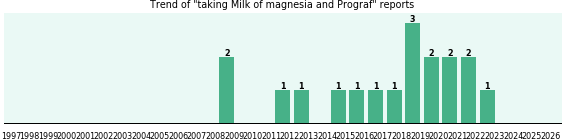
What are the common drug interactions of Milk Of Magnesia and Prograf, by gender? *:
female:
- Chronic kidney disease
- Acute respiratory failure
- Death
- Pneumonia
- Abdominal pain
- Acute pulmonary oedema (sudden deposit of fluid in the lung))
- Diarrhoea
- Dyspnoea (difficult or laboured respiration)
- Nausea (feeling of having an urge to vomit)
- Pneumothorax (the presence of air or gas in the cavity between the lungs and the chest wall, causing collapse of the lung)
male:
- Abscess (pus)
- Blood creatinine increased
- Vomiting
- Blood bilirubin decreased
- Blood osmolarity increased
- Blood urea increased
- Chronic myelomonocytic leukaemia (cancers of the blood-forming cells of the bone marrow)
- Platelet count increased
- Red cell distribution width increased
- Weight gain poor
What are the common drug interactions of Milk Of Magnesia and Prograf, by age (0-1 to 60+)? *:
0-1:
- Capillary leak syndrome (capillary leaks plasma)
- Hypotension (abnormally low blood pressure)
2-9:
- Cough
- Pneumonia
- Vomiting
- Blood bilirubin decreased
- Blood osmolarity increased
- Blood urea increased
- Platelet count increased
- Red cell distribution width increased
- Weight gain poor
- White blood cell count increased
10-19:
n/a
20-29:
- Abdominal pain
30-39:
n/a
40-49:
- Abscess (pus)
- Blood creatinine increased
- Exostosis (formation of new bone on the surface of a bone)
- International normalised ratio increased
- Localised infection (infection at the single location)
- Muscular weakness (muscle weakness)
- Post procedural haemorrhage (post procedural bleeding)
- Skin ulcer
50-59:
- Pneumonia
- Acute respiratory failure
- Sepsis (a severe blood infection that can lead to organ failure and death)
- Acute pulmonary oedema (sudden deposit of fluid in the lung))
- Cardiac failure congestive
- Cytomegalovirus viraemia (cytomegalo virus in blood stream)
- Death
- Dyspnoea (difficult or laboured respiration)
- Fluid overload (too much fluid in the blood)
- Fluid retention (an abnormal accumulation of fluid in the blood)
60+:
- Chronic kidney disease
- Death
- Chronic myelomonocytic leukaemia (cancers of the blood-forming cells of the bone marrow)
- Acute respiratory failure
- Diarrhoea
- Nausea (feeling of having an urge to vomit)
- Pneumonia
- Pneumothorax (the presence of air or gas in the cavity between the lungs and the chest wall, causing collapse of the lung)
- Renal failure (kidney dysfunction)
- Vomiting
What are the existing conditions these people have? *
- High Blood Pressure: 5 people, 27.78%
- Pain: 5 people, 27.78%
- Gastroesophageal Reflux Disease (a condition in which stomach contents leak backward from the stomach into the oesophagus): 4 people, 22.22%
- Bacterial Infection: 3 people, 16.67%
- Pneumonia: 3 people, 16.67%
- Cardiac Disorder: 3 people, 16.67%
- Nausea (feeling of having an urge to vomit): 3 people, 16.67%
- Colitis (inflammation of colon): 3 people, 16.67%
- High Blood Cholesterol: 3 people, 16.67%
- Immunodeficiency Disorders: 2 people, 11.11%
* Approximation only. Some reports may have incomplete information.
Do you take Milk of magnesia and Prograf?
- Personalize this study to your gender, age, symptoms and drugs
- Predict drug outcomes for up to one year with AI
- Get an AI agent to monitor your drugs continuously
Related studies:
Effectiveness of, side effects of, and alternative drugs to the 2 drugs:
- Milk of magnesia (9,699 reports)
- Prograf (42,230 reports)
Browse all drug interactions of Milk of magnesia and Prograf:
a b c d e f g h i j k l m n o p q r s t u v w x y zSub-studies by gender and age:
Female: 0-1 2-9 10-19 20-29 30-39 40-49 50-59 60+
Male: 0-1 2-9 10-19 20-29 30-39 40-49 50-59 60+
Browse all side effects of Milk of magnesia:
a b c d e f g h i j k l m n o p q r s t u v w x y zBrowse all side effects of Prograf:
a b c d e f g h i j k l m n o p q r s t u v w x y zBrowse all interactions between Milk of magnesia and drugs from A to Z:
a b c d e f g h i j k l m n o p q r s t u v w x y zBrowse all interactions between Prograf and drugs from A to Z:
a b c d e f g h i j k l m n o p q r s t u v w x y zHow the study uses the data?
The study uses data from the FDA. It is based on magnesium hydroxide and tacrolimus (the active ingredients of Milk of magnesia and Prograf, respectively), and Milk of magnesia and Prograf (the brand names). Other drugs that have the same active ingredients (e.g. generic drugs) are not considered. Dosage of drugs is not considered in the study.
How to use the study?
DO NOT STOP MEDICATIONS without first consulting your doctor. If there are any serious or long term adverse effects discovered in the study, discuss the study with your doctor to ensure that proper medication management will be in place if applicable.
Who is eHealthMe?
With medical big data and proven AI/ML algorithms, eHealthMe provides a platform for everyone to run phase IV clinical trials. We study millions of patients and 5,000 more each day. Results of our real-world drug study have been referenced on 800+ peer-reviewed medical publications, including The Lancet, Mayo Clinic Proceedings, and Nature. Our analysis results are available to researchers, health care professionals, patients (testimonials), and software developers (open API).
WARNING, DISCLAIMER, USE FOR PUBLICATION
WARNING: Please DO NOT STOP MEDICATIONS without first consulting a physician since doing so could be hazardous to your health.
DISCLAIMER: All material available on eHealthMe.com is for informational purposes only, and is not a substitute for medical advice, diagnosis, or treatment provided by a qualified healthcare provider. All information is observation-only. Our phase IV clinical studies alone cannot establish cause-effect relationship. Different individuals may respond to medication in different ways. Every effort has been made to ensure that all information is accurate, up-to-date, and complete, but no guarantee is made to that effect. The use of the eHealthMe site and its content is at your own risk.
If you use this eHealthMe study on publication, please acknowledge it with a citation: study title, URL, accessed date.
Recent studies on eHealthMe:
- Drug interactions of Cranberry and Thiamine Hydrochloride - 8 seconds ago
- Could Micardis cause Back Disorder? - 10 seconds ago
- Could Enoxaparin Sodium cause Haematoma? - 13 seconds ago
- Could Topiramate cause Laboratory Test Abnormal? - 14 seconds ago
- Could Clonazepam cause Pancreatitis? - 14 seconds ago
- Could Xanax cause Gastrointestinal Motility Disorder? - 16 seconds ago
- Could Metformin cause Blood Chloride Increased? - 21 seconds ago
- Could Temazepam cause Blood Pressure Diastolic Increased? - 31 seconds ago
- Drug interactions of Duloxetine Hydrochloride and Desflurane - 33 seconds ago
- Drug interactions of Zetonna and Epipen - 34 seconds ago