Orphenadrine citrate and Allegra drug interactions - a phase IV clinical study of FDA data
Summary:
Drug interactions are reported among people who take Orphenadrine citrate (orphenadrine citrate) and Allegra (fexofenadine hydrochloride). Common drug interactions include deep vein thrombosis among females and abscess jaw among males.
The phase IV clinical study analyzes what interactions people have when they take Orphenadrine citrate and Allegra. It is created by eHealthMe based on reports of 25 people who take the same drugs from the FDA, and is updated regularly.
What is Orphenadrine citrate?
Orphenadrine citrate has active ingredients of orphenadrine citrate. It is often used in muscle aches. eHealthMe is studying from 1,189 Orphenadrine citrate users. Check the latest studies of Orphenadrine citrate.
What is Allegra?
Allegra has active ingredients of fexofenadine hydrochloride. It is often used in allergies. eHealthMe is studying from 75,497 Allegra users. Check the latest studies of Allegra.
25 people who take Orphenadrine citrate and Allegra together, and have interactions are studied.
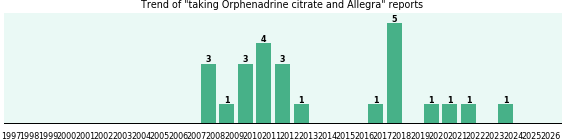
What are the common drug interactions of Orphenadrine Citrate and Allegra, by gender? *:
female:
- Deep vein thrombosis (blood clot in a major vein that usually develops in the legs and/or pelvis)
- Dehydration (dryness resulting from the removal of water)
- Depressed mood
- Diabetes mellitus inadequate control
- Diarrhoea
- Diverticulum (out pouching of a hollow (or a fluid-filled) structure in the body)
- Dizziness
- Dry mouth
- Dry skin
- Dyskinesia (abnormality or impairment of voluntary movement)
male:
- Abscess jaw (tooth abscess or root abscess)
- Adverse drug reaction
- Dental fistula
- Depression
- Tooth disorder (tooth disease)
- Tooth impacted (a tooth that fails to fully pass through the gums)
- Toothache (tooth pain)
- Osteonecrosis (death of bone)
- Osteonecrosis of jaw (death of bone of jaw)
- Rectal prolapse (falling of rectum from normal place)
What are the common drug interactions of Orphenadrine Citrate and Allegra, by age (0-1 to 60+)? *:
0-1:
n/a
2-9:
n/a
10-19:
n/a
20-29:
- Gallbladder disorder
- Pain
- Cholecystitis (infection of gallbladder)
- Drug hypersensitivity
- Injection site haematoma (localized swelling filled with blood at injection site)
- Injection site infection
- Injection site reaction
- Pseudomonas infection (pseudomonas infection is caused by a bacterium, pseudomonas aeruginosa)
- Pyrexia (fever)
- Rash
30-39:
- Arthralgia (joint pain)
- Bone disorder
- Dysstasia (difficulty in standing)
- Femur fracture
- Fracture delayed union (delayed cure of broken bone)
- Fracture displacement
- Fracture nonunion (permanent failure of healing following a broken bone)
- Groin pain
- Haematoma (collection of blood outside the blood vessels)
- Low turnover osteopathy (slow removal of old bone and its replacement by new bone)
40-49:
- Abscess jaw (tooth abscess or root abscess)
- Adverse drug reaction
- Arthritis (form of joint disorder that involves inflammation of one or more joints)
- Arthropathy
- Chronic sinusitis (long lasting inflammation of the paranasal sinuses)
- Hypoaesthesia (reduced sense of touch or sensation)
- Tooth infection
- Venous thrombosis limb (blood clot that forms in a vein in the limb)
- Anxiety
- Dental caries
50-59:
- Anxiety
- Feeling cold
- Hot flush (sudden feelings of heat)
- Hypertension (high blood pressure)
- Nausea (feeling of having an urge to vomit)
- Nervousness
- Peripheral swelling
- Vision blurred
- Initial insomnia (feeling of inadequate or poor-quality sleep)
60+:
- Chronic kidney disease
- Renal failure (kidney dysfunction)
- Chest pain
- Cholecystitis chronic (long lasting infection of gallbladder)
- Decreased interest
- Depressed mood
- Depression
- Fall
- Femur fracture
- Fracture delayed union (delayed cure of broken bone)
What are the existing conditions these people have? *
- Gastroesophageal Reflux Disease (a condition in which stomach contents leak backward from the stomach into the oesophagus): 9 people, 36.00%
- High Blood Cholesterol: 7 people, 28.00%
- Muscle Spasms (muscle contraction): 7 people, 28.00%
- Asthma: 7 people, 28.00%
- High Blood Pressure: 7 people, 28.00%
- Fibromyalgia (a long-term condition which causes pain all over the body): 7 people, 28.00%
- Stress And Anxiety: 5 people, 20.00%
- Pain: 5 people, 20.00%
- Hypersensitivity: 5 people, 20.00%
- Migraine (headache): 5 people, 20.00%
* Approximation only. Some reports may have incomplete information.
Do you take Orphenadrine citrate and Allegra?
- Personalize this study to your gender, age, symptoms and drugs
- Predict drug outcomes for up to one year with AI
- Get an AI agent to monitor your drugs continuously
Related studies:
Effectiveness of, side effects of, and alternative drugs to the 2 drugs:
- Orphenadrine citrate (1,189 reports)
- Allegra (75,497 reports)
Browse all drug interactions of Orphenadrine citrate and Allegra:
a b c d e f g h i j k l m n o p q r s t u v w x y zSub-studies by gender and age:
Female: 0-1 2-9 10-19 20-29 30-39 40-49 50-59 60+
Male: 0-1 2-9 10-19 20-29 30-39 40-49 50-59 60+
Browse all side effects of Orphenadrine citrate:
a b c d e f g h i j k l m n o p q r s t u v w x y zBrowse all side effects of Allegra:
a b c d e f g h i j k l m n o p q r s t u v w x y zBrowse all interactions between Orphenadrine citrate and drugs from A to Z:
a b c d e f g h i j k l m n o p q r s t u v w x y zBrowse all interactions between Allegra and drugs from A to Z:
a b c d e f g h i j k l m n o p q r s t u v w x y zHow the study uses the data?
The study uses data from the FDA. It is based on orphenadrine citrate and fexofenadine hydrochloride (the active ingredients of Orphenadrine citrate and Allegra, respectively), and Orphenadrine citrate and Allegra (the brand names). Other drugs that have the same active ingredients (e.g. generic drugs) are not considered. Dosage of drugs is not considered in the study.
How to use the study?
DO NOT STOP MEDICATIONS without first consulting your doctor. If there are any serious or long term adverse effects discovered in the study, discuss the study with your doctor to ensure that proper medication management will be in place if applicable.
Who is eHealthMe?
With medical big data and proven AI/ML algorithms, eHealthMe provides a platform for everyone to run phase IV clinical trials. We study millions of patients and 5,000 more each day. Results of our real-world drug study have been referenced on 800+ peer-reviewed medical publications, including The Lancet, Mayo Clinic Proceedings, and Nature. Our analysis results are available to researchers, health care professionals, patients (testimonials), and software developers (open API).
WARNING, DISCLAIMER, USE FOR PUBLICATION
WARNING: Please DO NOT STOP MEDICATIONS without first consulting a physician since doing so could be hazardous to your health.
DISCLAIMER: All material available on eHealthMe.com is for informational purposes only, and is not a substitute for medical advice, diagnosis, or treatment provided by a qualified healthcare provider. All information is observation-only. Our phase IV clinical studies alone cannot establish cause-effect relationship. Different individuals may respond to medication in different ways. Every effort has been made to ensure that all information is accurate, up-to-date, and complete, but no guarantee is made to that effect. The use of the eHealthMe site and its content is at your own risk.
If you use this eHealthMe study on publication, please acknowledge it with a citation: study title, URL, accessed date.
Recent studies on eHealthMe:
- Could Meridia cause Swallowing Difficulty? - 22 seconds ago
- Drug interactions of Zofran and Acetaminophen And Hydrocodone Bitartrate - 32 seconds ago
- Could Alvesco cause Pressure Ulcer? - 38 seconds ago
- Drug interactions of Cetirizine Hydrochloride and Tobramycin - 39 seconds ago
- Drug interactions of Caduet and Reclast - 41 seconds ago
- Could Entocort Ec cause Musculoskeletal Pain? - a minute ago
- Could Aloe Vera cause Psoriasis? - a minute ago
- Drug interactions of Methylprednisolone and Mylotarg - a minute ago
- Drug interactions of Hydramine and Namenda Xr - a minute ago
- Drug interactions of Androgel and Viagra - a minute ago