Potassium iodide and Cholestyramine drug interactions - a phase IV clinical study of FDA data
Summary:
Drug interactions are reported among people who take Potassium iodide (potassium iodide) and Cholestyramine (cholestyramine). Common drug interactions include drug ineffective among females and drug ineffective among males.
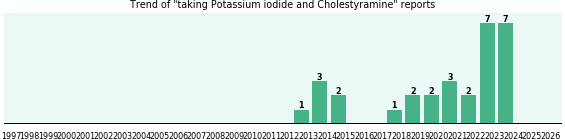
The phase IV clinical study analyzes what interactions people have when they take Potassium iodide and Cholestyramine. It is created by eHealthMe based on reports of 30 people who take the same drugs from the FDA, and is updated regularly.
What is Potassium iodide?
Potassium iodide has active ingredients of potassium iodide. It is often used in thyroid diseases. eHealthMe is studying from 1,919 Potassium iodide users. Check the latest studies of Potassium iodide.
What is Cholestyramine?
Cholestyramine has active ingredients of cholestyramine. It is often used in diarrhea. eHealthMe is studying from 9,893 Cholestyramine users. Check the latest studies of Cholestyramine.
30 people who take Potassium iodide and Cholestyramine together, and have interactions are studied.
What are the common drug interactions of Potassium Iodide and Cholestyramine, by gender? *:
female:
- Drug ineffective
- Acute hepatic failure
- Maternal exposure during pregnancy (use of substance during pregnancy)
- Hepatitis cholestatic (flow of bile from the liver is slowed or blocked)
- Hepatotoxicity (chemical-driven liver damage)
- Nephropathy toxic (damage to kidney due to toxins)
- Respiratory distress (difficulty in breathing)
- Sepsis (a severe blood infection that can lead to organ failure and death)
- Thyroid mass
- Thyrotoxic crisis (a life threatening condition due to excess secretion of thyroid hormone)
male:
- Drug ineffective
- Hyperthyroidism (over activity of the thyroid gland)
- Leukopenia (less number of white blood cells in blood)
- Neutropenia (an abnormally low number of neutrophils)
- Thrombocytopenia (decrease of platelets in blood)
- Thyrotoxic crisis (a life threatening condition due to excess secretion of thyroid hormone)
- Ventricular tachycardia (rapid heartbeat that originates in one of the lower chambers (the ventricles) of the heart)
- Acute hepatic failure
- Hepatotoxicity (chemical-driven liver damage)
- Cardiac arrest
What are the common drug interactions of Potassium Iodide and Cholestyramine, by age (0-1 to 60+)? *:
0-1:
n/a
2-9:
n/a
10-19:
n/a
20-29:
- Haemodynamic instability (disturbances in the blood movement in our body)
30-39:
- Drug ineffective
- Neutropenia (an abnormally low number of neutrophils)
- Sepsis (a severe blood infection that can lead to organ failure and death)
- Abdominal pain
- Abortion spontaneous (naturally occurring miscarriage)
- Acute respiratory distress syndrome
- Agranulocytosis (a deficiency of granulocytes in the blood, causing increased vulnerability to infection)
- Ecthyma (an ulcerative pyoderma of the skin, caused by group a beta haemolytic streptococci)
- Haemothorax (collection of blood in the pleural space (the space between the lungs and the walls of the chest))
- Immunodeficiency
40-49:
- Acute hepatic failure
- Drug ineffective
- Hepatitis cholestatic (flow of bile from the liver is slowed or blocked)
- Hepatotoxicity (chemical-driven liver damage)
- Aspartate aminotransferase increased
- Ejection fraction (the percentage of blood that is pumped out of a filled ventricle as a result of a heartbeat)
- Ischaemic hepatitis (decreased blood supply to the liver resulting in injury to liver cells)
- Myocarditis (inflammation of heart muscle myocardium)
50-59:
- Thyroid mass
- Thyrotoxic crisis (a life threatening condition due to excess secretion of thyroid hormone)
- Disseminated intravascular coagulation (systemic activation of blood coagulation)
- Haemorrhage (bleeding)
- Thrombocytopenia (decrease of platelets in blood)
- Drug ineffective
- Hyperthyroidism (over activity of the thyroid gland)
- Respiratory distress (difficulty in breathing)
60+:
- Hyperthyroidism (over activity of the thyroid gland)
- Nephropathy toxic (damage to kidney due to toxins)
- Cardiac arrest
- Cardiogenic shock (inadequate circulation of blood)
- Drug ineffective
- Thyrotoxic crisis (a life threatening condition due to excess secretion of thyroid hormone)
- Ventricular tachycardia (rapid heartbeat that originates in one of the lower chambers (the ventricles) of the heart)
What are the existing conditions these people have? *
- Atrial Fibrillation/flutter (atrial fibrillation and flutter are abnormal heart rhythms in which the atria, or upper chambers of the heart, are out of sync with the ventricles): 13 people, 43.33%
- Thyrotoxic Crisis (a life threatening condition due to excess secretion of thyroid hormone): 11 people, 36.67%
- Hyperthyroidism (over activity of the thyroid gland): 7 people, 23.33%
- Tachyarrhythmia (disturbance of the heart rhythm in which the heart rate is abnormally increased): 2 people, 6.67%
- Basedow's Disease (autoimmune disease where the thyroid is overactive, producing an excessive amount of thyroid hormones): 2 people, 6.67%
* Approximation only. Some reports may have incomplete information.
Do you take Potassium iodide and Cholestyramine?
- Personalize this study to your gender, age, symptoms and drugs
- Predict drug outcomes for up to one year with AI
- Get an AI agent to monitor your drugs continuously
Related studies:
Effectiveness of, side effects of, and alternative drugs to the 2 drugs:
- Potassium iodide (1,919 reports)
- Cholestyramine (9,893 reports)
Browse all drug interactions of Potassium iodide and Cholestyramine:
a b c d e f g h i j k l m n o p q r s t u v w x y zSub-studies by gender and age:
Female: 0-1 2-9 10-19 20-29 30-39 40-49 50-59 60+
Male: 0-1 2-9 10-19 20-29 30-39 40-49 50-59 60+
Browse all side effects of Potassium iodide:
a b c d e f g h i j k l m n o p q r s t u v w x y zBrowse all side effects of Cholestyramine:
a b c d e f g h i j k l m n o p q r s t u v w x y zBrowse all interactions between Potassium iodide and drugs from A to Z:
a b c d e f g h i j k l m n o p q r s t u v w x y zBrowse all interactions between Cholestyramine and drugs from A to Z:
a b c d e f g h i j k l m n o p q r s t u v w x y zHow the study uses the data?
The study uses data from the FDA. It is based on potassium iodide and cholestyramine (the active ingredients of Potassium iodide and Cholestyramine, respectively), and Potassium iodide and Cholestyramine (the brand names). Other drugs that have the same active ingredients (e.g. generic drugs) are not considered. Dosage of drugs is not considered in the study.
How to use the study?
DO NOT STOP MEDICATIONS without first consulting your doctor. If there are any serious or long term adverse effects discovered in the study, discuss the study with your doctor to ensure that proper medication management will be in place if applicable.
Who is eHealthMe?
With medical big data and proven AI/ML algorithms, eHealthMe provides a platform for everyone to run phase IV clinical trials. We study millions of patients and 5,000 more each day. Results of our real-world drug study have been referenced on 800+ peer-reviewed medical publications, including The Lancet, Mayo Clinic Proceedings, and Nature. Our analysis results are available to researchers, health care professionals, patients (testimonials), and software developers (open API).
WARNING, DISCLAIMER, USE FOR PUBLICATION
WARNING: Please DO NOT STOP MEDICATIONS without first consulting a physician since doing so could be hazardous to your health.
DISCLAIMER: All material available on eHealthMe.com is for informational purposes only, and is not a substitute for medical advice, diagnosis, or treatment provided by a qualified healthcare provider. All information is observation-only. Our phase IV clinical studies alone cannot establish cause-effect relationship. Different individuals may respond to medication in different ways. Every effort has been made to ensure that all information is accurate, up-to-date, and complete, but no guarantee is made to that effect. The use of the eHealthMe site and its content is at your own risk.
If you use this eHealthMe study on publication, please acknowledge it with a citation: study title, URL, accessed date.
Recent studies on eHealthMe:
- Morphine and Valium drug interactions for women aged 30-39 - a second ago
- Could Rabeprazole Sodium cause Neuroleptic Malignant Syndrome? - 2 seconds ago
- Fosrenol and Death for Men aged 40-49 - 4 seconds ago
- Fosrenol and Sudden Death for Men aged 40-49 - 4 seconds ago
- Fosrenol and Death Sudden for Men aged 40-49 - 5 seconds ago
- Could Adalat Cc cause C-Reactive Protein Increased? - 6 seconds ago
- Thyroid Cancer and drugs of ingredients of mesalamine - 6 seconds ago
- Could Sporanox cause Cervical Spinal Stenosis? - 7 seconds ago
- Humira and Aseptic Necrosis for Women aged 30-39 - 8 seconds ago
- Humira and Avascular Necrosis for Women aged 30-39 - 8 seconds ago