Rosiglitazone and Tysabri drug interactions - a phase IV clinical study of FDA data
Summary:
Drug interactions are reported among people who take Rosiglitazone (rosiglitazone maleate) and Tysabri (natalizumab). Common drug interactions include type 2 diabetes mellitus among females and arteriosclerosis coronary artery among males.
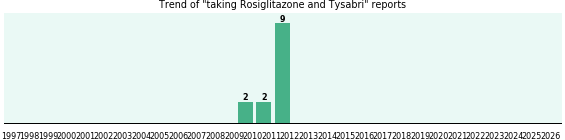
The phase IV clinical study analyzes what interactions people have when they take Rosiglitazone and Tysabri. It is created by eHealthMe based on reports of 13 people who take the same drugs from the FDA, and is updated regularly.
What is Rosiglitazone?
Rosiglitazone has active ingredients of rosiglitazone maleate. eHealthMe is studying from 4,700 Rosiglitazone users. Check the latest studies of Rosiglitazone.
What is Tysabri?
Tysabri has active ingredients of natalizumab. It is often used in multiple sclerosis. eHealthMe is studying from 221,369 Tysabri users. Check the latest studies of Tysabri.
eHealthMe: drug outcomes in the real world
eHealthMe runs one of the largest post-marketing drug safety studies in the world. We study millions of patients and 5,000 more each day. Our data-driven phase IV clinical trials have been referenced on 800+ peer-reviewed medical publications including The Lancet, Mayo Clinic Proceedings, and Nature. Tools to study our phase IV findings are available to the public, anonymous and free >>>.
13 people who take Rosiglitazone and Tysabri together, and have interactions are studied.
What are the common drug interactions of Rosiglitazone and Tysabri, by gender? *:
female:
- Type 2 diabetes mellitus
- Vasculitis (inflammation of a blood vessel or blood vessels)
- Viral infection
- Myocardial infarction (destruction of heart tissue resulting from obstruction of the blood supply to the heart muscle)
- Coronary artery disease (plaque building up along the inner walls of the arteries of the heart, which narrows the arteries and restricts blood flow to the heart)
- Stent placement
- Angioplasty
- Aphasia (damage to the parts of the brain that control language)
- Arterial stenosis (abnormal narrowing of the aortic valve in the heart)
- Brain injury
male:
- Arteriosclerosis coronary artery (thickening and hardening of arteries- coronary artery)
- Death
- Heart valve incompetence (heart's valves do not work correctly)
- Myocardial infarction (destruction of heart tissue resulting from obstruction of the blood supply to the heart muscle)
- Atrial fibrillation (fibrillation of the muscles of the atria of the heart)
- Cardiac failure congestive
- Cardiovascular disorder (heart diseases)
- Pericardial effusion (fluid around the heart)
- Urinary tract infection
What are the common drug interactions of Rosiglitazone and Tysabri, by age (0-1 to 60+)? *:
0-1:
n/a
2-9:
n/a
10-19:
n/a
20-29:
n/a
30-39:
- Agitation (state of anxiety or nervous excitement)
- Aphasia (damage to the parts of the brain that control language)
- Constipation
- Fatigue (feeling of tiredness)
- Hemiparesis (weakness on one side of the body)
- Hyperphagia (an abnormal appetite for food)
- Hypertension (high blood pressure)
- Hypoaesthesia (reduced sense of touch or sensation)
- Insomnia (sleeplessness)
- Metabolic disorder (an abnormal function and pattern of body fat. insulin resistance refers to the diminished ability of cells to respond to the action of insulin in promoting the transport of the sugar glucose, from blood into muscles and other tissues)
40-49:
- Immune system disorder
- Type 2 diabetes mellitus
- Vasculitis (inflammation of a blood vessel or blood vessels)
- Viral infection
- Myocardial infarction (destruction of heart tissue resulting from obstruction of the blood supply to the heart muscle)
- Death
- Arteriosclerosis coronary artery (thickening and hardening of arteries- coronary artery)
- Atrioventricular block first degree (heart block first degree)
- Coronary artery disease (plaque building up along the inner walls of the arteries of the heart, which narrows the arteries and restricts blood flow to the heart)
- Heart valve incompetence (heart's valves do not work correctly)
50-59:
- Acute myocardial infarction (acute heart attack)
- Bladder squamous cell carcinoma stage unspecified (bladder squamous cell cancer stage unspecified)
- Cardiac failure congestive
- Cardiovascular disorder (heart diseases)
- Cerebrovascular accident (sudden death of some brain cells due to lack of oxygen when the blood flow to the brain is impaired by blockage or rupture)
- Death
- Malaise (a feeling of general discomfort or uneasiness)
- Malignant melanoma (skin cancer rises from melancytes)
- Metastatic malignant melanoma (spreadable cancer tumour of melanine)
- Myocardial infarction (destruction of heart tissue resulting from obstruction of the blood supply to the heart muscle)
60+:
- Aphasia (damage to the parts of the brain that control language)
- Atrial fibrillation (fibrillation of the muscles of the atria of the heart)
- Cardiac failure congestive
- Cardiovascular disorder (heart diseases)
- Mental disorder (a psychological term for a mental or behavioural pattern or anomaly that causes distress or disability)
- Pericardial effusion (fluid around the heart)
- Retinal exudates (discharge from retina)
- Retinopathy (acute damage to the retina of the eye)
- Urinary tract infection
What are the existing conditions these people have? *
- Diabetes: 9 people, 69.23%
- Type 2 Diabetes: 2 people, 15.38%
- Vasculitis (inflammation of a blood vessel or blood vessels): 1 person, 7.69%
- Migraine (headache): 1 person, 7.69%
- Gait Disturbance: 1 person, 7.69%
- Hepatitis C: 1 person, 7.69%
- High Blood Pressure: 1 person, 7.69%
- Immune System Disorder: 1 person, 7.69%
- Lung Infiltration (a substance that normally includes fluid, inflammatory exudates or cells that fill a region of lung): 1 person, 7.69%
- Nausea (feeling of having an urge to vomit): 1 person, 7.69%
* Approximation only. Some reports may have incomplete information.
Do you take Rosiglitazone and Tysabri?
- Personalize this study to your gender, age, symptoms and drugs
- Predict drug outcomes for up to one year with AI
- Get an AI agent to monitor your drugs continuously
Related studies:
Effectiveness of, side effects of, and alternative drugs to the 2 drugs:
- Rosiglitazone (4,700 reports)
- Tysabri (221,369 reports)
Browse all drug interactions of Rosiglitazone and Tysabri:
a b c d e f g h i j k l m n o p q r s t u v w x y zSub-studies by gender and age:
Female: 0-1 2-9 10-19 20-29 30-39 40-49 50-59 60+
Male: 0-1 2-9 10-19 20-29 30-39 40-49 50-59 60+
Browse all side effects of Rosiglitazone:
a b c d e f g h i j k l m n o p q r s t u v w x y zBrowse all side effects of Tysabri:
a b c d e f g h i j k l m n o p q r s t u v w x y zBrowse all interactions between Rosiglitazone and drugs from A to Z:
a b c d e f g h i j k l m n o p q r s t u v w x y zBrowse all interactions between Tysabri and drugs from A to Z:
a b c d e f g h i j k l m n o p q r s t u v w x y zHow the study uses the data?
The study uses data from the FDA. It is based on rosiglitazone maleate and natalizumab (the active ingredients of Rosiglitazone and Tysabri, respectively), and Rosiglitazone and Tysabri (the brand names). Other drugs that have the same active ingredients (e.g. generic drugs) are not considered. Dosage of drugs is not considered in the study.
How to use the study?
DO NOT STOP MEDICATIONS without first consulting your doctor. If there are any serious or long term adverse effects discovered in the study, discuss the study with your doctor to ensure that proper medication management will be in place if applicable.
Who is eHealthMe?
With medical big data and proven AI/ML algorithms, eHealthMe provides a platform for everyone to run phase IV clinical trials. We study millions of patients and 5,000 more each day. Results of our real-world drug study have been referenced on 800+ peer-reviewed medical publications, including The Lancet, Mayo Clinic Proceedings, and Nature. Our analysis results are available to researchers, health care professionals, patients (testimonials), and software developers (open API).
WARNING, DISCLAIMER, USE FOR PUBLICATION
WARNING: Please DO NOT STOP MEDICATIONS without first consulting a physician since doing so could be hazardous to your health.
DISCLAIMER: All material available on eHealthMe.com is for informational purposes only, and is not a substitute for medical advice, diagnosis, or treatment provided by a qualified healthcare provider. All information is observation-only. Our phase IV clinical studies alone cannot establish cause-effect relationship. Different individuals may respond to medication in different ways. Every effort has been made to ensure that all information is accurate, up-to-date, and complete, but no guarantee is made to that effect. The use of the eHealthMe site and its content is at your own risk.
If you use this eHealthMe study on publication, please acknowledge it with a citation: study title, URL, accessed date.
Recent studies on eHealthMe:
- Could Zometa cause Hair Loss? - now
- Abdominal Pain Aggravated and Pain Exacerbated - 6 seconds ago
- Could Centrum Silver cause Flank Pain? - 10 seconds ago
- Could Glivec cause Memory Loss? - 15 seconds ago
- Abdominal Discomfort and Renal Cyst - 17 seconds ago
- Could Proair Hfa cause Diarrhea Aggravated? - 17 seconds ago
- Could Clonidine cause Spondylolisthesis? - 18 seconds ago
- Drug interactions of Trazodone Hydrochloride and Duloxetine Hydrochloride - 19 seconds ago
- Could Celecoxib cause Oedema Aggravated? - 33 seconds ago
- Could Prinivil cause Tachycardia Aggravated? - 36 seconds ago