Sandostatin and Avodart drug interactions - a phase IV clinical study of FDA data
Summary:
Drug interactions are reported among people who take Sandostatin (octreotide acetate) and Avodart (dutasteride). Common drug interactions include blood pressure systolic increased among females and fatigue among males.
The phase IV clinical study analyzes what interactions people have when they take Sandostatin and Avodart. It is created by eHealthMe based on reports of 40 people who take the same drugs from the FDA, and is updated regularly.
What is Sandostatin?
Sandostatin has active ingredients of octreotide acetate. It is often used in acromegaly. eHealthMe is studying from 46,793 Sandostatin users. Check the latest studies of Sandostatin.
What is Avodart?
Avodart has active ingredients of dutasteride. It is often used in prostate examination abnormal. eHealthMe is studying from 16,428 Avodart users. Check the latest studies of Avodart.
40 people who take Sandostatin and Avodart together, and have interactions are studied.
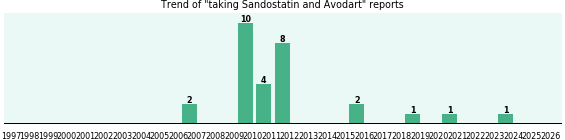
What are the common drug interactions of Sandostatin and Avodart, by gender? *:
female:
- Blood pressure systolic increased
- Fatigue (feeling of tiredness)
- Haemoglobin decreased
- Heart rate irregular
- Injection site haemorrhage (bleeding from injection site)
- Injection site pain
- Leukocytoclastic vasculitis (inflammation of small blood vessels (usually post-capillary venules in the dermis), characterized by palpable purpura)
- Petechiae (a small red or purple spot caused by bleeding into the skin)
- Platelet count decreased
- Pneumonia primary atypical (primary atypical pneumonia which were probably caused by mycoplasma pneumoniae)
male:
- Fatigue (feeling of tiredness)
- Anxiety
- Tendonitis (a condition that causes pain and swelling of tendons)
- Asthenia (weakness)
- Loss of consciousness
- Malignant neoplasm progression (cancer tumour came back)
- Pyrexia (fever)
- Urinary tract infection
- Blood pressure increased
- Dizziness
What are the common drug interactions of Sandostatin and Avodart, by age (0-1 to 60+)? *:
0-1:
- Loss of consciousness
2-9:
n/a
10-19:
n/a
20-29:
n/a
30-39:
n/a
40-49:
- Dysarthria (speech disorder)
- Hypertension (high blood pressure)
- Pain
- Abdominal discomfort
- Abdominal pain
- Amnesia (deficit in memory caused by brain damage, disease, or psychological trauma)
- Anaemia (lack of blood)
- Anhedonia (inability to experience pleasure from activities usually found enjoyable)
- Anxiety
- Aortic arteriosclerosis (hardening of the aortic arteries)
50-59:
- Anaemia (lack of blood)
- Arthralgia (joint pain)
- Basal cell carcinoma (a skin cancer, it rarely metastasizes or kills)
- Blood pressure diastolic decreased
- Blood pressure increased
- Blood urine present
- Body temperature decreased
- Diabetes mellitus (diabetes, caused by a deficiency of the pancreatic hormone insulin)
- Diarrhoea
- Dizziness
60+:
- Fatigue (feeling of tiredness)
- Decreased appetite
- Osteonecrosis of jaw (death of bone of jaw)
- Pain in jaw
- Sinus disorder (disease of sinus)
- Weight decreased
- Cellulitis (infection under the skin)
- Bone density decreased
- Osteopenia (a condition where bone mineral density is lower than normal)
- Deep vein thrombosis (blood clot in a major vein that usually develops in the legs and/or pelvis)
What are the existing conditions these people have? *
- Prostate Cancer: 10 people, 25.00%
- Neuroendocrine Tumor: 5 people, 12.50%
- Crohn's Disease (a condition that causes inflammation of the gastrointestinal tract): 3 people, 7.50%
* Approximation only. Some reports may have incomplete information.
Do you take Sandostatin and Avodart?
- Personalize this study to your gender, age, symptoms and drugs
- Predict drug outcomes for up to one year with AI
- Get an AI agent to monitor your drugs continuously
Related studies:
Effectiveness of, side effects of, and alternative drugs to the 2 drugs:
- Sandostatin (46,793 reports)
- Avodart (16,428 reports)
Browse all drug interactions of Sandostatin and Avodart:
a b c d e f g h i j k l m n o p q r s t u v w x y zSub-studies by gender and age:
Female: 0-1 2-9 10-19 20-29 30-39 40-49 50-59 60+
Male: 0-1 2-9 10-19 20-29 30-39 40-49 50-59 60+
Browse all side effects of Sandostatin:
a b c d e f g h i j k l m n o p q r s t u v w x y zBrowse all side effects of Avodart:
a b c d e f g h i j k l m n o p q r s t u v w x y zBrowse all interactions between Sandostatin and drugs from A to Z:
a b c d e f g h i j k l m n o p q r s t u v w x y zBrowse all interactions between Avodart and drugs from A to Z:
a b c d e f g h i j k l m n o p q r s t u v w x y zRelated publications that referenced our studies
- Saif MW, "Rheumatoid arthritis associated with the use of Sandostatin? LAR? depot in a patient with pancreatic neuroendocrine tumor", An association or a coincidence? The first case report, 2017 Jan .
- Azkur D, Yoldas T, Toyran M, Kocabas CN, "A pediatric case of anaphylaxis due to octreotide", Asian Pacific journal of allergy and immunology, 2011 Dec .
- Saif MW, "Rheumatoid arthritis associated with the use of Sandostatin? LAR? depot in a patient with pancreatic neuroendocrine tumor", An association or a coincidence? The first case report, 2017 Jan .
- Azkur D, Yoldas T, Toyran M, Kocabas CN, "A pediatric case of anaphylaxis due to octreotide", Asian Pacific journal of allergy and immunology, 2011 Dec .
How the study uses the data?
The study uses data from the FDA. It is based on octreotide acetate and dutasteride (the active ingredients of Sandostatin and Avodart, respectively), and Sandostatin and Avodart (the brand names). Other drugs that have the same active ingredients (e.g. generic drugs) are not considered. Dosage of drugs is not considered in the study.
How to use the study?
DO NOT STOP MEDICATIONS without first consulting your doctor. If there are any serious or long term adverse effects discovered in the study, discuss the study with your doctor to ensure that proper medication management will be in place if applicable.
Who is eHealthMe?
With medical big data and proven AI/ML algorithms, eHealthMe provides a platform for everyone to run phase IV clinical trials. We study millions of patients and 5,000 more each day. Results of our real-world drug study have been referenced on 800+ peer-reviewed medical publications, including The Lancet, Mayo Clinic Proceedings, and Nature. Our analysis results are available to researchers, health care professionals, patients (testimonials), and software developers (open API).
WARNING, DISCLAIMER, USE FOR PUBLICATION
WARNING: Please DO NOT STOP MEDICATIONS without first consulting a physician since doing so could be hazardous to your health.
DISCLAIMER: All material available on eHealthMe.com is for informational purposes only, and is not a substitute for medical advice, diagnosis, or treatment provided by a qualified healthcare provider. All information is observation-only. Our phase IV clinical studies alone cannot establish cause-effect relationship. Different individuals may respond to medication in different ways. Every effort has been made to ensure that all information is accurate, up-to-date, and complete, but no guarantee is made to that effect. The use of the eHealthMe site and its content is at your own risk.
If you use this eHealthMe study on publication, please acknowledge it with a citation: study title, URL, accessed date.
Recent studies on eHealthMe:
- Drug interactions of Biaxin Xl and Furosemide - 5 seconds ago
- Could Bisacodyl cause Constipation? - 10 seconds ago
- Drug interactions of Amitriptyline Hydrochloride and Formoterol Fumarate - 13 seconds ago
- Could Zinbryta cause Dyspnea Exacerbated? - 33 seconds ago
- Could Pregabalin cause Oxygen Consumption Decreased? - 36 seconds ago
- Could Zide cause Encephalopathy? - 37 seconds ago
- Could Lunesta cause Skin Infection? - 38 seconds ago
- Amyloidosis - Senile and Micturition Urgency - 39 seconds ago
- Could Amoxicillin cause Lymph Follicular Hypertrophy? - 41 seconds ago
- Could Acetaminophen cause Oesophageal Spasm? - 44 seconds ago