Sodium bicarbonate and Zyvox drug interactions - a phase IV clinical study of FDA data
Summary:
Drug interactions are reported among people who take Sodium bicarbonate (sodium bicarbonate) and Zyvox (linezolid). Common drug interactions include renal failure among females and anaemia among males.
The phase IV clinical study analyzes what interactions people have when they take Sodium bicarbonate and Zyvox. It is created by eHealthMe based on reports of 60 people who take the same drugs from the FDA, and is updated regularly.
What is Sodium bicarbonate?
Sodium bicarbonate has active ingredients of sodium bicarbonate. It is often used in gastroesophageal reflux disease. eHealthMe is studying from 27,283 Sodium bicarbonate users. Check the latest studies of Sodium bicarbonate.
What is Zyvox?
Zyvox has active ingredients of linezolid. It is often used in mrsa infection. eHealthMe is studying from 9,399 Zyvox users. Check the latest studies of Zyvox.
60 people who take Sodium bicarbonate and Zyvox together, and have interactions are studied.
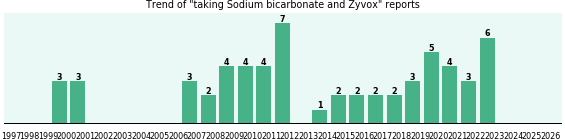
What are the common drug interactions of Sodium Bicarbonate and Zyvox, by gender? *:
female:
- Renal failure (kidney dysfunction)
- Unresponsive to stimuli
- Renal failure acute (rapid kidney dysfunction)
- Vomiting
- Cardiac arrest
- Clostridium difficile colitis (inflammation of colon by clostridium difficile bacteria infection)
- Renal tubular necrosis (death of kidney tubules)
- Respiratory failure (inadequate gas exchange by the respiratory system)
- Septic shock (shock due to blood infection)
- Upper gastrointestinal haemorrhage (upper gastrointestinal bleeding)
male:
- Anaemia (lack of blood)
- Diarrhoea
- Neutrophil count increased (excess than normal number of neutrophil a type of blood cell)
- Peritonitis (inflammation of the peritoneum, the thin tissue that lines the inner wall of the abdomen and covers most of the abdominal organs)
- Pyrexia (fever)
- Cytokine release syndrome (immediate complication occurring with the use of anti-t cell antibody infusions)
- Pancreatitis (inflammation of pancreas)
- Alanine aminotransferase increased
- Aspartate aminotransferase increased
- Metabolic acidosis (body produces too much acid, or when the kidneys are not removing enough acid from the body)
What are the common drug interactions of Sodium Bicarbonate and Zyvox, by age (0-1 to 60+)? *:
0-1:
n/a
2-9:
- Acinetobacter infection (infection by group of bacteria commonly found in soil and water)
- Diarrhoea
- Diarrhoea haemorrhagic (bloody diarrhoea)
- Graft versus host disease (the donated bone marrow or stem cells view the recipient's body as foreign, and the donated cells/bone marrow attack the body)
- Haematoma (collection of blood outside the blood vessels)
- Pleural effusion (water on the lungs)
- Pyrexia (fever)
- Septic shock (shock due to blood infection)
- Tooth abscess (pus formation in tooth)
- Urine output decreased
10-19:
n/a
20-29:
- Cardio-respiratory arrest (sudden dysfunction of heart and lungs)
- Chest pain
- Dyspnoea (difficult or laboured respiration)
- Hypoaesthesia (reduced sense of touch or sensation)
- Pharyngeal oedema (abnormal accumulation of fluid in the cavities and intercellular spaces of the pharyngeal)
- Pruritus (severe itching of the skin)
30-39:
- Abdominal discomfort
- Anaemia (lack of blood)
- Blood glucose increased
- Blood urea increased
- Diarrhoea
- Haemoglobin decreased
- Hyperuricaemia (level of uric acid in the blood that is abnormally high)
- Incision site pain
- Lymphocyte count decreased
- Neutrophil count increased (excess than normal number of neutrophil a type of blood cell)
40-49:
- Gastrointestinal haemorrhage (bleeding gastrointestinal tract)
- Lactic acidosis (low ph in body tissues)
- Shock (a life-threatening condition with symptoms like low blood pressure, weakness, shallow breathing, cold, clammy skin)
- Altered state of consciousness (altered state of mind)
- Muscular weakness (muscle weakness)
- Nephrogenic systemic fibrosis (involves fibrosis of skin, joints, eyes due to kidney disease)
- Abscess (pus)
- Anorectal infection
- Blood creatinine increased
- Cerebral atrophy (decrement in size of brain)
50-59:
- Hypovolaemic shock (shock caused by severe blood or fluid loss)
- Insomnia (sleeplessness)
- International normalised ratio increased
- Mouth ulceration (mouth ulcers)
- Nausea (feeling of having an urge to vomit)
- Nephrogenic anaemia (anaemia due to kidney disease)
- Neutropenia (an abnormally low number of neutrophils)
- Neutrophil count decreased (less than normal number of neutrophil a type of blood cell)
- Pancytopenia (medical condition in which there is a reduction in the number of red and white blood cells, as well as platelets)
- Pseudomonas infection (pseudomonas infection is caused by a bacterium, pseudomonas aeruginosa)
60+:
- Sepsis (a severe blood infection that can lead to organ failure and death)
- Metabolic acidosis (body produces too much acid, or when the kidneys are not removing enough acid from the body)
- Clostridium difficile colitis (inflammation of colon by clostridium difficile bacteria infection)
- Dermatitis (inflammation of the skin resulting from direct irritation by an external agent or an allergic reaction to it)
- Diarrhoea
- Nephritis interstitial (a kidney condition characterized by swelling in between the kidney tubules)
- Palpitations (feelings or sensations that your heart is pounding or racing)
- Renal failure (kidney dysfunction)
- Respiratory alkalosis (elevated blood ph due to excess breathing)
- Respiratory failure (inadequate gas exchange by the respiratory system)
What are the existing conditions these people have? *
- High Blood Pressure: 16 people, 26.67%
- Infection: 16 people, 26.67%
- Pain: 15 people, 25.00%
- Hypotension (abnormally low blood pressure): 12 people, 20.00%
- Nausea And Vomiting: 10 people, 16.67%
- Nausea (feeling of having an urge to vomit): 9 people, 15.00%
- Productive Cough: 8 people, 13.33%
- Hypoalbuminaemia (levels of albumin in blood serum are abnormally low): 6 people, 10.00%
- Anaemia (lack of blood): 6 people, 10.00%
- Constipation: 6 people, 10.00%
* Approximation only. Some reports may have incomplete information.
Do you take Sodium bicarbonate and Zyvox?
- Personalize this study to your gender, age, symptoms and drugs
- Predict drug outcomes for up to one year with AI
- Get an AI agent to monitor your drugs continuously
Related studies:
Effectiveness of, side effects of, and alternative drugs to the 2 drugs:
- Sodium bicarbonate (27,283 reports)
- Zyvox (9,399 reports)
Browse all drug interactions of Sodium bicarbonate and Zyvox:
a b c d e f g h i j k l m n o p q r s t u v w x y zSub-studies by gender and age:
Female: 0-1 2-9 10-19 20-29 30-39 40-49 50-59 60+
Male: 0-1 2-9 10-19 20-29 30-39 40-49 50-59 60+
Browse all side effects of Sodium bicarbonate:
a b c d e f g h i j k l m n o p q r s t u v w x y zBrowse all side effects of Zyvox:
a b c d e f g h i j k l m n o p q r s t u v w x y zBrowse all interactions between Sodium bicarbonate and drugs from A to Z:
a b c d e f g h i j k l m n o p q r s t u v w x y zBrowse all interactions between Zyvox and drugs from A to Z:
a b c d e f g h i j k l m n o p q r s t u v w x y zHow the study uses the data?
The study uses data from the FDA. It is based on sodium bicarbonate and linezolid (the active ingredients of Sodium bicarbonate and Zyvox, respectively), and Sodium bicarbonate and Zyvox (the brand names). Other drugs that have the same active ingredients (e.g. generic drugs) are not considered. Dosage of drugs is not considered in the study.
How to use the study?
DO NOT STOP MEDICATIONS without first consulting your doctor. If there are any serious or long term adverse effects discovered in the study, discuss the study with your doctor to ensure that proper medication management will be in place if applicable.
Who is eHealthMe?
With medical big data and proven AI/ML algorithms, eHealthMe provides a platform for everyone to run phase IV clinical trials. We study millions of patients and 5,000 more each day. Results of our real-world drug study have been referenced on 800+ peer-reviewed medical publications, including The Lancet, Mayo Clinic Proceedings, and Nature. Our analysis results are available to researchers, health care professionals, patients (testimonials), and software developers (open API).
WARNING, DISCLAIMER, USE FOR PUBLICATION
WARNING: Please DO NOT STOP MEDICATIONS without first consulting a physician since doing so could be hazardous to your health.
DISCLAIMER: All material available on eHealthMe.com is for informational purposes only, and is not a substitute for medical advice, diagnosis, or treatment provided by a qualified healthcare provider. All information is observation-only. Our phase IV clinical studies alone cannot establish cause-effect relationship. Different individuals may respond to medication in different ways. Every effort has been made to ensure that all information is accurate, up-to-date, and complete, but no guarantee is made to that effect. The use of the eHealthMe site and its content is at your own risk.
If you use this eHealthMe study on publication, please acknowledge it with a citation: study title, URL, accessed date.
Recent studies on eHealthMe:
- Drug interactions of Lorazepam and Motrin Ib - 12 seconds ago
- Lamotrigine vs. Clonidine Hydrochloride, side effect and effectiveness comparison - 13 seconds ago
- Zopiclone vs. Magnesium Oxide, side effect and effectiveness comparison - 16 seconds ago
- Weed vs. Tizanidine Hydrochloride, side effect and effectiveness comparison - 20 seconds ago
- Drug interactions of Farxiga and Keytruda - 28 seconds ago
- Nuclear Magnetic Resonance Imaging Abdominal Abnormal and Restless Leg Syndrome - 39 seconds ago
- Could Cubicin cause Myositis? - 39 seconds ago
- Drug interactions of Acetylsalicylic Acid and Leukine - 44 seconds ago
- Bud vs. Inositol, side effect and effectiveness comparison - 48 seconds ago
- Sudafed 12 Hour vs. Vicks Formula 44, side effect and effectiveness comparison - 54 seconds ago