Topiramate and Skelaxin drug interactions - a phase IV clinical study of FDA data
Summary:
Drug interactions are reported among people who take Topiramate (topiramate) and Skelaxin (metaxalone). Common drug interactions include vomiting among females and cyst among males.
The phase IV clinical study analyzes what interactions people have when they take Topiramate and Skelaxin. It is created by eHealthMe based on reports of 68 people who take the same drugs from the FDA, and is updated regularly.
What is Topiramate?
Topiramate has active ingredients of topiramate. It is often used in migraine. eHealthMe is studying from 49,809 Topiramate users. Check the latest studies of Topiramate.
What is Skelaxin?
Skelaxin has active ingredients of metaxalone. It is often used in back pain. eHealthMe is studying from 9,706 Skelaxin users. Check the latest studies of Skelaxin.
68 people who take Topiramate and Skelaxin together, and have interactions are studied.
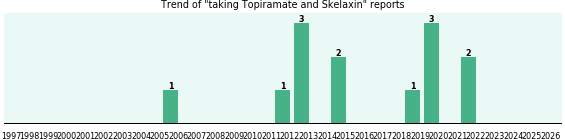
What are the common drug interactions of Topiramate and Skelaxin, by gender? *:
female:
- Vomiting
- Renal failure (kidney dysfunction)
- Anxiety disorder
- Central nervous system lesion (an abnormality in tissue of brain or spinal cord)
- Convulsion (muscles contract and relax rapidly and repeatedly, resulting in an uncontrolled shaking of the body)
- Cough
- Drug hypersensitivity
- Dysgeusia (disorder of the sense of taste)
- Dyspepsia (indigestion)
- Dyspnoea (difficult or laboured respiration)
male:
- Cyst (a closed sac)
- Fibromyalgia (a long-term condition which causes pain all over the body)
- Acute myeloid leukaemia recurrent (acute cancer in which the bone marrow makes abnormal myeloblast- recurrent)
- Acute myocardial infarction (acute heart attack)
- Angina pectoris (chest pain due to ischemia of the heart muscle)
- Arthritis (form of joint disorder that involves inflammation of one or more joints)
- Atrial fibrillation (fibrillation of the muscles of the atria of the heart)
- Atrophy (wasting away of a part of the body)
- Bone disorder
- Bone pain
What are the common drug interactions of Topiramate and Skelaxin, by age (0-1 to 60+)? *:
0-1:
n/a
2-9:
n/a
10-19:
- Hepatic enzyme increased
- Hepatic neoplasm (liver tumour)
- Hepatic steatosis (fatty liver disease)
20-29:
- Bipolar disorder (mood disorder)
- Cognitive disorder (mental health disorders affects learning, memory, perception, and problem solving)
- Hallucinations, mixed (sensations that appear real but are created by your mind -mixed)
- Memory impairment
30-39:
- Fatigue (feeling of tiredness)
- Pyrexia (fever)
- Chronic kidney disease
- Food poisoning (poison in food)
- Gastrointestinal infection (infection of stomach and intestine)
- Headache (pain in head)
- Myalgia (muscle pain)
- Nasal congestion (blockage of the nasal passages usually due to membranes lining the nose becoming swollen from inflamed blood vessels)
- Nausea (feeling of having an urge to vomit)
- Otitis media (inflammation of the middle ear)
40-49:
- Alopecia (absence of hair from areas of the body)
- Cerebrovascular accident (sudden death of some brain cells due to lack of oxygen when the blood flow to the brain is impaired by blockage or rupture)
- Chronic kidney disease
- Drug ineffective
- Dry mouth
- Dyspepsia (indigestion)
- Fall
- Gait disturbance
- Headache (pain in head)
- Joint injury
50-59:
- Carotid artery disease
- Drug ineffective
- Dyspnoea (difficult or laboured respiration)
- Exercise tolerance decreased
- Fatigue (feeling of tiredness)
- Femur fracture
- Gait disturbance
- Headache (pain in head)
- Hyperacusis (disorder in loudness perception)
- Joint stiffness
60+:
- Visual impairment
- Abasia (inability to walk)
- Adrenal mass
- Adrenal neoplasm (abnormal growth of adrenal gland)
- Adverse drug reaction
- Angina pectoris (chest pain due to ischemia of the heart muscle)
- Anxiety
- Arterial occlusive disease (slow process through which arteries throughout the body become progressively narrowed and eventually completely blocked)
- Arthralgia (joint pain)
- Arthritis (form of joint disorder that involves inflammation of one or more joints)
What are the existing conditions these people have? *
- Pain: 17 people, 25.00%
- Depression: 12 people, 17.65%
- Stress And Anxiety: 11 people, 16.18%
- Muscle Spasms (muscle contraction): 10 people, 14.71%
- Gastroesophageal Reflux Disease (a condition in which stomach contents leak backward from the stomach into the oesophagus): 9 people, 13.24%
- Headache (pain in head): 8 people, 11.76%
- Nausea (feeling of having an urge to vomit): 8 people, 11.76%
- Multiple Sclerosis (a nervous system disease that affects your brain and spinal cord. it damages the myelin sheath): 7 people, 10.29%
- Inflammation: 7 people, 10.29%
- Neuralgia (pain in one or more nerves): 7 people, 10.29%
* Approximation only. Some reports may have incomplete information.
Do you take Topiramate and Skelaxin?
- Personalize this study to your gender, age, symptoms and drugs
- Predict drug outcomes for up to one year with AI
- Get an AI agent to monitor your drugs continuously
Related studies:
Effectiveness of, side effects of, and alternative drugs to the 2 drugs:
- Topiramate (49,809 reports)
- Skelaxin (9,706 reports)
Browse all drug interactions of Topiramate and Skelaxin:
a b c d e f g h i j k l m n o p q r s t u v w x y zSub-studies by gender and age:
Female: 0-1 2-9 10-19 20-29 30-39 40-49 50-59 60+
Male: 0-1 2-9 10-19 20-29 30-39 40-49 50-59 60+
Browse all side effects of Topiramate:
a b c d e f g h i j k l m n o p q r s t u v w x y zBrowse all side effects of Skelaxin:
a b c d e f g h i j k l m n o p q r s t u v w x y zBrowse all interactions between Topiramate and drugs from A to Z:
a b c d e f g h i j k l m n o p q r s t u v w x y zBrowse all interactions between Skelaxin and drugs from A to Z:
a b c d e f g h i j k l m n o p q r s t u v w x y zRelated publications that referenced our studies
- Baloch M, Siddiqui MA, "Topiramate induced sudden loss of vision", JPMA, 2012 Oct .
- Kocamaz, M., & Karadag, O., "Topiramate-Induced Acute Myopia, Diplopia, and Photosensitivity: A Case Report", Beyoglu Eye Journal, 2019 Jan .
- Baloch M, Siddiqui MA, "Topiramate induced sudden loss of vision", JPMA, 2012 Oct .
- Kocamaz, M., & Karadag, O., "Topiramate-Induced Acute Myopia, Diplopia, and Photosensitivity: A Case Report", Beyoglu Eye Journal, 2019 Jan .
How the study uses the data?
The study uses data from the FDA. It is based on topiramate and metaxalone (the active ingredients of Topiramate and Skelaxin, respectively), and Topiramate and Skelaxin (the brand names). Other drugs that have the same active ingredients (e.g. generic drugs) are not considered. Dosage of drugs is not considered in the study.
How to use the study?
DO NOT STOP MEDICATIONS without first consulting your doctor. If there are any serious or long term adverse effects discovered in the study, discuss the study with your doctor to ensure that proper medication management will be in place if applicable.
Who is eHealthMe?
With medical big data and proven AI/ML algorithms, eHealthMe provides a platform for everyone to run phase IV clinical trials. We study millions of patients and 5,000 more each day. Results of our real-world drug study have been referenced on 800+ peer-reviewed medical publications, including The Lancet, Mayo Clinic Proceedings, and Nature. Our analysis results are available to researchers, health care professionals, patients (testimonials), and software developers (open API).
WARNING, DISCLAIMER, USE FOR PUBLICATION
WARNING: Please DO NOT STOP MEDICATIONS without first consulting a physician since doing so could be hazardous to your health.
DISCLAIMER: All material available on eHealthMe.com is for informational purposes only, and is not a substitute for medical advice, diagnosis, or treatment provided by a qualified healthcare provider. All information is observation-only. Our phase IV clinical studies alone cannot establish cause-effect relationship. Different individuals may respond to medication in different ways. Every effort has been made to ensure that all information is accurate, up-to-date, and complete, but no guarantee is made to that effect. The use of the eHealthMe site and its content is at your own risk.
If you use this eHealthMe study on publication, please acknowledge it with a citation: study title, URL, accessed date.
Recent studies on eHealthMe:
- Could Lansoprazole cause Neutrophil Percentage Increased? - now
- Could Byetta cause Feeling Cold? - 11 seconds ago
- Could Zoledronic Acid cause Tetany? - 13 seconds ago
- Drug interactions of Dilacor Xr and Niaspan - 18 seconds ago
- Krill vs. Voltaren, side effect and effectiveness comparison - 22 seconds ago
- Could Biaxin cause Bundle Branch Block Right? - 33 seconds ago
- Could Nexium cause Small Intestinal Obstruction? - 39 seconds ago
- Endometriosis and Herpes Zoster - 40 seconds ago
- Could Vasotec cause Myopathy? - 42 seconds ago
- Asthma Aggravated and Diarrhea - 47 seconds ago