Valproic acid and Dilaudid drug interactions - a phase IV clinical study of FDA data
Summary:
Drug interactions are reported among people who take Valproic acid (valproic acid) and Dilaudid (hydromorphone hydrochloride). Common drug interactions include bursitis among females and cardiac arrest among males.
The phase IV clinical study analyzes what interactions people have when they take Valproic acid and Dilaudid. It is created by eHealthMe based on reports of 35 people who take the same drugs from the FDA, and is updated regularly.
What is Valproic acid?
Valproic acid has active ingredients of valproic acid. It is often used in epilepsy. eHealthMe is studying from 36,193 Valproic acid users. Check the latest studies of Valproic acid.
What is Dilaudid?
Dilaudid has active ingredients of hydromorphone hydrochloride. It is often used in pain. eHealthMe is studying from 96,466 Dilaudid users. Check the latest studies of Dilaudid.
35 people who take Valproic acid and Dilaudid together, and have interactions are studied.
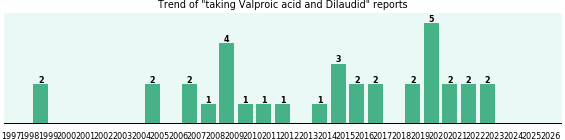
What are the common drug interactions of Valproic Acid and Dilaudid, by gender? *:
female:
- Bursitis (inflammation of a bursa, typically one in the knee, elbow, or shoulder)
- Butterfly rash
- Cardiomegaly (increased size of heart than normal)
- Cataract (clouding of the lens inside the eye)
- Chest discomfort
- Chronic obstructive pulmonary disease (a progressive disease that makes it hard to breathe)
- Claustrophobia (fear of having no escape and being closed in small spaces)
- Colon adenoma (non cancerous epithelial colon tumour having a glandular origin and structure)
- Completed suicide (act of taking one's own life)
- Confusional state
male:
- Cardiac arrest
- Peritonitis (inflammation of the peritoneum, the thin tissue that lines the inner wall of the abdomen and covers most of the abdominal organs)
- Muscle spasms (muscle contraction)
- Torticollis (a twisted neck in which the head is tipped to one side, while the chin is turned to the other)
- Injury
- Overdose
- Road traffic accident
- Urticaria (rash of round, red welts on the skin that itch intensely)
- Dysphagia (a condition in which swallowing is difficult or painful)
- Fall
What are the common drug interactions of Valproic Acid and Dilaudid, by age (0-1 to 60+)? *:
0-1:
- Abdominal pain
- Abscess (pus)
- Anaemia (lack of blood)
- Clostridium difficile colitis (inflammation of colon by clostridium difficile bacteria infection)
- Colitis ulcerative (inflammation of colon with ulcer)
- Constipation
- Dehydration (dryness resulting from the removal of water)
- Depression
- Gastrointestinal haemorrhage (bleeding gastrointestinal tract)
- Headache (pain in head)
2-9:
n/a
10-19:
- Leukaemia recurrent (repeat cancer of bone marrow or blood cells)
20-29:
- Bradycardia (abnormally slow heart action)
- Chest discomfort
- Chills (felling of cold)
- Device failure
- Drug ineffective
- Dyspnoea (difficult or laboured respiration)
- Feeling hot
- Flushing (the warm, red condition of human skin)
- Headache (pain in head)
- Influenza
30-39:
- Constipation
- Weight increased
- Headache (pain in head)
- Abdominal pain
- Abscess (pus)
- Anaemia (lack of blood)
- Clostridium difficile colitis (inflammation of colon by clostridium difficile bacteria infection)
- Colitis ulcerative (inflammation of colon with ulcer)
- Dehydration (dryness resulting from the removal of water)
- Depression
40-49:
- Joint effusion (presence of extra fluid in joint covering)
- Joint swelling
- Kyphosis (a condition of over-curvature of the thoracic vertebrae (upper back))
- Leukocytosis (increased white blood cells)
- Ligament sprain (ligament stretched)
- Lipoma (a growth of fatty tissue that slowly develops just under your skin)
- Lumbar spine flattening (flatten the curve of the lower spine)
- Lung consolidation (a condition whereby the lung tissues solidify because of the accumulation of solid and liquid material in the air spaces)
- Lung infiltration (a substance that normally includes fluid, inflammatory exudates or cells that fill a region of lung)
- Lung neoplasm malignant (cancer tumour of lung)
50-59:
- Impulsive behaviour
- Suicidal ideation
- Suicide attempt
- Drug hypersensitivity
60+:
- Blood creatinine increased
- Cardiac arrest
- Peritonitis (inflammation of the peritoneum, the thin tissue that lines the inner wall of the abdomen and covers most of the abdominal organs)
- Respiratory failure (inadequate gas exchange by the respiratory system)
- Death
- Acute myocardial infarction (acute heart attack)
- Pneumonia
- Staphylococcal infection (an infection with staphylococcus bacteria)
- Thrombotic microangiopathy (a pathology that results in thrombosis in capillaries and arterioles, due to an endothelial injury)
What are the existing conditions these people have? *
- Depression: 6 people, 17.14%
- Asthma: 5 people, 14.29%
- High Blood Pressure: 4 people, 11.43%
- Stress And Anxiety: 4 people, 11.43%
- Sleep Disorder: 4 people, 11.43%
- Rheumatoid Arthritis (a chronic progressive disease causing inflammation in the joints): 4 people, 11.43%
- Constipation: 3 people, 8.57%
- Hypersensitivity: 3 people, 8.57%
- Osteoarthritis (a joint disease caused by cartilage loss in a joint): 3 people, 8.57%
- Dry Skin: 2 people, 5.71%
* Approximation only. Some reports may have incomplete information.
Do you take Valproic acid and Dilaudid?
- Personalize this study to your gender, age, symptoms and drugs
- Predict drug outcomes for up to one year with AI
- Get an AI agent to monitor your drugs continuously
Related studies:
Effectiveness of, side effects of, and alternative drugs to the 2 drugs:
- Valproic acid (36,193 reports)
- Dilaudid (96,466 reports)
Browse all drug interactions of Valproic acid and Dilaudid:
a b c d e f g h i j k l m n o p q r s t u v w x y zSub-studies by gender and age:
Female: 0-1 2-9 10-19 20-29 30-39 40-49 50-59 60+
Male: 0-1 2-9 10-19 20-29 30-39 40-49 50-59 60+
Browse all side effects of Valproic acid:
a b c d e f g h i j k l m n o p q r s t u v w x y zBrowse all side effects of Dilaudid:
a b c d e f g h i j k l m n o p q r s t u v w x y zBrowse all interactions between Valproic acid and drugs from A to Z:
a b c d e f g h i j k l m n o p q r s t u v w x y zBrowse all interactions between Dilaudid and drugs from A to Z:
a b c d e f g h i j k l m n o p q r s t u v w x y zRelated publications that referenced our studies
- Gupta E, Kunjal R, Cury JD, "Severe hyponatremia due to valproic acid toxicity", Journal of clinical medicine research, 2015 Jan .
- Hwabejire JO, Lu J, Liu B, Li Y, Halaweish I, Alam HB, "Valproic acid for the treatment of hemorrhagic shock: a dose-optimization study", journal of surgical research, 2014 Jan .
- Gupta E, Kunjal R, Cury JD, "Severe hyponatremia due to valproic acid toxicity", Journal of clinical medicine research, 2015 Jan .
- Hwabejire JO, Lu J, Liu B, Li Y, Halaweish I, Alam HB, "Valproic acid for the treatment of hemorrhagic shock: a dose-optimization study", journal of surgical research, 2014 Jan .
How the study uses the data?
The study uses data from the FDA. It is based on valproic acid and hydromorphone hydrochloride (the active ingredients of Valproic acid and Dilaudid, respectively), and Valproic acid and Dilaudid (the brand names). Other drugs that have the same active ingredients (e.g. generic drugs) are not considered. Dosage of drugs is not considered in the study.
How to use the study?
DO NOT STOP MEDICATIONS without first consulting your doctor. If there are any serious or long term adverse effects discovered in the study, discuss the study with your doctor to ensure that proper medication management will be in place if applicable.
Who is eHealthMe?
With medical big data and proven AI/ML algorithms, eHealthMe provides a platform for everyone to run phase IV clinical trials. We study millions of patients and 5,000 more each day. Results of our real-world drug study have been referenced on 800+ peer-reviewed medical publications, including The Lancet, Mayo Clinic Proceedings, and Nature. Our analysis results are available to researchers, health care professionals, patients (testimonials), and software developers (open API).
WARNING, DISCLAIMER, USE FOR PUBLICATION
WARNING: Please DO NOT STOP MEDICATIONS without first consulting a physician since doing so could be hazardous to your health.
DISCLAIMER: All material available on eHealthMe.com is for informational purposes only, and is not a substitute for medical advice, diagnosis, or treatment provided by a qualified healthcare provider. All information is observation-only. Our phase IV clinical studies alone cannot establish cause-effect relationship. Different individuals may respond to medication in different ways. Every effort has been made to ensure that all information is accurate, up-to-date, and complete, but no guarantee is made to that effect. The use of the eHealthMe site and its content is at your own risk.
If you use this eHealthMe study on publication, please acknowledge it with a citation: study title, URL, accessed date.
Recent studies on eHealthMe:
- Trandolapril vs. Catapres-Tts-1, side effect and effectiveness comparison - a second ago
- Could Benadryl cause Cerebral Thrombosis? - 5 seconds ago
- Ramipril and Loss Of Sense Of Smell for Men aged 60+ - 29 seconds ago
- Ramipril and Loss Of Smell for Men aged 60+ - 29 seconds ago
- Ramipril and Anosmia for Men aged 60+ - 30 seconds ago
- Ramipril and Smell - Impaired for Men aged 60+ - 30 seconds ago
- Could Dilaudid cause Abscess Oral? - 31 seconds ago
- Could Forteo cause Head Injury? - 38 seconds ago
- Xenical and Sweating Increased for Women aged 50-59 - 41 seconds ago
- Traumatic Injury Of The Bladder And Urethra and drugs of ingredients of estrogens, conjugated - 42 seconds ago