Haloperidol and Viagra drug interactions - a phase IV clinical study of FDA data
Summary:
Drug interactions are reported among people who take Haloperidol (haloperidol) and Viagra (sildenafil citrate). Common drug interactions include emotional distress among males.
The phase IV clinical study analyzes what interactions people have when they take Haloperidol and Viagra. It is created by eHealthMe based on reports of 24 people who take the same drugs from the FDA, and is updated regularly.
What is Haloperidol?
Haloperidol has active ingredients of haloperidol. It is often used in schizophrenia. eHealthMe is studying from 16,637 Haloperidol users. Check the latest studies of Haloperidol.
What is Viagra?
Viagra has active ingredients of sildenafil citrate. It is often used in erection problems. eHealthMe is studying from 63,865 Viagra users. Check the latest studies of Viagra.
24 people who take Haloperidol and Viagra together, and have interactions are studied.
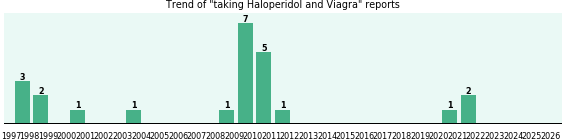
What are the common drug interactions of Haloperidol and Viagra, by gender? *:
female:
n/a
male:
- Emotional distress
- General physical health deterioration (weak health status)
- Hallucination, visual (seeing things that aren't there)
- Impaired healing
- Jaw disorder (jaw disease)
- Metastases to bone (cancer spreads to bone)
- Myalgia (muscle pain)
- Oral pain
- Osteoarthritis (a joint disease caused by cartilage loss in a joint)
- Osteonecrosis of jaw (death of bone of jaw)
What are the common drug interactions of Haloperidol and Viagra, by age (0-1 to 60+)? *:
0-1:
n/a
2-9:
n/a
10-19:
n/a
20-29:
- Cardio-respiratory arrest (sudden dysfunction of heart and lungs)
- Coma (state of unconsciousness lasting more than six hours)
- Hypotension (abnormally low blood pressure)
- Mental impairment (a condition affecting the body, perhaps through sight or hearing loss, a mobility difficulty or a health condition)
- Lung disorder (lung disease)
30-39:
n/a
40-49:
- Diabetes mellitus (diabetes, caused by a deficiency of the pancreatic hormone insulin)
- Diabetes mellitus inadequate control
- Diabetic neuropathy (neuropathic disorders that are associated with diabetes mellitus)
- Hyperglycaemia (high blood sugar)
- Obesity (having too much body fat)
- Oesophageal varices haemorrhage (bleeding from extremely dilated sub-mucosal veins in the lower third of the oesophagus)
- Type 2 diabetes mellitus
- Weight increased
50-59:
- Anxiety
- Arthralgia (joint pain)
- Blood oestrogen increased
- Bone disorder
- Decreased interest
- Depression
- Emotional distress
- General physical health deterioration (weak health status)
- Gingival disorder (gum disease)
- Hallucination, visual (seeing things that aren't there)
60+:
- Anorgasmia (type of sexual dysfunction in which a person cannot achieve orgasm, even with adequate stimulation)
- Drug ineffective
- Chest pressure sensation (feeling of pressure on chest)
- Chronic kidney disease
- Compression fracture (fracture due to pressure caused by injury)
- Coronary artery disease (plaque building up along the inner walls of the arteries of the heart, which narrows the arteries and restricts blood flow to the heart)
- Delusion of reference
- Depressed level of consciousness
- Drug maladministration
- Dysarthria (speech disorder)
What are the existing conditions these people have? *
- Prostate Cancer: 9 people, 37.50%
- Metastases To Bone (cancer spreads to bone): 9 people, 37.50%
- Nausea (feeling of having an urge to vomit): 4 people, 16.67%
* Approximation only. Some reports may have incomplete information.
Do you take Haloperidol and Viagra?
- Personalize this study to your gender, age, symptoms and drugs
- Predict drug outcomes for up to one year with AI
- Get an AI agent to monitor your drugs continuously
Related studies:
Effectiveness of, side effects of, and alternative drugs to the 2 drugs:
- Haloperidol (16,637 reports)
- Viagra (63,865 reports)
Browse all drug interactions of Haloperidol and Viagra:
a b c d e f g h i j k l m n o p q r s t u v w x y zSub-studies by gender and age:
Female: 0-1 2-9 10-19 20-29 30-39 40-49 50-59 60+
Male: 0-1 2-9 10-19 20-29 30-39 40-49 50-59 60+
Browse all side effects of Haloperidol:
a b c d e f g h i j k l m n o p q r s t u v w x y zBrowse all side effects of Viagra:
a b c d e f g h i j k l m n o p q r s t u v w x y zBrowse all interactions between Haloperidol and drugs from A to Z:
a b c d e f g h i j k l m n o p q r s t u v w x y zBrowse all interactions between Viagra and drugs from A to Z:
a b c d e f g h i j k l m n o p q r s t u v w x y zRelated publications that referenced our studies
- Obayi, O., & Tagbo, N. , "Bilateral Pedal Oedema Associated with Intramuscular Haloperidol–A Rare Observation", International Neuropsychiatric Disease Journal, 2018 Jan .
- Jeong SY, Jeon SJ, Kim YR, Choi SS, Kwak HS, "A Rare Case of Viagra Induced Toxic Encephalopathy", Investigative Magnetic Resonance Imaging, 2016 Sep .
- Obayi, O., & Tagbo, N. , "Bilateral Pedal Oedema Associated with Intramuscular Haloperidol–A Rare Observation", International Neuropsychiatric Disease Journal, 2018 Jan .
- Jeong SY, Jeon SJ, Kim YR, Choi SS, Kwak HS, "A Rare Case of Viagra Induced Toxic Encephalopathy", Investigative Magnetic Resonance Imaging, 2016 Sep .
How the study uses the data?
The study uses data from the FDA. It is based on haloperidol and sildenafil citrate (the active ingredients of Haloperidol and Viagra, respectively), and Haloperidol and Viagra (the brand names). Other drugs that have the same active ingredients (e.g. generic drugs) are not considered. Dosage of drugs is not considered in the study.
How to use the study?
DO NOT STOP MEDICATIONS without first consulting your doctor. If there are any serious or long term adverse effects discovered in the study, discuss the study with your doctor to ensure that proper medication management will be in place if applicable.
Who is eHealthMe?
With medical big data and proven AI/ML algorithms, eHealthMe provides a platform for everyone to run phase IV clinical trials. We study millions of patients and 5,000 more each day. Results of our real-world drug study have been referenced on 800+ peer-reviewed medical publications, including The Lancet, Mayo Clinic Proceedings, and Nature. Our analysis results are available to researchers, health care professionals, patients (testimonials), and software developers (open API).
WARNING, DISCLAIMER, USE FOR PUBLICATION
WARNING: Please DO NOT STOP MEDICATIONS without first consulting a physician since doing so could be hazardous to your health.
DISCLAIMER: All material available on eHealthMe.com is for informational purposes only, and is not a substitute for medical advice, diagnosis, or treatment provided by a qualified healthcare provider. All information is observation-only. Our phase IV clinical studies alone cannot establish cause-effect relationship. Different individuals may respond to medication in different ways. Every effort has been made to ensure that all information is accurate, up-to-date, and complete, but no guarantee is made to that effect. The use of the eHealthMe site and its content is at your own risk.
If you use this eHealthMe study on publication, please acknowledge it with a citation: study title, URL, accessed date.
Recent studies on eHealthMe:
- Could Paroxetine cause Pleural Effusion? - now
- Could Hydroxyurea cause Heart Rate Decreased? - 5 seconds ago
- Drug interactions of Ivermectin and Celecoxib - 10 seconds ago
- Could Avandia cause Irritability? - 16 seconds ago
- Stalevo 125 vs. Donepezil, side effect and effectiveness comparison - 23 seconds ago
- Drug interactions of Ketoconazole and Gralise - 24 seconds ago
- Drug interactions of Midazolam and Triamcinolone - 29 seconds ago
- Drug interactions of Definity and Topamax - 36 seconds ago
- Could Paxil cause Hydrocephalus? - 36 seconds ago
- Drug interactions of Esomeprazole Magnesium and Vitamin E - 41 seconds ago