Vibramycin and Glucophage drug interactions - a phase IV clinical study of FDA data
Summary:
Drug interactions are reported among people who take Vibramycin (doxycycline) and Glucophage (metformin hydrochloride). Common drug interactions include dyspnoea among females and cellulitis among males.
The phase IV clinical study analyzes what interactions people have when they take Vibramycin and Glucophage. It is created by eHealthMe based on reports of 25 people who take the same drugs from the FDA, and is updated regularly.
What is Vibramycin?
Vibramycin has active ingredients of doxycycline. It is often used in acne. eHealthMe is studying from 1,692 Vibramycin users. Check the latest studies of Vibramycin.
What is Glucophage?
Glucophage has active ingredients of metformin hydrochloride. It is often used in diabetes. eHealthMe is studying from 60,851 Glucophage users. Check the latest studies of Glucophage.
25 people who take Vibramycin and Glucophage together, and have interactions are studied.
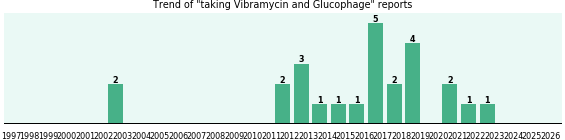
What are the common drug interactions of Vibramycin and Glucophage, by gender? *:
female:
- Dyspnoea (difficult or laboured respiration)
- Osteomyelitis (infection of bone)
- Chronic obstructive pulmonary disease (a progressive disease that makes it hard to breathe)
- Diabetic foot infection
- Gastrointestinal haemorrhage (bleeding gastrointestinal tract)
- Graft complication
- Myocardial ischaemia (the blood flow through one or more of the blood vessels that lead to heart (coronary arteries) is decreased)
- Weight decreased
- Abdominal pain lower
- Dermatitis allergic (inflammation of the skin due allergic reaction)
male:
- Cellulitis (infection under the skin)
- Dyspnoea (difficult or laboured respiration)
- Deep vein thrombosis (blood clot in a major vein that usually develops in the legs and/or pelvis)
- International normalised ratio increased
- Pyrexia (fever)
- Asthenia (weakness)
- Contusion (a type of hematoma of tissue in which capillaries)
- Cough
- Diverticulum intestinal haemorrhagic (a pouch that is attached to the first part of the small intestine with bleeding)
- Drug level increased
What are the common drug interactions of Vibramycin and Glucophage, by age (0-1 to 60+)? *:
0-1:
n/a
2-9:
n/a
10-19:
n/a
20-29:
n/a
30-39:
- Osteomyelitis (infection of bone)
- Diabetic foot infection
- Graft complication
- Myocardial ischaemia (the blood flow through one or more of the blood vessels that lead to heart (coronary arteries) is decreased)
40-49:
- Fall
- Wrist fracture
50-59:
- Cellulitis (infection under the skin)
- Electrocardiogram qt prolonged
- Erythema (redness of the skin)
- Fatigue (feeling of tiredness)
- Heart rate irregular
- Muscular weakness (muscle weakness)
- Myocardial infarction (destruction of heart tissue resulting from obstruction of the blood supply to the heart muscle)
- Pain in extremity
- Pancreatitis (inflammation of pancreas)
- Pyrexia (fever)
60+:
- Dyspnoea (difficult or laboured respiration)
- Abdominal distension
- Coagulopathy (blood's ability to clot is impaired)
- Deep vein thrombosis (blood clot in a major vein that usually develops in the legs and/or pelvis)
- Gastrointestinal haemorrhage (bleeding gastrointestinal tract)
- International normalised ratio increased
- Weight decreased
- Asthenia (weakness)
- Contusion (a type of hematoma of tissue in which capillaries)
- Cough
What are the existing conditions these people have? *
- High Blood Pressure: 10 people, 40.00%
- Gastroesophageal Reflux Disease (a condition in which stomach contents leak backward from the stomach into the oesophagus): 9 people, 36.00%
- Cellulitis (infection under the skin): 7 people, 28.00%
- Type 2 Diabetes: 7 people, 28.00%
- Neuropathy Peripheral (surface nerve damage): 6 people, 24.00%
- Sinusitis (inflammation of sinus): 6 people, 24.00%
- Rosacea (a skin condition that causes facial redness): 6 people, 24.00%
- Restless Leg Syndrome (a powerful urge to move your legs): 6 people, 24.00%
- Polycythaemia Vera (blood disorder in which the bone marrow makes too many red blood cells): 6 people, 24.00%
- Ocular Rosacea (redness, irritation or burning of the eyes): 6 people, 24.00%
* Approximation only. Some reports may have incomplete information.
Do you take Vibramycin and Glucophage?
- Personalize this study to your gender, age, symptoms and drugs
- Predict drug outcomes for up to one year with AI
- Get an AI agent to monitor your drugs continuously
Related studies:
Effectiveness of, side effects of, and alternative drugs to the 2 drugs:
- Vibramycin (1,692 reports)
- Glucophage (60,851 reports)
Browse all drug interactions of Vibramycin and Glucophage:
a b c d e f g h i j k l m n o p q r s t u v w x y zSub-studies by gender and age:
Female: 0-1 2-9 10-19 20-29 30-39 40-49 50-59 60+
Male: 0-1 2-9 10-19 20-29 30-39 40-49 50-59 60+
Browse all side effects of Vibramycin:
a b c d e f g h i j k l m n o p q r s t u v w x y zBrowse all side effects of Glucophage:
a b c d e f g h i j k l m n o p q r s t u v w x y zBrowse all interactions between Vibramycin and drugs from A to Z:
a b c d e f g h i j k l m n o p q r s t u v w x y zBrowse all interactions between Glucophage and drugs from A to Z:
a b c d e f g h i j k l m n o p q r s t u v w x y zRelated publications that referenced our studies
- T.Audi Yanto, I.Huang, F.Nathania Kosasih, NP Hardjo Lugito, "Nightmare and Abnormal Dreams: Rare Side Effects of Metformin?", Case Reports in Endocrinology, 2018 Jan .
- Al-Hamdy RA, "Assessment of electrolytes and HbA1c in type 2 diabetic patients using metformin and evaluation of guidelines obedience regarding renal impairment", J.Thi-Qar Sci., 2015 Jan .
- Dmour HH, Zayadeen AR, Shawagfeh JS, "Effect of Long Term Prophylaxis of Antimalarial Drug (Doxycycline) on Liver Span by Ultrasound", Middle East Journal of Internal Medicine, 2013 Jan .
- Wiwanitkit S, Wiwanitkit V, "Metformin and sleep disorders", Indian journal of endocrinology and metabolism, 2012 Jan .
- T.Audi Yanto, I.Huang, F.Nathania Kosasih, NP Hardjo Lugito, "Nightmare and Abnormal Dreams: Rare Side Effects of Metformin?", Case Reports in Endocrinology, 2018 Jan .
- Al-Hamdy RA, "Assessment of electrolytes and HbA1c in type 2 diabetic patients using metformin and evaluation of guidelines obedience regarding renal impairment", J.Thi-Qar Sci., 2015 Jan .
- Dmour HH, Zayadeen AR, Shawagfeh JS, "Effect of Long Term Prophylaxis of Antimalarial Drug (Doxycycline) on Liver Span by Ultrasound", Middle East Journal of Internal Medicine, 2013 Jan .
- Wiwanitkit S, Wiwanitkit V, "Metformin and sleep disorders", Indian journal of endocrinology and metabolism, 2012 Jan .
How the study uses the data?
The study uses data from the FDA. It is based on doxycycline and metformin hydrochloride (the active ingredients of Vibramycin and Glucophage, respectively), and Vibramycin and Glucophage (the brand names). Other drugs that have the same active ingredients (e.g. generic drugs) are not considered. Dosage of drugs is not considered in the study.
How to use the study?
DO NOT STOP MEDICATIONS without first consulting your doctor. If there are any serious or long term adverse effects discovered in the study, discuss the study with your doctor to ensure that proper medication management will be in place if applicable.
Who is eHealthMe?
With medical big data and proven AI/ML algorithms, eHealthMe provides a platform for everyone to run phase IV clinical trials. We study millions of patients and 5,000 more each day. Results of our real-world drug study have been referenced on 800+ peer-reviewed medical publications, including The Lancet, Mayo Clinic Proceedings, and Nature. Our analysis results are available to researchers, health care professionals, patients (testimonials), and software developers (open API).
WARNING, DISCLAIMER, USE FOR PUBLICATION
WARNING: Please DO NOT STOP MEDICATIONS without first consulting a physician since doing so could be hazardous to your health.
DISCLAIMER: All material available on eHealthMe.com is for informational purposes only, and is not a substitute for medical advice, diagnosis, or treatment provided by a qualified healthcare provider. All information is observation-only. Our phase IV clinical studies alone cannot establish cause-effect relationship. Different individuals may respond to medication in different ways. Every effort has been made to ensure that all information is accurate, up-to-date, and complete, but no guarantee is made to that effect. The use of the eHealthMe site and its content is at your own risk.
If you use this eHealthMe study on publication, please acknowledge it with a citation: study title, URL, accessed date.
Recent studies on eHealthMe:
- Taxotere and Fulvestrant drug interactions for women aged 60+ - now
- Could Simethicone cause Speech Impairment (Adult)? - now
- Could Curcumin cause Tremor? - a second ago
- Could Calcitriol cause Vascular Calcification? - 2 seconds ago
- Rituxan vs. Cyclobenzaprine Hydrochloride, side effect and effectiveness comparison - 7 seconds ago
- Bruxism in Mirtazapine, how severe and when it was recovered? - 9 seconds ago
- Thyrogen and Vomiting for Women aged 40-49 - 12 seconds ago
- Thyrogen and Upset Stomach for Women aged 40-49 - 12 seconds ago
- Thyrogen and Stomach Upset for Women aged 40-49 - 13 seconds ago
- Thyrogen and Emesis for Women aged 40-49 - 13 seconds ago