Levaquin and Sweating increased - a phase IV clinical study of FDA data
Summary:
Sweating increased is reported as a side effect among people who take Levaquin (levofloxacin), especially for people who are male, 60+ old, have been taking the drug for < 1 month also take Prilosec, and have Body temperature increased.
The phase IV clinical study analyzes which people have Sweating increased when taking Levaquin. It is created by eHealthMe based on reports of 54,998 people who have side effects when taking Levaquin from the FDA, and is updated regularly.
What is Levaquin?
Levaquin has active ingredients of levofloxacin. It is often used in sinusitis. eHealthMe is studying from 56,638 Levaquin users. Check the latest studies of Levaquin.
What is Sweating increased?
Sweating increased (excess sweating) is found to be associated with 676 drugs and 413 conditions by eHealthMe. Check the latest studies of Sweating increased.
eHealthMe: drug outcomes in the real world
eHealthMe runs one of the largest post-marketing drug safety studies in the world. We study millions of patients and 5,000 more each day. Our data-driven phase IV clinical trials have been referenced on 800+ peer-reviewed medical publications including The Lancet, Mayo Clinic Proceedings, and Nature. Tools to study our phase IV findings are available to the public, anonymous and free >>>.
54,998 people reported to have side effects when taking Levaquin.
Among them, 56 people (0.1%) have Sweating increased.
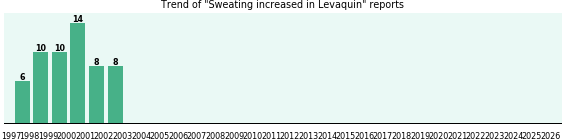
Among these 56 people:
How long have people been on Levaquin when they have Sweating increased? *
- < 1 month: 100 %
- 1 - 6 months: 0.0 %
- 6 - 12 months: 0.0 %
- 1 - 2 years: 0.0 %
- 2 - 5 years: 0.0 %
- 5 - 10 years: 0.0 %
- 10+ years: 0.0 %
What is the gender of people who have Sweating increased when taking Levaquin? *
- female: 40 %
- male: 60 %
What is the age of people who have Sweating increased when taking Levaquin? *
- 0-1: 0.0 %
- 2-9: 0.0 %
- 10-19: 0.0 %
- 20-29: 2.17 %
- 30-39: 10.87 %
- 40-49: 10.87 %
- 50-59: 23.91 %
- 60+: 52.17 %
What are other drugs people take besides Levaquin? *
- Prilosec: 7 people, 12.50%
- Lasix: 5 people, 8.93%
- Xanax: 5 people, 8.93%
- Oxycontin: 5 people, 8.93%
- Percocet: 5 people, 8.93%
- Theophylline: 5 people, 8.93%
- Colace: 4 people, 7.14%
- Albuterol: 4 people, 7.14%
- Synthroid: 4 people, 7.14%
- Lanoxin: 4 people, 7.14%
What are other side effects people have besides Sweating increased? *
- Nausea (feeling of having an urge to vomit): 16 people, 28.57%
- Fever: 13 people, 23.21%
- Weakness: 11 people, 19.64%
- Fatigue (feeling of tiredness): 9 people, 16.07%
- Chills (felling of cold): 8 people, 14.29%
- Chest Pain: 8 people, 14.29%
- Weight Decreased: 7 people, 12.50%
- Fall: 6 people, 10.71%
- Drug Ineffective: 6 people, 10.71%
- Depression: 6 people, 10.71%
What are the existing conditions these people have? *
- High Blood Cholesterol: 1 person, 1.79%
- Body Temperature Increased: 1 person, 1.79%
* Approximation only. Some reports may have incomplete information.
Do you take Levaquin and have Sweating increased?
- Check whether Sweating increased is associated with a drug or a condition
- Predict drug outcomes for up to one year with AI
- Get an AI agent to monitor your drugs continuously
Related studies:
Effectiveness of, long term effects of, and alternative drugs to Levaquin:
- Levaquin (56,638 reports)
Sweating increased treatments and more:
- Sweating increased (12,830 reports)
How severe was Sweating increased and when was it recovered:
Expand to all the drugs that have ingredients of levofloxacin:
Sub-studies by gender and age:
Female: 0-1 2-9 10-19 20-29 30-39 40-49 50-59 60+
Male: 0-1 2-9 10-19 20-29 30-39 40-49 50-59 60+
Browse all side effects of Levaquin:
a b c d e f g h i j k l m n o p q r s t u v w x y zBrowse all the drugs that are associated with Sweating increased:
- Sweating increased (676 drugs)
Browse all the conditions that are associated with Sweating increased:
- Sweating increased (413 conditions)
Related publications that referenced our studies
- Bhuvan KC, ALrasheedy AA, Ibrahim MI, "A case report from Nepalese community pharmacy on levofloxacin induced severe abdominal pain", Saudi Pharmaceutical Journal, 2013 Jul .
- MITTAL V, ARCHANA D, GUPTA A, SRIVASTAV U, CHANDRA V, SAXENA A, AGRAWAL P, "Aphasia: a Rarest Complication with a Well Known Drug Levofloxacin", Medical Science, 2013 Jan .
- Bhuvan KC, ALrasheedy AA, Ibrahim MI, "A case report from Nepalese community pharmacy on levofloxacin induced severe abdominal pain", Saudi Pharmaceutical Journal, 2013 Jul .
- MITTAL V, ARCHANA D, GUPTA A, SRIVASTAV U, CHANDRA V, SAXENA A, AGRAWAL P, "Aphasia: a Rarest Complication with a Well Known Drug Levofloxacin", Medical Science, 2013 Jan .
How the study uses the data?
The study uses data from the FDA. It is based on levofloxacin (the active ingredients of Levaquin) and Levaquin (the brand name). Other drugs that have the same active ingredients (e.g. generic drugs) are not considered. Dosage of drugs is not considered in the study.
How to use the study?
DO NOT STOP MEDICATIONS without first consulting your doctor. If there are any serious or long term adverse effects discovered in the study, discuss the study with your doctor to ensure that proper medication management will be in place if applicable.
Who is eHealthMe?
With medical big data and proven AI/ML algorithms, eHealthMe provides a platform for everyone to run phase IV clinical trials. We study millions of patients and 5,000 more each day. Results of our real-world drug study have been referenced on 800+ peer-reviewed medical publications, including The Lancet, Mayo Clinic Proceedings, and Nature. Our analysis results are available to researchers, health care professionals, patients (testimonials), and software developers (open API).
WARNING, DISCLAIMER, USE FOR PUBLICATION
WARNING: Please DO NOT STOP MEDICATIONS without first consulting a physician since doing so could be hazardous to your health.
DISCLAIMER: All material available on eHealthMe.com is for informational purposes only, and is not a substitute for medical advice, diagnosis, or treatment provided by a qualified healthcare provider. All information is observation-only. Our phase IV clinical studies alone cannot establish cause-effect relationship. Different individuals may respond to medication in different ways. Every effort has been made to ensure that all information is accurate, up-to-date, and complete, but no guarantee is made to that effect. The use of the eHealthMe site and its content is at your own risk.
If you use this eHealthMe study on publication, please acknowledge it with a citation: study title, URL, accessed date.
Recent studies on eHealthMe:
- Could Pristiq cause Bladder Disorder? - 6 seconds ago
- Could Metformin cause Skin Odor Abnormal? - 6 seconds ago
- Could Ultracet cause Abscess Jaw? - 15 seconds ago
- Could Ultram Er cause Abdominal Discomfort? - 15 seconds ago
- Could Klonopin cause Optic Neuritis? - 18 seconds ago
- Could Hytrin cause Bleeding Disorders? - 18 seconds ago
- Drug interactions of Lamotrigine and Kesimpta - 20 seconds ago
- Drug interactions of Omeprazole and Tylenol - 24 seconds ago
- Drug interactions of Magnesium and Carbamazepine - 35 seconds ago
- Could Forteo cause Intestinal Infarction? - 39 seconds ago