High blood pressure and Angiogram abnormal
Summary:
Angiogram abnormal is found among people with High blood pressure, especially for people who are male, 60+ old.
The study analyzes which people have Angiogram abnormal with High blood pressure. It is created by eHealthMe based on reports of 28 people who have High blood pressure from the Food and Drug Administration (FDA), and is updated regularly. You can use the study as a second opinion to make health care decisions.
What is High blood pressure?
High blood pressure is found to be associated with 3,485 drugs and 5,242 conditions by eHealthMe. Check the latest studies of High blood pressure.
What is Angiogram abnormal?
Angiogram abnormal is found to be associated with 150 drugs and 184 conditions by eHealthMe. Check the latest studies of Angiogram abnormal.
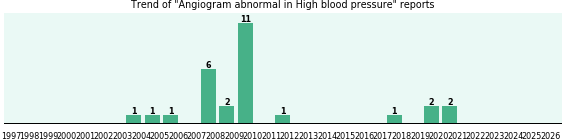
28 people who have High Blood Pressure and Angiogram Abnormal are studied.
Gender of people who have High Blood Pressure and experienced Angiogram Abnormal *:
- female: 50 %
- male: 50 %
Age of people who have High Blood Pressure and experienced Angiogram Abnormal *:
- 0-1: 0.0 %
- 2-9: 0.0 %
- 10-19: 0.0 %
- 20-29: 0.0 %
- 30-39: 0.0 %
- 40-49: 0.0 %
- 50-59: 19.05 %
- 60+: 80.95 %
Common co-existing conditions for these people *:
- Diabetes: 10 people, 35.71%
- High Blood Cholesterol: 9 people, 32.14%
- Hyperlipidaemia (presence of excess lipids in the blood): 4 people, 14.29%
- Systolic Dysfunction (impaired ventricular contraction): 3 people, 10.71%
- Cardiac Failure: 3 people, 10.71%
- Fluid Retention (an abnormal accumulation of fluid in the blood): 3 people, 10.71%
- Type 2 Diabetes: 3 people, 10.71%
- Pulmonary Embolism (blockage of the main artery of the lung): 3 people, 10.71%
- Pulmonary Hypertension (increase in blood pressure in the lung artery): 3 people, 10.71%
- Coronary Heart Disease (narrowing or blockage of the coronary arteries): 2 people, 7.14%
Common drugs taken by these people *:
- Lantus: 7 people, 25.00%
- Norvasc: 6 people, 21.43%
- Metformin: 5 people, 17.86%
- Simvastatin: 4 people, 14.29%
- Amlodipine: 4 people, 14.29%
- Aspirin: 4 people, 14.29%
- Humalog: 4 people, 14.29%
- Diovan: 4 people, 14.29%
- Carvedilol: 3 people, 10.71%
- Nifedipine: 3 people, 10.71%
Common symptoms for these people *:
- High Blood Cholesterol: 7 people, 25.00%
- Left Ventricular Hypertrophy (the thickening of the myocardium (muscle) of the left ventricle of the heart): 6 people, 21.43%
- Blood Pressure Abnormal: 5 people, 17.86%
- Stable Angina (a constant chest pain): 5 people, 17.86%
- Glycosylated Haemoglobin Increased: 4 people, 14.29%
- Electrocardiogram Qrs Complex Prolonged: 4 people, 14.29%
- Chest Pain: 4 people, 14.29%
- Drug Ineffective: 4 people, 14.29%
- Blood Glucose Increased: 4 people, 14.29%
- Loss Of Consciousness: 4 people, 14.29%
* Approximation only. Some reports may have incomplete information.
Do you take medications and have Angiogram abnormal?
- Check whether Angiogram abnormal is associated with a drug or a conditionRelated studies:
Treatments, associated drugs and conditions:
- High blood pressure (1,062,849 reports)
- Angiogram abnormal (178 reports)
All the drugs that are associated with Angiogram abnormal:
- Angiogram abnormal (150 drugs)
All the conditions that are associated with Angiogram abnormal:
- Angiogram abnormal (184 conditions)
How the study uses the data?
How to use the study?
DO NOT STOP MEDICATIONS without first consulting your doctor. If there are any serious or long term adverse effects discovered in the study, discuss the study with your doctor to ensure that proper medication management will be in place if applicable.
The study is based on Angiogram abnormal and High blood pressure, and their synonyms.
Who is eHealthMe?
With medical big data and proven AI/ML algorithms, eHealthMe provides a platform for everyone to run phase IV clinical trials. We study millions of patients and 5,000 more each day. Results of our real-world drug study have been referenced on 800+ peer-reviewed medical publications, including The Lancet, Mayo Clinic Proceedings, and Nature. Our analysis results are available to researchers, health care professionals, patients (testimonials), and software developers (open API).
WARNING, DISCLAIMER, USE FOR PUBLICATION
WARNING: Please DO NOT STOP MEDICATIONS without first consulting a physician since doing so could be hazardous to your health.
DISCLAIMER: All material available on eHealthMe.com is for informational purposes only, and is not a substitute for medical advice, diagnosis, or treatment provided by a qualified healthcare provider. All information is observation-only. Our phase IV clinical studies alone cannot establish cause-effect relationship. Different individuals may respond to medication in different ways. Every effort has been made to ensure that all information is accurate, up-to-date, and complete, but no guarantee is made to that effect. The use of the eHealthMe site and its content is at your own risk.
If you use this eHealthMe study on publication, please acknowledge it with a citation: study title, URL, accessed date.
Recent studies on eHealthMe:
- Could Butrans cause Hoarseness Or Changing Voice? - 10 seconds ago
- Could Fenofibrate cause Restless Leg Syndrome? - 22 seconds ago
- Could Exelon cause Aphagia? - 28 seconds ago
- Drug interactions of Elavil and Vancomycin Hcl - 35 seconds ago
- Drug interactions of Repatha and Bisacodyl - 43 seconds ago
- Could Prednisolone cause West Nile Viral Infection? - 48 seconds ago
- Could Prednicarbate cause Pain Exacerbated? - a minute ago
- Drug interactions of Maxzide-25 and Ambien - a minute ago
- Drug interactions of Plavix and Zytiga - a minute ago
- How effective is Metoprolol Tartrate for Paroxysmal Supraventricular Tachycardia? - a minute ago