Abilify and Haloperidol lactate drug interactions - a phase IV clinical study of FDA data
Summary:
Drug interactions are reported among people who take Abilify (aripiprazole) and Haloperidol lactate (haloperidol lactate). Common drug interactions include overdose among females and anxiety among males.
The phase IV clinical study analyzes what interactions people have when they take Abilify and Haloperidol lactate. It is created by eHealthMe based on reports of 15 people who take the same drugs from the FDA, and is updated regularly.
What is Abilify?
Abilify has active ingredients of aripiprazole. It is often used in depression. eHealthMe is studying from 101,454 Abilify users. Check the latest studies of Abilify.
What is Haloperidol lactate?
Haloperidol lactate has active ingredients of haloperidol lactate. eHealthMe is studying from 606 Haloperidol lactate users. Check the latest studies of Haloperidol lactate.
15 people who take Abilify and Haloperidol lactate together, and have interactions are studied.
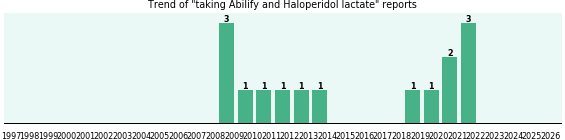
What are the common drug interactions of Abilify and Haloperidol Lactate, by gender? *:
female:
- Overdose
- Arthralgia (joint pain)
- Arthritis (form of joint disorder that involves inflammation of one or more joints)
- Blood cholesterol increased
- Blood triglycerides increased
- Diabetes mellitus (diabetes, caused by a deficiency of the pancreatic hormone insulin)
- Diabetic ketoacidosis (diabetic ketoacidosis (dka) is high concentrations of ketone bodies)
- Gallbladder disorder
- Hepatic enzyme increased
- Hepatic steatosis (fatty liver disease)
male:
- Anxiety
- Sexual dysfunction (difficulty experienced by an individual or a couple during any stage of a normal sexual activity)
- Bone density decreased
- Bone loss
- Chronic kidney disease
- Dysuria (painful or difficult urination)
- Emotional distress
- Emotional poverty
- Hyperprolactinaemia (abnormally high levels of prolactin in the blood)
- Nephrolithiasis (calculi in the kidneys)
What are the common drug interactions of Abilify and Haloperidol Lactate, by age (0-1 to 60+)? *:
0-1:
n/a
2-9:
n/a
10-19:
n/a
20-29:
- Anxiety
- Delusion (a false belief or opinion)
- Disturbance in attention
- Dizziness
- Drug ineffective
- Extrapyramidal disorder (involuntary muscle spasms in the face and neck)
- Fatigue (feeling of tiredness)
- Muscle fatigue (a condition in which muscles cannot exert their normal force)
- Parkinsonian gait (gait exhibited by patients suffering from parkinson's disease)
- Psychotic disorder
30-39:
- Arthralgia (joint pain)
- Synovial cyst (cyst of joint filled with synovial fluid)
- Tardive dyskinesia (a disorder that involves involuntary movements)
- Weight increased
- Back pain
- Drug abuse
- Drug diversion
- Fatigue (feeling of tiredness)
- Headache (pain in head)
- Hypersensitivity
40-49:
- Arthritis (form of joint disorder that involves inflammation of one or more joints)
- Blood cholesterol increased
- Blood triglycerides increased
- Diabetes mellitus (diabetes, caused by a deficiency of the pancreatic hormone insulin)
- Diabetic ketoacidosis (diabetic ketoacidosis (dka) is high concentrations of ketone bodies)
- Gallbladder disorder
- Hepatic enzyme increased
- Hepatic steatosis (fatty liver disease)
- Liver disorder (liver diseases)
- Mental disorder (a psychological term for a mental or behavioural pattern or anomaly that causes distress or disability)
50-59:
- Akathisia (a movement disorder characterized by a feeling of inner restlessness)
- Anhedonia (inability to experience pleasure from activities usually found enjoyable)
- Emotional poverty
- Extrapyramidal disorder (involuntary muscle spasms in the face and neck)
- Fatigue (feeling of tiredness)
- Hyperprolactinaemia (abnormally high levels of prolactin in the blood)
- Nephrolithiasis (calculi in the kidneys)
- Osteonecrosis (death of bone)
- Pain
- Psychosexual disorder
60+:
n/a
What are the existing conditions these people have? *
- Sleep Disorder: 3 people, 20.00%
- Schizophrenia (a mental disorder characterized by a breakdown of thought processes): 3 people, 20.00%
- Pain: 3 people, 20.00%
- Narcolepsy (brain's inability to regulate sleep-wake cycles normally): 3 people, 20.00%
- Insomnia (sleeplessness): 3 people, 20.00%
- Bipolar I Disorder (mood disorder that is characterized by at least one manic or mixed episode): 3 people, 20.00%
- Hiv Infection: 2 people, 13.33%
- Drowsiness: 2 people, 13.33%
- Cataplexy (loss of muscle tone accompanied by full conscious awareness): 2 people, 13.33%
- Schizoaffective Disorder Bipolar Type (mental illness featuring schizophrenia and a mood disorder with mania): 1 person, 6.67%
* Approximation only. Some reports may have incomplete information.
Do you take Abilify and Haloperidol lactate?
- Personalize this study to your gender, age, symptoms and drugs
- Predict drug outcomes for up to one year with AI
- Get an AI agent to monitor your drugs continuously
Related studies:
Effectiveness of, side effects of, and alternative drugs to the 2 drugs:
- Abilify (101,454 reports)
- Haloperidol lactate (606 reports)
Browse all drug interactions of Abilify and Haloperidol lactate:
a b c d e f g h i j k l m n o p q r s t u v w x y zSub-studies by gender and age:
Female: 0-1 2-9 10-19 20-29 30-39 40-49 50-59 60+
Male: 0-1 2-9 10-19 20-29 30-39 40-49 50-59 60+
Browse all side effects of Abilify:
a b c d e f g h i j k l m n o p q r s t u v w x y zBrowse all side effects of Haloperidol lactate:
a b c d e f g h i j k l m n o p q r s t u v w x y zBrowse all interactions between Abilify and drugs from A to Z:
a b c d e f g h i j k l m n o p q r s t u v w x y zBrowse all interactions between Haloperidol lactate and drugs from A to Z:
a b c d e f g h i j k l m n o p q r s t u v w x y zRelated publications that referenced our studies
- Cetin, M., Celik, M., Cakici, M., Polat, M., & Suner, A, "Aripiprazole-Induced Hoarseness", Turk Psikiyatri Dergisi, 2018 Jan .
- Cetin M, Celik M, Cakici M, Polat M, Suner A, "Aripiprazole induced non-cardiogenic pulmonary edema: a case report", Turk Psikiyatri Dergisi, 2014 Dec .
- Cetin, M., Celik, M., Cakici, M., Polat, M., & Suner, A, "Aripiprazole-Induced Hoarseness", Turk Psikiyatri Dergisi, 2018 Jan .
- Cetin M, Celik M, Cakici M, Polat M, Suner A, "Aripiprazole induced non-cardiogenic pulmonary edema: a case report", Turk Psikiyatri Dergisi, 2014 Dec .
How the study uses the data?
The study uses data from the FDA. It is based on aripiprazole and haloperidol lactate (the active ingredients of Abilify and Haloperidol lactate, respectively), and Abilify and Haloperidol lactate (the brand names). Other drugs that have the same active ingredients (e.g. generic drugs) are not considered. Dosage of drugs is not considered in the study.
How to use the study?
DO NOT STOP MEDICATIONS without first consulting your doctor. If there are any serious or long term adverse effects discovered in the study, discuss the study with your doctor to ensure that proper medication management will be in place if applicable.
Who is eHealthMe?
With medical big data and proven AI/ML algorithms, eHealthMe provides a platform for everyone to run phase IV clinical trials. We study millions of patients and 5,000 more each day. Results of our real-world drug study have been referenced on 800+ peer-reviewed medical publications, including The Lancet, Mayo Clinic Proceedings, and Nature. Our analysis results are available to researchers, health care professionals, patients (testimonials), and software developers (open API).
WARNING, DISCLAIMER, USE FOR PUBLICATION
WARNING: Please DO NOT STOP MEDICATIONS without first consulting a physician since doing so could be hazardous to your health.
DISCLAIMER: All material available on eHealthMe.com is for informational purposes only, and is not a substitute for medical advice, diagnosis, or treatment provided by a qualified healthcare provider. All information is observation-only. Our phase IV clinical studies alone cannot establish cause-effect relationship. Different individuals may respond to medication in different ways. Every effort has been made to ensure that all information is accurate, up-to-date, and complete, but no guarantee is made to that effect. The use of the eHealthMe site and its content is at your own risk.
If you use this eHealthMe study on publication, please acknowledge it with a citation: study title, URL, accessed date.
Recent studies on eHealthMe:
- Drug interactions of Sandostatin and Tradjenta - 2 seconds ago
- Drug interactions of Atorvastatin Calcium and Ascorbate - 3 seconds ago
- Drug interactions of Promacta and Latanoprost - 3 seconds ago
- Tapentadol Hydrochloride vs. Vivitrol, side effect and effectiveness comparison - 10 seconds ago
- Could Leqvio cause Hair Loss? - 15 seconds ago
- Drug interactions of Zyrtec and Tarka - 32 seconds ago
- Could Provera cause Gout? - 37 seconds ago
- Drug interactions of Biktarvy and Oxycodone And Acetaminophen - 39 seconds ago
- Drug interactions of Yupelri and Albuterol - 41 seconds ago
- Drug interactions of Lamotrigine and Relistor - 51 seconds ago