Amlodipine and Cataflam drug interactions - a phase IV clinical study of FDA data
Summary:
Drug interactions are reported among people who take Amlodipine (amlodipine besylate) and Cataflam (diclofenac potassium). Common drug interactions include erythema among females and chronic kidney disease among males.
The phase IV clinical study analyzes what interactions people have when they take Amlodipine and Cataflam. It is created by eHealthMe based on reports of 30 people who take the same drugs from the FDA, and is updated regularly.
What is Amlodipine?
Amlodipine has active ingredients of amlodipine besylate. It is often used in high blood pressure. eHealthMe is studying from 354,829 Amlodipine users. Check the latest studies of Amlodipine.
What is Cataflam?
Cataflam has active ingredients of diclofenac potassium. It is often used in pain. eHealthMe is studying from 1,851 Cataflam users. Check the latest studies of Cataflam.
30 people who take Amlodipine and Cataflam together, and have interactions are studied.
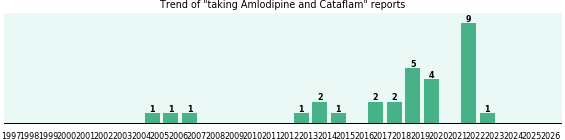
What are the common drug interactions of Amlodipine and Cataflam, by gender? *:
female:
- Erythema (redness of the skin)
- Lip swelling
- Nausea (feeling of having an urge to vomit)
- Vomiting
- Bacteriuria (presence of bacteria in urine)
- Body temperature increased
- C-reactive protein increased
- Cranial nerve disorder (impaired functioning of one of the twelve cranial nerves)
- Diarrhoea
- Drug ineffective
male:
- Chronic kidney disease
- Drug hypersensitivity
- Diarrhoea
- Drug ineffective
- Hypophagia (reduced food intake)
- Local swelling (swelling at the site of some application of substance or injury)
- Muscular weakness (muscle weakness)
- Rectal haemorrhage (bleeding from anus)
- Respiratory failure (inadequate gas exchange by the respiratory system)
- Urinary incontinence (inability to control the flow of urine and involuntary urination)
What are the common drug interactions of Amlodipine and Cataflam, by age (0-1 to 60+)? *:
0-1:
n/a
2-9:
n/a
10-19:
n/a
20-29:
n/a
30-39:
n/a
40-49:
- Chronic kidney disease
- Gastrooesophageal reflux disease (stomach contents (food or liquid) leak backwards from the stomach into the oesophagus)
- Renal failure (kidney dysfunction)
50-59:
- Urticaria (rash of round, red welts on the skin that itch intensely)
- Chronic kidney disease
- Erythema (redness of the skin)
- Hypersensitivity
- Insomnia (sleeplessness)
- Lip blister
- Lip swelling
- Pruritus (severe itching of the skin)
- Rash
- Swelling
60+:
- Erythema (redness of the skin)
- Vomiting
- Hepatic enzyme increased
- Hepatic steatosis (fatty liver disease)
- Hot flush (sudden feelings of heat)
- Hyperhidrosis (abnormally increased sweating)
- Hypoaesthesia (reduced sense of touch or sensation)
- Hypothyroidism (abnormally low activity of the thyroid gland, resulting in retardation of growth and mental development)
- Lip swelling
- Lymphoedema (localized fluid retention and tissue swelling)
What are the existing conditions these people have? *
- Bacteriuria (presence of bacteria in urine): 9 people, 30.00%
- Breast Cancer Metastatic: 9 people, 30.00%
- Gastroesophageal Reflux Disease (a condition in which stomach contents leak backward from the stomach into the oesophagus): 6 people, 20.00%
- Breast Cancer: 5 people, 16.67%
- Depression: 3 people, 10.00%
- Fluid Retention (an abnormal accumulation of fluid in the blood): 3 people, 10.00%
- Hypotension (abnormally low blood pressure): 3 people, 10.00%
- Metastases To Bone (cancer spreads to bone): 3 people, 10.00%
- Inflammation: 2 people, 6.67%
- Indigestion: 2 people, 6.67%
* Approximation only. Some reports may have incomplete information.
Do you take Amlodipine and Cataflam?
- Personalize this study to your gender, age, symptoms and drugs
- Predict drug outcomes for up to one year with AI
- Get an AI agent to monitor your drugs continuously
Related studies:
Effectiveness of, side effects of, and alternative drugs to the 2 drugs:
- Amlodipine (354,829 reports)
- Cataflam (1,851 reports)
Browse all drug interactions of Amlodipine and Cataflam:
a b c d e f g h i j k l m n o p q r s t u v w x y zSub-studies by gender and age:
Female: 0-1 2-9 10-19 20-29 30-39 40-49 50-59 60+
Male: 0-1 2-9 10-19 20-29 30-39 40-49 50-59 60+
Browse all side effects of Amlodipine:
a b c d e f g h i j k l m n o p q r s t u v w x y zBrowse all side effects of Cataflam:
a b c d e f g h i j k l m n o p q r s t u v w x y zBrowse all interactions between Amlodipine and drugs from A to Z:
a b c d e f g h i j k l m n o p q r s t u v w x y zBrowse all interactions between Cataflam and drugs from A to Z:
a b c d e f g h i j k l m n o p q r s t u v w x y zHow the study uses the data?
The study uses data from the FDA. It is based on amlodipine besylate and diclofenac potassium (the active ingredients of Amlodipine and Cataflam, respectively), and Amlodipine and Cataflam (the brand names). Other drugs that have the same active ingredients (e.g. generic drugs) are not considered. Dosage of drugs is not considered in the study.
How to use the study?
DO NOT STOP MEDICATIONS without first consulting your doctor. If there are any serious or long term adverse effects discovered in the study, discuss the study with your doctor to ensure that proper medication management will be in place if applicable.
Who is eHealthMe?
With medical big data and proven AI/ML algorithms, eHealthMe provides a platform for everyone to run phase IV clinical trials. We study millions of patients and 5,000 more each day. Results of our real-world drug study have been referenced on 800+ peer-reviewed medical publications, including The Lancet, Mayo Clinic Proceedings, and Nature. Our analysis results are available to researchers, health care professionals, patients (testimonials), and software developers (open API).
WARNING, DISCLAIMER, USE FOR PUBLICATION
WARNING: Please DO NOT STOP MEDICATIONS without first consulting a physician since doing so could be hazardous to your health.
DISCLAIMER: All material available on eHealthMe.com is for informational purposes only, and is not a substitute for medical advice, diagnosis, or treatment provided by a qualified healthcare provider. All information is observation-only. Our phase IV clinical studies alone cannot establish cause-effect relationship. Different individuals may respond to medication in different ways. Every effort has been made to ensure that all information is accurate, up-to-date, and complete, but no guarantee is made to that effect. The use of the eHealthMe site and its content is at your own risk.
If you use this eHealthMe study on publication, please acknowledge it with a citation: study title, URL, accessed date.
Recent studies on eHealthMe:
- Could Seroquel Xr cause Bedwetting? - 15 seconds ago
- Could Fortaz cause Gait Disturbance? - 44 seconds ago
- High Blood Pressure and Micturition Frequency Decreased - 51 seconds ago
- Drug interactions of Lexapro and Budesonide - a minute ago
- Drug interactions of Lamisil and Ciprofloxacin - 2 minutes ago
- Drug interactions of Nitrofurantoin and Terconazole - 2 minutes ago
- Drug interactions of Fioricet and Tivicay - 2 minutes ago
- Epilepsy and Confusional State - 2 minutes ago
- Could Fluphenazine cause Hospitalisation? - 2 minutes ago
- Could Tobradex cause Arrhythmias? - 2 minutes ago