Starlix and Clopidogrel drug interactions - a phase IV clinical study of FDA data
Summary:
Drug interactions are reported among people who take Starlix (nateglinide) and Clopidogrel (clopidogrel). Common drug interactions include hypothyroidism among females and renal failure among males.
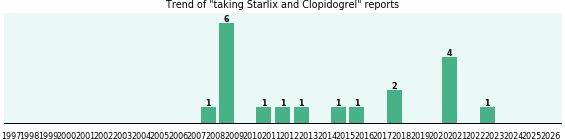
The phase IV clinical study analyzes what interactions people have when they take Starlix and Clopidogrel. It is created by eHealthMe based on reports of 19 people who take the same drugs from the FDA, and is updated regularly.
What is Starlix?
Starlix has active ingredients of nateglinide. It is often used in diabetes. eHealthMe is studying from 3,768 Starlix users. Check the latest studies of Starlix.
What is Clopidogrel?
Clopidogrel has active ingredients of clopidogrel. It is often used in blood clots. eHealthMe is studying from 92,160 Clopidogrel users. Check the latest studies of Clopidogrel.
19 people who take Starlix and Clopidogrel together, and have interactions are studied.
What are the common drug interactions of Starlix and Clopidogrel, by gender? *:
female:
- Hypothyroidism (abnormally low activity of the thyroid gland, resulting in retardation of growth and mental development)
- Injury
- Multiple injuries
- Muscle spasms (muscle contraction)
- Musculoskeletal stiffness (stiffness of the body's muscles, joints, tendons, ligaments and nerves)
- Myalgia (muscle pain)
- Myocardial ischaemia (the blood flow through one or more of the blood vessels that lead to heart (coronary arteries) is decreased)
- Nausea (feeling of having an urge to vomit)
- Neoplasm malignant (cancer tumour)
- Osteoporosis (bones weak and more likely to break)
male:
- Renal failure (kidney dysfunction)
- Cardiac failure congestive
- Cough
- Gastric polyps (abnormal growth of stomach tissue projecting from a mucous membrane)
- Musculoskeletal pain (pain affects the bones, muscles, ligaments, tendons, and nerves)
- Pain in extremity
- Spinal column stenosis (narrowing of spinal column)
- Angina pectoris (chest pain due to ischemia of the heart muscle)
- Chest pain
- Coronary artery disease (plaque building up along the inner walls of the arteries of the heart, which narrows the arteries and restricts blood flow to the heart)
What are the common drug interactions of Starlix and Clopidogrel, by age (0-1 to 60+)? *:
0-1:
n/a
2-9:
n/a
10-19:
n/a
20-29:
n/a
30-39:
n/a
40-49:
- Coronary artery disease (plaque building up along the inner walls of the arteries of the heart, which narrows the arteries and restricts blood flow to the heart)
50-59:
- Facet joint syndrome (problem with movement of the facet joints of the spine)
- Fatigue (feeling of tiredness)
- Gastroenteritis (inflammation of stomach and intestine)
- Hyperglycaemia (high blood sugar)
- Ill-defined disorder
- Injury
- Intermittent claudication
- Intervertebral disc space narrowing (spinal disc space narrowing)
- Ischaemia (insufficient supply of blood to an organ, usually due to a blocked artery)
- Jugular vein distension (overloaded jugular vein)
60+:
- Chronic kidney disease
- Renal failure (kidney dysfunction)
- Hypotension (abnormally low blood pressure)
- Left ventricular hypertrophy (the thickening of the myocardium (muscle) of the left ventricle of the heart)
- Nodule (a growth of abnormal tissue)
- Sick sinus syndrome (a collection of heart rhythm disorders)
- Umbilical hernia (an outward bulging (protrusion) of the abdominal lining or part of the abdominal organ(s) through the area around the belly button)
- Visual field defect
- Diarrhoea
- Dysphagia (a condition in which swallowing is difficult or painful)
What are the existing conditions these people have? *
- Cardiac Disorder: 10 people, 52.63%
- High Blood Cholesterol: 6 people, 31.58%
- Type 2 Diabetes: 5 people, 26.32%
- High Blood Pressure: 5 people, 26.32%
- Hypothyroidism (abnormally low activity of the thyroid gland, resulting in retardation of growth and mental development): 5 people, 26.32%
- Multiple Allergies (allergy to multiple agents): 4 people, 21.05%
- Gastroesophageal Reflux Disease (a condition in which stomach contents leak backward from the stomach into the oesophagus): 4 people, 21.05%
- Back Pain: 4 people, 21.05%
- Coronary Heart Disease (narrowing or blockage of the coronary arteries): 4 people, 21.05%
- Fever: 4 people, 21.05%
* Approximation only. Some reports may have incomplete information.
Do you take Starlix and Clopidogrel?
- Personalize this study to your gender, age, symptoms and drugs
- Predict drug outcomes for up to one year with AI
- Get an AI agent to monitor your drugs continuously
Related studies:
Effectiveness of, side effects of, and alternative drugs to the 2 drugs:
- Starlix (3,768 reports)
- Clopidogrel (92,160 reports)
Browse all drug interactions of Starlix and Clopidogrel:
a b c d e f g h i j k l m n o p q r s t u v w x y zSub-studies by gender and age:
Female: 0-1 2-9 10-19 20-29 30-39 40-49 50-59 60+
Male: 0-1 2-9 10-19 20-29 30-39 40-49 50-59 60+
Browse all side effects of Starlix:
a b c d e f g h i j k l m n o p q r s t u v w x y zBrowse all side effects of Clopidogrel:
a b c d e f g h i j k l m n o p q r s t u v w x y zBrowse all interactions between Starlix and drugs from A to Z:
a b c d e f g h i j k l m n o p q r s t u v w x y zBrowse all interactions between Clopidogrel and drugs from A to Z:
a b c d e f g h i j k l m n o p q r s t u v w x y zRelated publications that referenced our studies
- Lai SW, Lin CL, Liao KF, "Actively using clopidogrel correlates with an increased risk of acute pancreatitis in Taiwan", International journal of cardiology, 2015 Mar .
- Jacob S, Dunn BL, Qureshi ZP, Bandarenko N, Kwaan HC, Pandey DK, McKoy JM, Barnato SE, Winters JL, Cursio JF, Weiss I, "Ticlopidine-, clopidogrel-, and prasugrel-associated thrombotic thrombocytopenic purpura: a 20-year review from the Southern Network on Adverse Reactions (SONAR)", InSeminars in thrombosis and hemostasis, 2012 Jan .
- Frank P, "Ticlopidine-, Clopidogrel-, and Prasugrel-Associated Thrombotic Thrombocytopenic Purpura: A Twenty-Year Review from the Southern Network on Adverse Reactions (SONAR)", , 2012 Jan .
- Lai SW, Lin CL, Liao KF, "Actively using clopidogrel correlates with an increased risk of acute pancreatitis in Taiwan", International journal of cardiology, 2015 Mar .
- Jacob S, Dunn BL, Qureshi ZP, Bandarenko N, Kwaan HC, Pandey DK, McKoy JM, Barnato SE, Winters JL, Cursio JF, Weiss I, "Ticlopidine-, clopidogrel-, and prasugrel-associated thrombotic thrombocytopenic purpura: a 20-year review from the Southern Network on Adverse Reactions (SONAR)", InSeminars in thrombosis and hemostasis, 2012 Jan .
- Frank P, "Ticlopidine-, Clopidogrel-, and Prasugrel-Associated Thrombotic Thrombocytopenic Purpura: A Twenty-Year Review from the Southern Network on Adverse Reactions (SONAR)", , 2012 Jan .
How the study uses the data?
The study uses data from the FDA. It is based on nateglinide and clopidogrel (the active ingredients of Starlix and Clopidogrel, respectively), and Starlix and Clopidogrel (the brand names). Other drugs that have the same active ingredients (e.g. generic drugs) are not considered. Dosage of drugs is not considered in the study.
How to use the study?
DO NOT STOP MEDICATIONS without first consulting your doctor. If there are any serious or long term adverse effects discovered in the study, discuss the study with your doctor to ensure that proper medication management will be in place if applicable.
Who is eHealthMe?
With medical big data and proven AI/ML algorithms, eHealthMe provides a platform for everyone to run phase IV clinical trials. We study millions of patients and 5,000 more each day. Results of our real-world drug study have been referenced on 800+ peer-reviewed medical publications, including The Lancet, Mayo Clinic Proceedings, and Nature. Our analysis results are available to researchers, health care professionals, patients (testimonials), and software developers (open API).
WARNING, DISCLAIMER, USE FOR PUBLICATION
WARNING: Please DO NOT STOP MEDICATIONS without first consulting a physician since doing so could be hazardous to your health.
DISCLAIMER: All material available on eHealthMe.com is for informational purposes only, and is not a substitute for medical advice, diagnosis, or treatment provided by a qualified healthcare provider. All information is observation-only. Our phase IV clinical studies alone cannot establish cause-effect relationship. Different individuals may respond to medication in different ways. Every effort has been made to ensure that all information is accurate, up-to-date, and complete, but no guarantee is made to that effect. The use of the eHealthMe site and its content is at your own risk.
If you use this eHealthMe study on publication, please acknowledge it with a citation: study title, URL, accessed date.
Recent studies on eHealthMe:
- Could Felbatol cause Fever? - a second ago
- Drug interactions of Cortef and Ranexa - 2 seconds ago
- Drug interactions of Metochlopramide and Ondansetron - 2 seconds ago
- Could Finasteride cause Lobar Pneumonia? - 7 seconds ago
- Drug interactions of Olanzapine and Breo Ellipta - 8 seconds ago
- Could Temazepam cause Femur Fracture? - 20 seconds ago
- Drug interactions of Clonazepam and Zestril - 22 seconds ago
- Drug interactions of Ammonium Lactate and Ketoconazole - 24 seconds ago
- Could Dyazide cause Stomatitis? - 26 seconds ago
- Drug interactions of Tamsulosin Hydrochloride and Diclofenac - 28 seconds ago