Travatan and Vioxx drug interactions - a phase IV clinical study of FDA data
Summary:
Drug interactions are reported among people who take Travatan (travoprost) and Vioxx (rofecoxib). Common drug interactions include cataract among females and cerebrovascular accident among males.
The phase IV clinical study analyzes what interactions people have when they take Travatan and Vioxx. It is created by eHealthMe based on reports of 49 people who take the same drugs from the FDA, and is updated regularly.
What is Travatan?
Travatan has active ingredients of travoprost. It is often used in glaucoma. eHealthMe is studying from 13,103 Travatan users. Check the latest studies of Travatan.
What is Vioxx?
Vioxx has active ingredients of rofecoxib. It is often used in arthritis. eHealthMe is studying from 110,130 Vioxx users. Check the latest studies of Vioxx.
49 people who take Travatan and Vioxx together, and have interactions are studied.
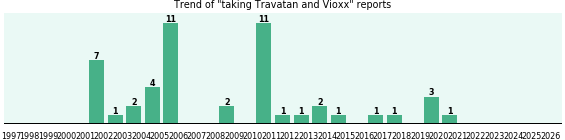
What are the common drug interactions of Travatan and Vioxx, by gender? *:
female:
- Cataract (clouding of the lens inside the eye)
- Confusional state
- Disorientation (disability in which the senses of time, direction, and recognition of people and places)
- Dizziness
- Fall
- Pulmonary hypertension (increase in blood pressure in the lung artery)
- Angina pectoris (chest pain due to ischemia of the heart muscle)
- Back pain
- Cognitive disorder (mental health disorders affects learning, memory, perception, and problem solving)
- Fatigue (feeling of tiredness)
male:
- Cerebrovascular accident (sudden death of some brain cells due to lack of oxygen when the blood flow to the brain is impaired by blockage or rupture)
- Hypertension (high blood pressure)
- Anxiety
- Back pain
- Bacteriuria (presence of bacteria in urine)
- Blood cholesterol increased
- Confusional state
- Coronary artery occlusion (complete obstruction of blood flow in a coronary artery)
- Depression
- Dyspepsia (indigestion)
What are the common drug interactions of Travatan and Vioxx, by age (0-1 to 60+)? *:
0-1:
n/a
2-9:
n/a
10-19:
n/a
20-29:
n/a
30-39:
n/a
40-49:
- Depression
- Chest pain
- Coronary artery disease (plaque building up along the inner walls of the arteries of the heart, which narrows the arteries and restricts blood flow to the heart)
- Generalised anxiety disorder (excessive, uncontrollable, unexplained and often irrational worry)
- Hyperlipidaemia (presence of excess lipids in the blood)
- Myocardial infarction (destruction of heart tissue resulting from obstruction of the blood supply to the heart muscle)
- Post-traumatic stress disorder
- Sleep disorder
- Ovarian disorder (disease of ovary)
- Gastrointestinal haemorrhage (bleeding gastrointestinal tract)
50-59:
- Carotid artery stenosis (narrowing of carotid artery)
- Cognitive disorder (mental health disorders affects learning, memory, perception, and problem solving)
- Coronary artery disease (plaque building up along the inner walls of the arteries of the heart, which narrows the arteries and restricts blood flow to the heart)
- Delirium (wild excitement)
- Dizziness
- Dysuria (painful or difficult urination)
- Emotional distress
- Gastrooesophageal reflux disease (stomach contents (food or liquid) leak backwards from the stomach into the oesophagus)
- Haematocrit decreased
- Hypertension (high blood pressure)
60+:
- Anxiety
- Cataract (clouding of the lens inside the eye)
- Tricuspid valve incompetence (inefficient heart valve)
- Aortic arteriosclerosis (hardening of the aortic arteries)
- Back pain
- Bronchitis (inflammation of the mucous membrane in the bronchial tubes)
- Cardiomegaly (increased size of heart than normal)
- Carpal tunnel syndrome (nerve compression at wrist results numbness weakness, pain , swelling)
- Chest pain
- Deformity (disfigurement)
What are the existing conditions these people have? *
- Multiple Myeloma (cancer of the plasma cells): 10 people, 20.41%
- Pain: 8 people, 16.33%
- Thyroid Diseases: 5 people, 10.20%
- Systemic Lupus Erythematosus (an autoimmune disease, which means the body's immune system mistakenly, attacks healthy tissue): 5 people, 10.20%
- High Blood Pressure: 5 people, 10.20%
- Stress And Anxiety: 3 people, 6.12%
- Paget's Disease (disorder that involves abnormal bone destruction and regrowth, which results in deformity): 3 people, 6.12%
- High Blood Cholesterol: 3 people, 6.12%
- Erection Problems: 3 people, 6.12%
* Approximation only. Some reports may have incomplete information.
Do you take Travatan and Vioxx?
- Personalize this study to your gender, age, symptoms and drugs
- Predict drug outcomes for up to one year with AI
- Get an AI agent to monitor your drugs continuously
Related studies:
Effectiveness of, side effects of, and alternative drugs to the 2 drugs:
Browse all drug interactions of Travatan and Vioxx:
a b c d e f g h i j k l m n o p q r s t u v w x y zSub-studies by gender and age:
Female: 0-1 2-9 10-19 20-29 30-39 40-49 50-59 60+
Male: 0-1 2-9 10-19 20-29 30-39 40-49 50-59 60+
Browse all side effects of Travatan:
a b c d e f g h i j k l m n o p q r s t u v w x y zBrowse all side effects of Vioxx:
a b c d e f g h i j k l m n o p q r s t u v w x y zBrowse all interactions between Travatan and drugs from A to Z:
a b c d e f g h i j k l m n o p q r s t u v w x y zBrowse all interactions between Vioxx and drugs from A to Z:
a b c d e f g h i j k l m n o p q r s t u v w x y zHow the study uses the data?
The study uses data from the FDA. It is based on travoprost and rofecoxib (the active ingredients of Travatan and Vioxx, respectively), and Travatan and Vioxx (the brand names). Other drugs that have the same active ingredients (e.g. generic drugs) are not considered. Dosage of drugs is not considered in the study.
How to use the study?
DO NOT STOP MEDICATIONS without first consulting your doctor. If there are any serious or long term adverse effects discovered in the study, discuss the study with your doctor to ensure that proper medication management will be in place if applicable.
Who is eHealthMe?
With medical big data and proven AI/ML algorithms, eHealthMe provides a platform for everyone to run phase IV clinical trials. We study millions of patients and 5,000 more each day. Results of our real-world drug study have been referenced on 800+ peer-reviewed medical publications, including The Lancet, Mayo Clinic Proceedings, and Nature. Our analysis results are available to researchers, health care professionals, patients (testimonials), and software developers (open API).
WARNING, DISCLAIMER, USE FOR PUBLICATION
WARNING: Please DO NOT STOP MEDICATIONS without first consulting a physician since doing so could be hazardous to your health.
DISCLAIMER: All material available on eHealthMe.com is for informational purposes only, and is not a substitute for medical advice, diagnosis, or treatment provided by a qualified healthcare provider. All information is observation-only. Our phase IV clinical studies alone cannot establish cause-effect relationship. Different individuals may respond to medication in different ways. Every effort has been made to ensure that all information is accurate, up-to-date, and complete, but no guarantee is made to that effect. The use of the eHealthMe site and its content is at your own risk.
If you use this eHealthMe study on publication, please acknowledge it with a citation: study title, URL, accessed date.
Recent studies on eHealthMe:
- Could Ms Contin cause Device Related Infection? - 3 seconds ago
- Drug interactions of Metoclopramide and Relistor - 11 seconds ago
- Neck Pain in Klonopin, how severe and when it was recovered? - 19 seconds ago
- Pindolol vs. Azor, side effect and effectiveness comparison - 24 seconds ago
- Drug interactions of Pepcid and Lidex - 26 seconds ago
- Drug interactions of Clindamycin Hydrochloride and Chlorhexidine Gluconate - 27 seconds ago
- Rickets and Lymphopenia - 28 seconds ago
- Could Rexulti cause Torticollis? - 29 seconds ago
- Anaemia and drugs of ingredients of clozapine - 33 seconds ago
- Could Celebrex cause Thyroid Diseases? - 50 seconds ago