Xeloda and Multivitamin drug interactions - a phase IV clinical study of FDA data
Summary:
Drug interactions are reported among people who take Xeloda (capecitabine) and Multivitamin (ascorbic acid; biotin; cyanocobalamin; dexpanthenol; ergocalciferol; folic acid; niacinamide; pyridoxine hydrochloride; riboflavin phosphate sodium; thiamine hydrochloride; vitamin a; vitamin e). Common drug interactions include osteomyelitis among females and convulsion among males.
The phase IV clinical study analyzes what interactions people have when they take Xeloda and Multivitamin. It is created by eHealthMe based on reports of 89 people who take the same drugs from the FDA, and is updated regularly.
What is Xeloda?
Xeloda has active ingredients of capecitabine. It is often used in colon cancer. eHealthMe is studying from 46,649 Xeloda users. Check the latest studies of Xeloda.
What is Multivitamin?
Multivitamin has active ingredients of ascorbic acid; biotin; cyanocobalamin; dexpanthenol; ergocalciferol; folic acid; niacinamide; pyridoxine hydrochloride; riboflavin phosphate sodium; thiamine hydrochloride; vitamin a; vitamin e. It is often used in vitamin supplementation. eHealthMe is studying from 83,597 Multivitamin users. Check the latest studies of Multivitamin.
89 people who take Xeloda and Multivitamin together, and have interactions are studied.
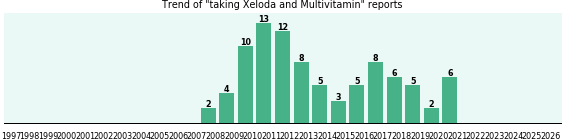
What are the common drug interactions of Xeloda and Multivitamin, by gender? *:
female:
- Osteomyelitis (infection of bone)
- Osteonecrosis of jaw (death of bone of jaw)
- Anxiety
- Injury
- Primary sequestrum (piece of dead bone that has become separated during the process of necrosis from normal/sound bone)
- Infection
- Metastases to bone (cancer spreads to bone)
- Asthenia (weakness)
- Death
- Nausea (feeling of having an urge to vomit)
male:
- Convulsion (muscles contract and relax rapidly and repeatedly, resulting in an uncontrolled shaking of the body)
- Malignant neoplasm progression (cancer tumour came back)
- Bone disorder
- Bone lesion (bone with abnormalities. bone lesions can result from growth formations, infections, or injuries)
- Cataract (clouding of the lens inside the eye)
- Dental caries
- Emphysema (chronic respiratory disease - over inflation of the air sacs (alveoli) in the lungs)
- Fistula (an abnormal connection or passageway between two)
- Haematocrit decreased
- Hyperlipidaemia (presence of excess lipids in the blood)
What are the common drug interactions of Xeloda and Multivitamin, by age (0-1 to 60+)? *:
0-1:
n/a
2-9:
n/a
10-19:
n/a
20-29:
n/a
30-39:
- Alopecia (absence of hair from areas of the body)
- Anxiety
- Emotional distress
- Pain
- Febrile neutropenia (fever with reduced white blood cells)
- Psychological trauma
40-49:
- Anxiety
- Bone lesion (bone with abnormalities. bone lesions can result from growth formations, infections, or injuries)
- Cardiac murmur (an heart sound in valve abnormality)
- Intervertebral disc protrusion (spinal disc protrusion)
- Metastases to bone (cancer spreads to bone)
- Osteonecrosis of jaw (death of bone of jaw)
- Pain
- Pain in extremity
- Tooth fracture
- Abdominal pain
50-59:
- Dry eye (lack of adequate tears)
- General physical health deterioration (weak health status)
- Hypothyroidism (abnormally low activity of the thyroid gland, resulting in retardation of growth and mental development)
- Impaired healing
- Irritable bowel syndrome
- Lung neoplasm malignant (cancer tumour of lung)
- Metastases to liver (cancer spreads to liver)
- Neutropenia (an abnormally low number of neutrophils)
- Oral candidiasis (fungal infection of mouth)
- Osteomyelitis (infection of bone)
60+:
- Diarrhoea
- Asthenia (weakness)
- Eating disorder
- Fistula (an abnormal connection or passageway between two)
- Influenza
- Injury
- Local swelling (swelling at the site of some application of substance or injury)
- Menorrhagia (an abnormally heavy bleeding and prolonged menstrual period at regular intervals)
- Metastases to bone (cancer spreads to bone)
- Myocardial infarction (destruction of heart tissue resulting from obstruction of the blood supply to the heart muscle)
What are the existing conditions these people have? *
- Breast Cancer Metastatic: 24 people, 26.97%
- Breast Cancer: 19 people, 21.35%
- Metastases To Bone (cancer spreads to bone): 6 people, 6.74%
- Depression: 6 people, 6.74%
- Pain: 5 people, 5.62%
- Hypercalcaemia Of Malignancy (elevated calcium (ca+) level in the blood with cancer): 5 people, 5.62%
- Cystitis Interstitial (unknown cause characterized by bladder pain): 5 people, 5.62%
* Approximation only. Some reports may have incomplete information.
Do you take Xeloda and Multivitamin?
- Personalize this study to your gender, age, symptoms and drugs
- Predict drug outcomes for up to one year with AI
- Get an AI agent to monitor your drugs continuously
Related studies:
Effectiveness of, side effects of, and alternative drugs to the 2 drugs:
- Xeloda (46,649 reports)
- Multivitamin (83,597 reports)
Browse all drug interactions of Xeloda and Multivitamin:
a b c d e f g h i j k l m n o p q r s t u v w x y zSub-studies by gender and age:
Female: 0-1 2-9 10-19 20-29 30-39 40-49 50-59 60+
Male: 0-1 2-9 10-19 20-29 30-39 40-49 50-59 60+
Browse all side effects of Xeloda:
a b c d e f g h i j k l m n o p q r s t u v w x y zBrowse all side effects of Multivitamin:
a b c d e f g h i j k l m n o p q r s t u v w x y zBrowse all interactions between Xeloda and drugs from A to Z:
a b c d e f g h i j k l m n o p q r s t u v w x y zBrowse all interactions between Multivitamin and drugs from A to Z:
a b c d e f g h i j k l m n o p q r s t u v w x y zRelated publications that referenced our studies
- Pinto HP, Bhat RM, Shet D, Dandekeri S, "Compound mucocutaneous adverse effects of oral capecitabine in a patient", Indian dermatology online journal, 2014 Jan .
- Kang SM, Baek JY, Hwangbo B, Kim HY, Lee GK, Lee HS, "A case of capecitabine-induced sarcoidosis", Tuberculosis and respiratory diseases, 2012 Mar .
- Pinto HP, Bhat RM, Shet D, Dandekeri S, "Compound mucocutaneous adverse effects of oral capecitabine in a patient", Indian dermatology online journal, 2014 Jan .
- Kang SM, Baek JY, Hwangbo B, Kim HY, Lee GK, Lee HS, "A case of capecitabine-induced sarcoidosis", Tuberculosis and respiratory diseases, 2012 Mar .
How the study uses the data?
The study uses data from the FDA. It is based on capecitabine and ascorbic acid; biotin; cyanocobalamin; dexpanthenol; ergocalciferol; folic acid; niacinamide; pyridoxine hydrochloride; riboflavin phosphate sodium; thiamine hydrochloride; vitamin a; vitamin e (the active ingredients of Xeloda and Multivitamin, respectively), and Xeloda and Multivitamin (the brand names). Other drugs that have the same active ingredients (e.g. generic drugs) are not considered. Dosage of drugs is not considered in the study.
How to use the study?
DO NOT STOP MEDICATIONS without first consulting your doctor. If there are any serious or long term adverse effects discovered in the study, discuss the study with your doctor to ensure that proper medication management will be in place if applicable.
Who is eHealthMe?
With medical big data and proven AI/ML algorithms, eHealthMe provides a platform for everyone to run phase IV clinical trials. We study millions of patients and 5,000 more each day. Results of our real-world drug study have been referenced on 800+ peer-reviewed medical publications, including The Lancet, Mayo Clinic Proceedings, and Nature. Our analysis results are available to researchers, health care professionals, patients (testimonials), and software developers (open API).
WARNING, DISCLAIMER, USE FOR PUBLICATION
WARNING: Please DO NOT STOP MEDICATIONS without first consulting a physician since doing so could be hazardous to your health.
DISCLAIMER: All material available on eHealthMe.com is for informational purposes only, and is not a substitute for medical advice, diagnosis, or treatment provided by a qualified healthcare provider. All information is observation-only. Our phase IV clinical studies alone cannot establish cause-effect relationship. Different individuals may respond to medication in different ways. Every effort has been made to ensure that all information is accurate, up-to-date, and complete, but no guarantee is made to that effect. The use of the eHealthMe site and its content is at your own risk.
If you use this eHealthMe study on publication, please acknowledge it with a citation: study title, URL, accessed date.
Recent studies on eHealthMe:
- Drug interactions of Zopiclone and Tarceva - 5 seconds ago
- Drug interactions of Catapres and Atorvastatin Calcium - 15 seconds ago
- Could Incruse Ellipta cause Nightmares? - 16 seconds ago
- Nasal Discharge and Drug Ineffective - 16 seconds ago
- Drug interactions of Ampyra and Vitamin E - 16 seconds ago
- Could Cyramza cause Broken Bone? - 23 seconds ago
- Advil Cold And Sinus vs. Excedrin, side effect and effectiveness comparison - 27 seconds ago
- Could Klonopin cause Movement - Uncontrolled Or Slow? - 27 seconds ago
- Could Restoril cause Full Blood Count Decreased? - 28 seconds ago
- Could Cisplatin cause Joint Pain? - 30 seconds ago