Promacta and Acute myeloid leukaemia - a phase IV clinical study of FDA data
Summary:
Acute myeloid leukaemia is reported as a side effect among people who take Promacta (eltrombopag olamine), especially for people who are male, 60+ old, have been taking the drug for 1 - 6 months also take Danazol, and have Idiopathic thrombocytopenic purpura.
The phase IV clinical study analyzes which people have Acute myeloid leukaemia when taking Promacta. It is created by eHealthMe based on reports of 17,717 people who have side effects when taking Promacta from the FDA, and is updated regularly.
What is Promacta?
Promacta has active ingredients of eltrombopag olamine. It is often used in idiopathic thrombocytopenic purpura (itp). eHealthMe is studying from 17,758 Promacta users. Check the latest studies of Promacta.
What is Acute myeloid leukaemia?
Acute myeloid leukaemia (acute cancer in which the bone marrow makes abnormal myeloblasts) is found to be associated with 721 drugs and 1,223 conditions by eHealthMe. Check the latest studies of Acute myeloid leukaemia.
17,717 people reported to have side effects when taking Promacta.
Among them, 70 people (0.4%) have Acute myeloid leukaemia.
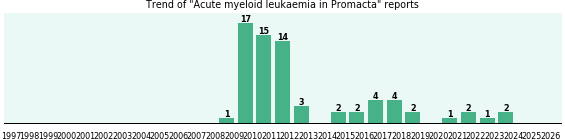
Among these 70 people:
How long have people been on Promacta when they have Acute myeloid leukaemia? *
- < 1 month: 33.33 %
- 1 - 6 months: 43.14 %
- 6 - 12 months: 19.61 %
- 1 - 2 years: 1.96 %
- 2 - 5 years: 1.96 %
- 5 - 10 years: 0.0 %
- 10+ years: 0.0 %
What is the gender of people who have Acute myeloid leukaemia when taking Promacta? *
- female: 47.06 %
- male: 52.94 %
What is the age of people who have Acute myeloid leukaemia when taking Promacta? *
- 0-1: 0.0 %
- 2-9: 0.0 %
- 10-19: 0.0 %
- 20-29: 0.0 %
- 30-39: 3.7 %
- 40-49: 0.0 %
- 50-59: 14.81 %
- 60+: 81.48 %
What are other drugs people take besides Promacta? *
- Danazol: 5 people, 7.14%
- Azathioprine: 3 people, 4.29%
- Vidaza: 3 people, 4.29%
- Venclexta: 3 people, 4.29%
- Neupogen: 2 people, 2.86%
- Revlimid: 2 people, 2.86%
- Desferal: 1 person, 1.43%
- Lorazepam: 1 person, 1.43%
- Klonopin: 1 person, 1.43%
- Ginseng Root: 1 person, 1.43%
What are other side effects people have besides Acute myeloid leukaemia? *
- Drug Ineffective: 37 people, 52.86%
- Myelodysplastic Syndrome (a group of conditions that occur when the blood-forming cells in the bone marrow are damaged): 19 people, 27.14%
- Disease Progression: 14 people, 20.00%
- Thrombocytopenia (decrease of platelets in blood): 9 people, 12.86%
- Splenomegaly (enlargement of spleen): 8 people, 11.43%
- Fatigue (feeling of tiredness): 6 people, 8.57%
- White Blood Cell Count Increased: 5 people, 7.14%
- Paleness (unusual lightness of skin colour): 5 people, 7.14%
- Anaemia (lack of blood): 5 people, 7.14%
- Haemorrhage (bleeding): 5 people, 7.14%
What are the existing conditions these people have? *
- Idiopathic Thrombocytopenic Purpura (bleeding disorder in which the immune system destroys platelets, which are necessary for normal blood clotting): 27 people, 38.57%
- Myelodysplastic Syndrome (a group of conditions that occur when the blood-forming cells in the bone marrow are damaged): 15 people, 21.43%
- Thrombocytopenia (decrease of platelets in blood): 7 people, 10.00%
- Multiple Myeloma (cancer of the plasma cells): 3 people, 4.29%
- Autoimmune Thrombocytopenia (isolated low platelet count (thrombocytopenia) with normal bone marrow and the absence of other causes of thrombocytopenia): 3 people, 4.29%
- Anaemia (lack of blood): 2 people, 2.86%
- Thrombocytopenic Purpura (a bleeding disorder in which the immune system destroys platelets): 1 person, 1.43%
- Relapsing-Remitting Multiple Sclerosis (reoccurrence of an inflammatory disease in which the insulating covers of nerve cells in the brain and spinal cord are damaged): 1 person, 1.43%
- Paroxysmal Nocturnal Haemoglobinuria (haemoglobin in the urine): 1 person, 1.43%
- Chronic Lymphocytic Leukaemia (cancer in which the bone marrow makes too many lymphocytes (a type of white blood cell)): 1 person, 1.43%
* Approximation only. Some reports may have incomplete information.
Do you take Promacta and have Acute myeloid leukaemia?
- Check whether Acute myeloid leukaemia is associated with a drug or a condition
- Predict drug outcomes for up to one year with AI
- Get an AI agent to monitor your drugs continuously
Related studies:
Effectiveness of, long term effects of, and alternative drugs to Promacta:
- Promacta (17,758 reports)
Acute myeloid leukaemia treatments and more:
- Acute myeloid leukaemia (68,363 reports)
How severe was Acute myeloid leukaemia and when was it recovered:
Expand to all the drugs that have ingredients of eltrombopag olamine:
Sub-studies by gender and age:
Female: 0-1 2-9 10-19 20-29 30-39 40-49 50-59 60+
Male: 0-1 2-9 10-19 20-29 30-39 40-49 50-59 60+
Browse all side effects of Promacta:
a b c d e f g h i j k l m n o p q r s t u v w x y zBrowse all the drugs that are associated with Acute myeloid leukaemia:
- Acute myeloid leukaemia (721 drugs)
Browse all the conditions that are associated with Acute myeloid leukaemia:
- Acute myeloid leukaemia (1,223 conditions)
How the study uses the data?
The study uses data from the FDA. It is based on eltrombopag olamine (the active ingredients of Promacta) and Promacta (the brand name). Other drugs that have the same active ingredients (e.g. generic drugs) are not considered. Dosage of drugs is not considered in the study.
How to use the study?
DO NOT STOP MEDICATIONS without first consulting your doctor. If there are any serious or long term adverse effects discovered in the study, discuss the study with your doctor to ensure that proper medication management will be in place if applicable.
Who is eHealthMe?
With medical big data and proven AI/ML algorithms, eHealthMe provides a platform for everyone to run phase IV clinical trials. We study millions of patients and 5,000 more each day. Results of our real-world drug study have been referenced on 800+ peer-reviewed medical publications, including The Lancet, Mayo Clinic Proceedings, and Nature. Our analysis results are available to researchers, health care professionals, patients (testimonials), and software developers (open API).
WARNING, DISCLAIMER, USE FOR PUBLICATION
WARNING: Please DO NOT STOP MEDICATIONS without first consulting a physician since doing so could be hazardous to your health.
DISCLAIMER: All material available on eHealthMe.com is for informational purposes only, and is not a substitute for medical advice, diagnosis, or treatment provided by a qualified healthcare provider. All information is observation-only. Our phase IV clinical studies alone cannot establish cause-effect relationship. Different individuals may respond to medication in different ways. Every effort has been made to ensure that all information is accurate, up-to-date, and complete, but no guarantee is made to that effect. The use of the eHealthMe site and its content is at your own risk.
If you use this eHealthMe study on publication, please acknowledge it with a citation: study title, URL, accessed date.
Recent studies on eHealthMe:
- Drug interactions of Trintellix and Reclast - 6 seconds ago
- Isoptin vs. Lisinopril And Hydrochlorothiazide, side effect and effectiveness comparison - 6 seconds ago
- Could Flovent cause Myocardial Ischaemia? - 19 seconds ago
- Could Tafinlar cause Haematuria? - 27 seconds ago
- Drug interactions of Raloxifene Hydrochloride and Tolterodine - 31 seconds ago
- Drug interactions of Simponi and Hydrodiuril - 34 seconds ago
- Could Nitroglycerin cause Impaired Self-Care? - 44 seconds ago
- Drug interactions of Mysoline and Duragesic - 57 seconds ago
- Could Amlodipine cause Lung Transplant? - a minute ago
- Could Lotemax cause Seasonal Allergy? - a minute ago